Refine search
Actions for selected content:
17 results
Topological methods in zero-sum Ramsey theory
- Part of
-
- Journal:
- Forum of Mathematics, Sigma / Volume 13 / 2025
- Published online by Cambridge University Press:
- 24 November 2025, e192
-
- Article
-
- You have access
- Open access
- HTML
- Export citation
-
A landmark result of Erdős, Ginzburg, and Ziv (EGZ) states that any sequence of $2n-1$ elements in ${\mathbb {Z}}/n$ contains a zero-sum subsequence of length n. While algebraic techniques have predominated in deriving many deep generalizations of this theorem over the past sixty years, here we introduce topological approaches to zero-sum problems which have proven fruitful in other combinatorial contexts. Our main result is a topological criterion for determining when any ${\mathbb {Z}}/n$-coloring of an n-uniform hypergraph contains a zero-sum hyperedge. In addition to applications for Kneser hypergraphs, for complete hypergraphs our methods recover Olson’s generalization of the EGZ theorem for arbitrary finite groups. Furthermore, we give a fractional generalization of the EGZ theorem with applications to balanced set families and provide a constrained EGZ theorem which imposes combinatorial restrictions on zero-sum sequences in the original result.


Linked orbits of homeomorphisms of the plane and Gambaudo–Kolev Theorem
- Part of
-
- Journal:
- Mathematical Proceedings of the Cambridge Philosophical Society / Volume 177 / Issue 1 / July 2024
- Published online by Cambridge University Press:
- 20 September 2024, pp. 103-108
- Print publication:
- July 2024
-
- Article
-
- You have access
- Open access
- HTML
- Export citation
-
Let $h : \mathbb{R}^2 \to \mathbb{R}^2$ be an orientation preserving homeomorphism of the plane. For any bounded orbit $\mathcal{O}(x)=\{h^n(x):n\in\mathbb{Z}\}$ there exists a fixed point $p\in\mathbb{R}^2$ of h linked to $\mathcal{O}(x)$ in the sense of Gambaudo: one cannot find a Jordan curve $C\subseteq\mathbb{R}^2$ around $\mathcal{O}(x)$, separating it from p, that is isotopic to h(C) in $\mathbb{R}^2\setminus\left(\mathcal{O}(x)\cup\{p\}\right)$.


MULTIPLE LOOSE MAPS BETWEEN GRAPHS
- Part of
-
- Journal:
- Bulletin of the Australian Mathematical Society / Volume 110 / Issue 3 / December 2024
- Published online by Cambridge University Press:
- 22 April 2024, pp. 554-563
- Print publication:
- December 2024
-
- Article
- Export citation
-
Given maps $f_1,\ldots ,f_n:X\to Y$ between (finite and connected) graphs, with $n\geq 3$ (the case $n=2$ is well known), we say that they are loose if they can be deformed by homotopy to coincidence free maps, and totally loose if they can be deformed by homotopy to maps which are two by two coincidence free. We prove that: (i) if Y is not homeomorphic to the circle, then any maps are totally loose; (ii) otherwise, any maps are loose and they are totally loose if and only if they are homotopic.


ESTIMATING THE SIZE OF THE $(H, G)$-COINCIDENCES SET IN REPRESENTATION SPHERES
- Part of
-
- Journal:
- Bulletin of the Australian Mathematical Society / Volume 107 / Issue 2 / April 2023
- Published online by Cambridge University Press:
- 17 October 2022, pp. 313-319
- Print publication:
- April 2023
-
- Article
- Export citation
-
Let W be a real vector space and let V be an orthogonal representation of a group G such that $V^{G} = \{0\}$ (for the set of fixed points of G). Let $S(V)$ be the sphere of V and suppose that $f: S(V) \to W$ is a continuous map. We estimate the size of the $(H, G)$-coincidences set if G is a cyclic group of prime power order $\mathbb {Z}_{p^k}$ or a p-torus $\mathbb {Z}_p^k$.


Bisecting measures with hyperplane arrangements
- Part of
-
- Journal:
- Mathematical Proceedings of the Cambridge Philosophical Society / Volume 169 / Issue 3 / November 2020
- Published online by Cambridge University Press:
- 31 October 2019, pp. 639-647
- Print publication:
- November 2020
-
- Article
- Export citation
Global fixed points for nilpotent actions on the torus
- Part of
-
- Journal:
- Ergodic Theory and Dynamical Systems / Volume 40 / Issue 12 / December 2020
- Published online by Cambridge University Press:
- 11 July 2019, pp. 3339-3367
- Print publication:
- December 2020
-
- Article
- Export citation
FREE ACTIONS OF SOME COMPACT GROUPS ON MILNOR MANIFOLDS
- Part of
-
- Journal:
- Glasgow Mathematical Journal / Volume 61 / Issue 3 / September 2019
- Published online by Cambridge University Press:
- 31 October 2018, pp. 727-742
- Print publication:
- September 2019
-
- Article
-
- You have access
- Export citation
-
In this paper, we investigate free actions of some compact groups on cohomology real and complex Milnor manifolds. More precisely, we compute the mod 2 cohomology algebra of the orbit space of an arbitrary free ℤ2 and $\mathbb{S}^1$-action on a compact Hausdorff space with mod 2 cohomology algebra of a real or a complex Milnor manifold. As applications, we deduce some Borsuk–Ulam type results for equivariant maps between spheres and these spaces. For the complex case, we obtain a lower bound on the Schwarz genus, which further establishes the existence of coincidence points for maps to the Euclidean plane.

FREE ACTION OF FINITE GROUPS ON SPACES OF COHOMOLOGY TYPE (0, b)
- Part of
-
- Journal:
- Glasgow Mathematical Journal / Volume 60 / Issue 3 / September 2018
- Published online by Cambridge University Press:
- 28 January 2018, pp. 673-680
- Print publication:
- September 2018
-
- Article
-
- You have access
- Export citation
-
Let G be a finite group acting freely on a finitistic space X having cohomology type (0, b) (for example, $\mathbb S$n × $\mathbb S$2n is a space of type (0, 1) and the one-point union $\mathbb S$n ∨ $\mathbb S$2n ∨ $\mathbb S$3n is a space of type (0, 0)). It is known that a finite group G that contains ℤp ⊕ ℤp ⊕ ℤp, p a prime, cannot act freely on $\mathbb S$n × $\mathbb S$2n. In this paper, we show that if a finite group G acts freely on a space of type (0, 1), where n is odd, then G cannot contain ℤp ⊕ ℤp, p an odd prime. For spaces of cohomology type (0, 0), we show that every p-subgroup of G is either cyclic or a generalized quaternion group. Moreover, for n even, it is shown that ℤ2 is the only group that can act freely on X.

HOMOTOPY MINIMAL PERIODS FOR HYPERBOLIC MAPS ON INFRA-NILMANIFOLDS
- Part of
-
- Journal:
- Nagoya Mathematical Journal / Volume 232 / December 2018
- Published online by Cambridge University Press:
- 08 May 2017, pp. 1-18
- Print publication:
- December 2018
-
- Article
-
- You have access
- HTML
- Export citation
-
In this paper, we show that for every nonnilpotent hyperbolic map $f$ on an infra-nilmanifold, the set $\operatorname{HPer}(f)$ is cofinite in $\mathbb{N}$. This is a generalization of a similar result for expanding maps in Lee and Zhao (J. Math. Soc. Japan 59(1) (2007), 179–184). Moreover, we prove that for every nilpotent map $f$ on an infra-nilmanifold, $\operatorname{HPer}(f)=\{1\}$.


AVERAGING FORMULA FOR NIELSEN NUMBERS OF MAPS ON INFRA-SOLVMANIFOLDS OF TYPE (R) – CORRIGENDUM
- Part of
-
- Journal:
- Nagoya Mathematical Journal / Volume 221 / Issue 1 / March 2016
- Published online by Cambridge University Press:
- 15 March 2016, pp. 207-212
- Print publication:
- March 2016
-
- Article
-
- You have access
- HTML
- Export citation
Averaging Formula for Nielsen Numbers of Maps on Infra-Solvmanifolds of Type (R)
-
- Journal:
- Nagoya Mathematical Journal / Volume 196 / 2009
- Published online by Cambridge University Press:
- 11 January 2016, pp. 117-134
- Print publication:
- 2009
-
- Article
-
- You have access
- Export citation
-
We prove that the averaging formula for Nielsen numbers holds for continuous maps on infra-solvmanifolds of type (R): Let M be such a manifold with holonomy group Ψ and let f: M → M be a continuous map. The averaging formula for Nielsen numbers

is proved. This is a workable formula for the difficult number N(f).
Averaging formula for Nielsen coincidence numbers
-
- Journal:
- Nagoya Mathematical Journal / Volume 186 / 2007
- Published online by Cambridge University Press:
- 11 January 2016, pp. 69-93
- Print publication:
- 2007
-
- Article
-
- You have access
- Export citation
-
In this paper we study the averaging formula for Nielsen coincidence numbers of pairs of maps (f,g): M→N between closed smooth manifolds of the same dimension. Suppose that G is a normal subgroup of Π = π1(M) with finite index and H is a normal subgroup of Δ = π1(N) with finite index such that
 Then we investigate the conditions for which the following averaging formula holds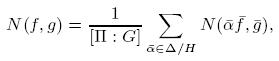
where
 is any pair of fixed liftings of (f, g). We prove that the averaging formula holds when M and N are orientable infra-nilmanifolds of the same dimension, and when M = N is a non-orientable infra-nilmanifold with holonomy group ℤ2 and (f, g) admits a pair of liftings
  on the nil-covering
  of M.
of M.
 Then we investigate the conditions for which the following averaging formula holds
 is any pair of fixed liftings of (
 on the nil-covering
  of
of Averaging Formula for Nielsen Numbers
-
- Journal:
- Nagoya Mathematical Journal / Volume 178 / 2005
- Published online by Cambridge University Press:
- 11 January 2016, pp. 37-53
- Print publication:
- 2005
-
- Article
-
- You have access
- Export citation
-
We prove that the averaging formula for Nielsen numbers holds for continuous maps on infra-nilmanifolds: Let M be an infra-nilmanifold and ƒ: M → M be a continuous map. Suppose MK is a regular covering of M which is a compact nilmanifold with π1(MK = K. Assume that f*(K) ⊂ K. Then ƒ has a lifting
 . We prove a question raised by McCord, which is for any
  with
with  an essential fixed point class, fix
 =1. As a consequence, we obtain the following averaging formula for Nielsen numbers
 . We prove a question raised by McCord, which is for any
  with
with  an essential fixed point class, fix
 =1. As a consequence, we obtain the following averaging formula for Nielsen numbers
THE UNSTABLE EQUIVARIANT FIXED POINT INDEX AND THE EQUIVARIANT DEGREE
-
- Journal:
- Journal of the London Mathematical Society / Volume 69 / Issue 1 / February 2004
- Published online by Cambridge University Press:
- 28 January 2004, pp. 214-230
- Print publication:
- February 2004
-
- Article
- Export citation
TWISTED CONJUGACY CLASSES IN EXPONENTIAL GROWTH GROUPS
-
- Journal:
- Bulletin of the London Mathematical Society / Volume 35 / Issue 2 / March 2003
- Published online by Cambridge University Press:
- 20 March 2003, pp. 261-268
- Print publication:
- March 2003
-
- Article
- Export citation
A Brouwer Type Coincidence Theorem and the Fundamental Theorem of Algebra
-
- Journal:
- Canadian Mathematical Bulletin / Volume 27 / Issue 4 / 01 December 1984
- Published online by Cambridge University Press:
- 20 November 2018, pp. 478-480
- Print publication:
- 01 December 1984
-
- Article
-
- You have access
- Export citation
On the Theorems of Borsuk-Ulam and Ljusternik-Schnirelmann-Borsuk
-
- Journal:
- Canadian Mathematical Bulletin / Volume 27 / Issue 2 / 01 June 1984
- Published online by Cambridge University Press:
- 20 November 2018, pp. 192-204
- Print publication:
- 01 June 1984
-
- Article
-
- You have access
- Export citation
