To save content items to your account,
please confirm that you agree to abide by our usage policies.
If this is the first time you use this feature, you will be asked to authorise Cambridge Core to connect with your account.
Find out more about saving content to .
To save content items to your Kindle, first ensure no-reply@cambridge.org
is added to your Approved Personal Document E-mail List under your Personal Document Settings
on the Manage Your Content and Devices page of your Amazon account. Then enter the ‘name’ part
of your Kindle email address below.
Find out more about saving to your Kindle.
Note you can select to save to either the @free.kindle.com or @kindle.com variations.
‘@free.kindle.com’ emails are free but can only be saved to your device when it is connected to wi-fi.
‘@kindle.com’ emails can be delivered even when you are not connected to wi-fi, but note that service fees apply.
The victim of a tort can generally claim compensatory damages for any loss suffered as a result of the tort. The assessment of such damages and the attribution of responsibility for such loss are generally governed by the rules discussed in Chs 2 to 4 for civil wrongs in general. Specific rules for tort are discussed in this chapter: the assessment of damages and the attribution of responsibility. The assessment of compensatory damages for personal injury, which are usually claimed in tort, is discussed.
In this chapter, we consider exemplary damages and aggravated damages, remedies with a strong vindicatory flavour, as recognised by the High Court of Australia in Lewis v Australian Capital Territory.
Exemplary damages vindicate the plaintiff’s interests, but also explicitly punish the defendant for the wrong in question. Punishment is not commonly recognised as a central aim of private law. Some commentators have argued that it should not be part of private law. However, exemplary damages are said to validate the plaintiff’s feelings of hurt and anger arising from the contumelious nature of the defendant’s wrong. Such damages also perform a vindicatory function. The fact that the law punishes a defendant for the manner of his interference with the plaintiff’s interests signals the importance of those interests.
This chapter explores rules on compensation that are peculiar to cases involving personal injury or death. The wrongful act is usually a tort, but it may also be a breach of contract1 or a statutory wrong. It is assumed that the claim is not excluded by statute; some exclusions are mentioned. This chapter does not discuss rules on compensation that apply to personal injury as well as other types of harm. Those rules are discussed in Part 1 and in the other chapters of Part 2. Furthermore, this chapter, like the rest of Part 2, is concerned only with ‘normal’ compensation. Aggravated damages, which may be awarded in cases of personal injury (and other cases), are discussed in Ch 15.
In the preceding chapters we have covered the core principles and methods of epidemiology and have shown you some of the main areas where epidemiological evidence is crucial for policy and planning. You will also have gained a sense of the breadth and depth of the subject from the examples throughout the book. To finish, we take a broader look at the role of epidemiological practice and logic in improving health. There is a growing desire for public health and medical research to be ‘translational’; that is, directly applicable to a population or patient. The process, whereby research evidence is used to change practice or policy, is known as ‘translation’, and the research outputs from epidemiology are critical at all stages (see Box 16.2); indeed, epidemiology has been described as ‘the epicenter of translational science’ (Hiatt, 2010).
The overarching goal of public health is to maximise the health of the population, and to achieve this we need evidence about what works and what does not work. Good studies are difficult to design and implement, and interpretation of their results and conclusions is not always as straightforward as we might hope. How, then, can we make the best use of this information? In the next three chapters we look at ways to identify, appraise, integrate and interpret the literature to generate the evidence we need to inform policy and practice. In this chapter we focus on interpreting the results from a single study, because if they are not valid they will be of limited value. The central question we have to answer when we read a study report is, ‘Are the results of the study valid?’
Confounding refers to a mixing or muddling of effects that can occur when the relationship we are interested in is confused by the effect of something else. It arises when the groups we are comparing are not completely exchangeable and so differ with respect to factors other than their exposure status. If one (or more) of these other factors is a cause of both the exposure and the outcome, then some or all of an observed association between the exposure and outcome may be due to that factor.
In this chapter, we consider other forms of remedies which seek to vindicate the plaintiff’s rights by a public statement of those rights, including declarations and awards of nominal damages and apologies. The court may make a public statement of rights (as with declarations) or the defendant himself may be compelled to make the statement (as with apology orders). We first consider apologies, then declarations, nominal damages and contemptuous damages, and then finally other vindicatory awards available under the Australian Consumer Law.
In the previous chapter we alluded to what is sometimes called ‘secondary’ prevention, where instead of trying to prevent disease from occurring, we try to detect it earlier, in the hope that this will enable more effective treatment and thus improved health outcomes. This is an aspect of public health that has great intuitive appeal, especially for serious conditions such as cancer, where the options for primary prevention can be very limited. However, screening programs are usually very costly exercises and they do not always deliver the expected benefits in terms of improved health outcomes. In this chapter we introduce you to the requirements for implementing a successful screening program and to some of the problems that we encounter when trying to determine whether such a program is actually beneficial in practice.
If the results of a study reveal an interesting association between an exposure and a health outcome, there is a natural tendency to assume that it is real. (Note: we are considering whether two things are associated. This does not imply that one causes the other to occur.) However, before we can even contemplate this possibility we have to try to rule out other possible explanations for the results. There are three main ‘alternative explanations’ that we have to consider whenever we analyse epidemiological data or read the reports of others, whatever the study design; namely, could the results be due to chance, bias or error, or confounding? We discuss the first of these, chance, in this chapter and cover bias and confounding in Chapters 7 and 8, respectively.
In this chapter we look at the ways in which we calculate, use and interpret ‘measures of association’, so-called because they describe the association between an exposure and a health outcome. An understanding of these measures will help you to interpret reports on the causes of ill health and the effects of particular exposures or interventions on the burden of illness in a community. Note that, while we discuss the measures in the context of an ‘exposure’ and ‘disease’, they can be used to assess the association between any measure of health status and any potential ‘cause’.
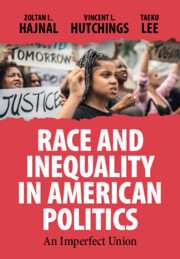
Authored by three of the USA's most well-known scholars on American politics, this undergraduate textbook argues that racial considerations are today-and have always been since the nation's founding-central to understanding America's political system writ large. Drawing on decades of teaching experience and compelling original research, Hajnal, Hutchings, and Lee present an up-to-date and comprehensive survey of race's role in American democracy, spanning topics as wide-ranging as public opinion, voting behavior, media representation, criminal justice, social policy, and protest movements. The reader will examine the perspectives of multiple racial groups, learn how to bring empirical analysis to bear on deeply divided viewpoints, and debate solutions to the many problems of governance in an America that is polarized by party, riven by race, and divided by inequality. Chapters open with a vignette to introduce the core issues and conclude with discussion questions and annotated suggested readings. Full color photos, figures, and boxed features elaborate on and reinforce important themes. Instructor resources are available online.