To save content items to your account,
please confirm that you agree to abide by our usage policies.
If this is the first time you use this feature, you will be asked to authorise Cambridge Core to connect with your account.
Find out more about saving content to .
To save content items to your Kindle, first ensure no-reply@cambridge.org
is added to your Approved Personal Document E-mail List under your Personal Document Settings
on the Manage Your Content and Devices page of your Amazon account. Then enter the ‘name’ part
of your Kindle email address below.
Find out more about saving to your Kindle.
Note you can select to save to either the @free.kindle.com or @kindle.com variations.
‘@free.kindle.com’ emails are free but can only be saved to your device when it is connected to wi-fi.
‘@kindle.com’ emails can be delivered even when you are not connected to wi-fi, but note that service fees apply.
Denis Argent, a professional journalist, joined the British Army in 1940 at the age of 23. He was already writing for Mass Observation, the innovative research organisation founded in 1937. During most of his first two years in uniform, when he was billeted in Bedford and Luton, he kept a remarkably detailed and probing diary. He wrote of street life and other aspects of the Home Front in Luton and Bedford, where the BBC's Symphony Orchestra had relocated shortly before he arrived; daily military routine; bomb disposal; transport; women, sex and leisure; his political views and cultural interests (he loved music and was widely read); the crucial importance of leave to see his girlfriend; and his fellow conscientious objectors - he was in the Non-Combatant Corps, though he later chose to take up arms.
Denis Argent had a keen and observant reporter's eye. He was also highly attuned to the modernist intellectual culture of his time. His is a wartime diary that is perceptive, colourful, wide-ranging, sometimes amusing, and very well written.
The first Moravian settlement in Britain was established in Bedford in 1745 and its members lived and worshipped as a close-knit community. The Bedford congregation is exceptionally well documented. In this edition Edwin Welch presents extracts from the principal sources for the period 1740 to 1786. The criteria for publication was to provide information on the foundation of the congregation and the events of the 1740s that led up to it. This is followed by specimen extracts from different types of records which may be found in their eighteenth century archives. Most are diaries or minutes - the congregation diaries; Jacob Rogers' diary; labourers' and helpers' conferences; the diaries of the single brethren and sisters; elders' conference; letters; and the rules and orders in 1777.
The sources throw light on the ordering of the congregation, its activities and concerns as well as noting journeys to London and elsewhere. Some cover procedural matters such as who preaches where; others are spiritual or religious; and others are practical and domestic. An example is the record of buying tea and sugar for the love-feasts, which is followed by a note that the love-feasts were not conducted with the respect and veneration that their dignity required.
The volume has an index of names and contains pictures of the leading figures in the church as well as illustrations of the buildings.
In the nineteenth century most of the education of Bedford was provided and run by the Harpur Trust, at both elementary and secondary levels (Bedford, Bedford Modern, the High School and Dame Alice Harpur schools). This study shows the extent of the contribution to elementary education by the Harpur Trust and its decline at the end of the century because of rise of state regulation.
The second half of the book contains a summary of the religious census taken in every parish in Bedfordshire on Sunday 30 March 1851. The returns provide a snapshot (albeit open to interpretation) of the religious allegiances of Bedfordshire people at mid-century. For a critique of the results, especially as they affect Methodist congregations, see BHRS vol. 92 The rise of Methodism by Dr Jonathan Rodell.
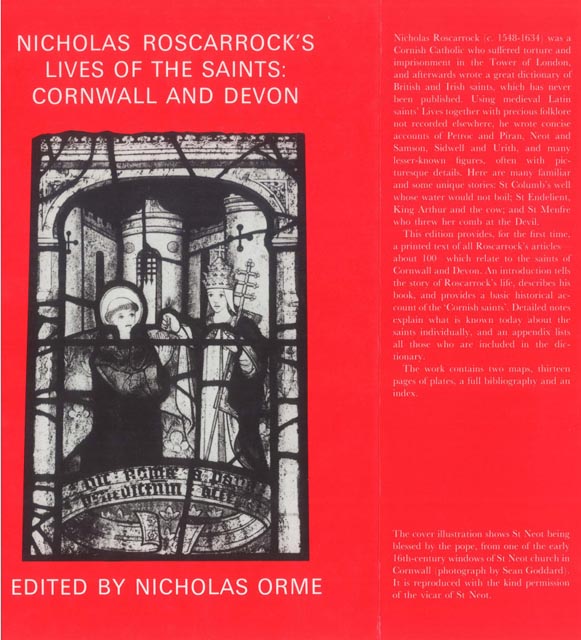
Nicholas Roscarrock (c. 1548-1634) was a Cornish Catholic who suffered torture and imprisonment in the Tower of London, and afterwards wrote a great dictionary of British and Irish saints. Using medieval Latin saints' lives together with precious folklore not recorded elsewhere, he wrote accounts of Petroc and Piran, Neot and Samson, Sidwell and Urith, and many lesser-known figures. Here are many familiar and some unique stories: St Columb's well whose water would not boil; St Endelient, King Arthur and the cow; and St Menfre who threw her comb at the Devil. This edition provides, for the first time, a printed text of all Roscarrock's articles which relate to the saints of Cornwall and Devon. An introduction tells the story of Roscarrock's life and describes his book, and detailed notes explain what is known today about the saints.
This is the third in a series of volumes describing Bedfordshire's parish churches in detail. It is based on specially commissioned research, bringing together original official sources and contemporary accounts. This volume covers Salford to Yelden. Many churches are illustrated, often with unusual drawings, watercolours, lantern slides, etc. Adding much new material to previously published accounts, the series will be an invaluable aid to research.
Part 1 Ampthill to Gravenhurst volume 73.
Part 2 Harlington to Roxton volume 77.
Part 4 Appendices and Index volume 80.
The volume contains a piece In Memoriam for Joyce Godber 1906-1999.
The dictionary is preceded by an introduction on timekeeping and the history of clock- and watchmaking in Bedfordshire. Extracts are included from a selection of documents to illustrate the sources used in compiling the dictionary. They range over advertisements, Bedfordshire Quarter Sessions' records, bills and customers' financial accounts, churchwardens' accounts, clubs, insurance records and settlement examinations.
The biographical dictionary provides family details, apprenticeships, places of work and examples of the person's work, amongst much other information. Here will be found information about Thomas Tompion from Northill 'widely regarded as the greatest English clockmaker'.
Appendices list the places of work in Bedfordshire and neighbouring counties of clock- and watchmakers (with a map) and of apprentices to the trade 1631-1881.
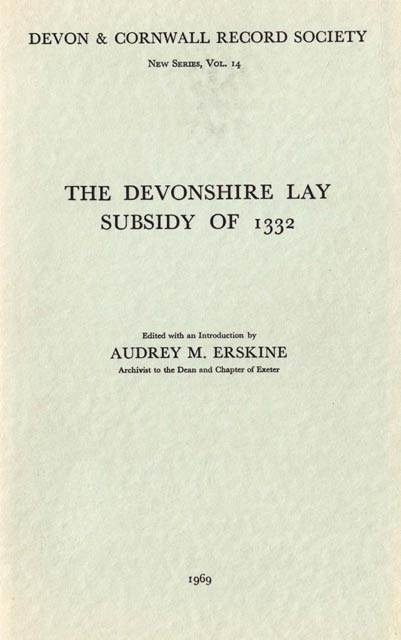
The documents known as Lay Subsidy Rolls are the accounts compiled by local assessors setting out the sums owed by taxpayers to the Exchequer for the taxation of their personal wealth. This volume publishes the text for Devon, translated into English. It provides a wealth of information for local history in the fourteenth century, and allows us to see how government administration worked at a local level.
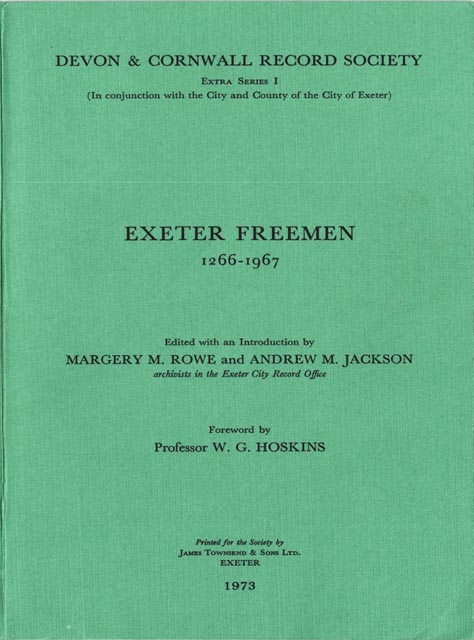
This volume puts together, from a number of different sources, a list of Exeter's freemen from the Middle Ages to the twentieth century, alongside a detailed introduction. It is a useful reference work for historians of Devon, and will also interest economic and social historians, and scholars studying the history of English towns and cities.
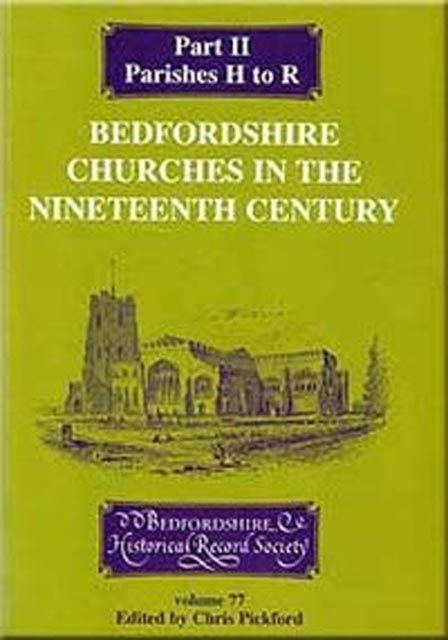
This is the second in a series of volumes describing Bedfordshire's parish churches in detail. The aim is to present a detailed account of each church together with text from five important nineteenth century sources. It is based on specially commissioned research, bringing together original official sources and contemporary accounts. Many churches are illustrated, often with unusual drawings, watercolours, lantern slides, etc.
Glebe terriers were records of parish income and endowments compiled to help the Church monitor its possessions. They tell us much about local history, including information about the parsonage and church lands, church furnishings, tithes and local topography and field names. The parsonage buildings are described in great detail that tells us much about local buildings and furniture. This edition publishes for the first time the 126 records surviving from 1679-80 and the 118 records for 1726-7, covering over half the parishes in Cornwall.
This is to Certifie whom it may Concern That Thomas Craner of Blunham in the County and Archdeaconry of Bedford and Mathew Basterfield of the Town and Archdeaconry of Bedford aforesaid Tayler have on this sixteenth day of October in the Year of Our Lord 1740 Certified to the Worshipfull Thomas Reynolds Esqr Master of Arts Commissary and Official of the Archdeaconry of Bedford that the Bam of Mrs Anne Okley scituate within the Parish of St Paul in the Town and County of Bedford aforesaid is intended to be made Use of for a place of Publick Worship for Protestants dissenting from the Church of England as by the Act of Toleration made in the first Year of the Reigns of King William and Queen Mary is allowed of Witness my hand the day and Year abovewritten.
William Frank Registrar
[BRO, MO 42]
Licence for the Bedford Chapel
To all to whom this may concern This is to Certify That George Tranker and William Vowell produced and filed a certificate to the Justices of the Peace Assembled at the General Quarter Sessions of the Peace held at the Town of Bedford in and for the said Town on Monday in the first week next after the Feast of Saint Michael the Archangel that is to say the first day of October in the Thirty third year of the Reign of our Sovereign Lord George the second by the Grace of God of Great Brittain France and Ireland King Defender of the Faith etc. and in the year of our Lord one Thousand seven Hundred and Fifty nine Reciting that in the year of our Lord one Thousand seven Hundred and Fifty two the Chapel situated in the parish of St Peters in the said Town of Bedford was Registered in the Archdeacons Court of the said Town as a place appointed for the Religious Use of those of his Majestys Protestant Subjects known by the name of Unitas Fratrum And that a large Room had since then been Built adjoining to the said Chapel on the East side in the Ministers House on the second story And certifying that the said Room is appointed solely for Religious Uses and as a Vestry Room to the said Chapel
I have enormous admiration for people who with a rare mixture of tenacity, scholarship and flair are able to open up the past so that it enriches the present. Chris Pickford is one such person.
He has been researching the churches of Bedfordshire for very many years but has done so with a lightness of touch which belies the underlying hard work. We now have the result of this in front of us.
Yet again he has shown us the eccentricities, the skills, the dedication that each generation has put into the care of their church buildings and has reminded us that these buildings are treasure-houses of the spirit as well as places of prayer and service.
The rootlessness and restlessness of contemporary society is counterpointed by the stillness and centredness of many of our churches - and that is a significant part of their importance for us; but to be able to enter those churches accompanied by Chris Pickford's researches is to be even more fully enriched.
It is a great privilege to have been invited to write this Foreword and I do so in the belief that the churches of Bedfordshire will continue to be uniquely important resources for the well-being of mind and spirit for the life of our communities in the years ahead
The list of incumbents at Salford goes back to 1229, but the present church is entirely of later date. The nave and south aisle were built in the late C13th and the chancel in the early C14th The timber-framed north porch includes a beam with C13th dogtooth ornament. The nave roof dates from the C15th and there are some C15th pews. The church also has monuments to the Salford, Polein and Peddar families.
In 1552 it was noted that “the said churche and steple coveryd with lede and the chancell and porch tyled”. The inventory also lists the mediaeval plate, ornaments, and three bells one of which still hangs in the open bellcote over the west end of the church. In 1617 the church was reported to be out of repair. One of the bells was recast in 1626 and another (now lost) in 1661. Dates of 1632 on a beam in the nave roof and 1633 in the porch clearly relate to repairs at that time. A new chalice and paten were obtained in 1638. The plate was later supplemented by the gift of a salver (hallmarked 1763) in 1771 and a flagon in 1802.
In 1750 the benefices of Hulcote and Salford were united, and from this date the churches share a similar history. Salford Vicarage was demolished when the Rectory at Hulcote was repaired and enlarged in 1824.
At some time around 1760, the original “steeple” over the west end of the church was taken down and replaced by a new tower of brick with comer pinnacles, pyramid roof and weathervane. When William White reported on the condition of the church in 1866 he considered the tower to have been built about a hundred years earlier. He also noted that it was built from the oak beams which carried the original bell turret. There was also a west gallery under the belfry. At about the same time, c.1760, the chancel was partially rebuilt and a plaster ceiling erected. Visiting in 1827, Boissier described Salford as “a small poor Decorated church with low tower & N porch”. Some repairs were ordered by Bonney in 1823 and 1833.
In 1836 the church was re-pewed, the south doors stopped up and other improvements carried out at the expense of the parish. Hulcote church was also repaired after the work at Salford had been completed.