To save content items to your account,
please confirm that you agree to abide by our usage policies.
If this is the first time you use this feature, you will be asked to authorise Cambridge Core to connect with your account.
Find out more about saving content to .
To save content items to your Kindle, first ensure no-reply@cambridge.org
is added to your Approved Personal Document E-mail List under your Personal Document Settings
on the Manage Your Content and Devices page of your Amazon account. Then enter the ‘name’ part
of your Kindle email address below.
Find out more about saving to your Kindle.
Note you can select to save to either the @free.kindle.com or @kindle.com variations.
‘@free.kindle.com’ emails are free but can only be saved to your device when it is connected to wi-fi.
‘@kindle.com’ emails can be delivered even when you are not connected to wi-fi, but note that service fees apply.
Marching to the Canon examines the history of Schubert's Marche militaire no.1 from its beginnings as a modest piano duet published for domestic consumption in 1826 to its ubiquitous presence over a century later. Myriad performances by professionals and amateurs made it Schubert's most recognizable and beloved instrumental work. Its success was due to its chameleon-like ability to cross the still porous borders between canonic and popular repertories. This study of both its reception and impact offers a unique narrative that illuminates the world that enshrined its otherwise humble dimensions. After detailing the composition, publication, and reception of the original march, the book examines the impact of transcriptions and arrangements for solo piano, orchestra, band, and other settings. Contemporary to these versions was its symbolic manipulation during three conflicts involving France and Germany: the Franco-Prussian War and the two world wars. Multiple iterations created a performance life that made deep inroads into dance, literature, and film, and inspired quotations or allusions in other music. The work's creative uses are remarkably diverse, ranging from now obscure individuals to significant figures as varied as Willa Cather, Isadora Duncan, Walt Disney, and Igor Stravinsky. Scott Messing is Charles A. Dana Professor of Music at Alma College, and the author of Neoclassicism in Music and the two volume Schubert in the European Imagination.
Writers of sixteenth-century German popular literature took great interest in describing, debating, commenting on, and prescribing gender roles, and discourses of gender can be traced in texts of all kinds from this period. This book focuses on popular works by Georg Wickram, Jakob Frey, Martin Montanus, and Johann Fischart, all of whom published novels, joke books, plays and/or moral treatises on marriage and family life in Strasbourg in the sixteenth century. Their works express not only their own ideas on women's roles as wives and mothers, but also societal values at a time of religious, political, and cultural change. The view of gender issues provided by these writers is not a simple one, as they ascribed widely varying characteristics to 'woman' and her relationship to 'man.' The book thus analyzes the social and cultural construction of the concept of 'woman' as indicated not only by the narrators' comments, but also by the relationships and roles of men and women characters in the narratives. Overall, the focus is on the disparities that persisted in the sixteenth-century discourse of gender, confusing all attempts to arrive at definitive gender roles. In the end, the study argues for something that can best be described as a 'flowing continuity' or a 'continuous flow' in the discourses that form the sixteenth-century concepts of 'woman' and 'man.' Elisabeth Wåghäll-Nivre is associate professor of German at Växjö University, Sweden.
High modernism is accepted shorthand for the core phase of literary modernism in the 1920s, when Eliot, Joyce, Pound, Woolf, Mann, Kafka, Proust, Gide, and others published pivotal works. While there is consensus about the term's meaning, the value and significance of the works it designates are highly contested. For advocates who helped establish its place in the canon, the works of high modernism mark the culmination of literature as high art, while other critics see them as elitist, inaccessible, patriarchal, imperialist, reactionary. Despite this wide range of judgments, all take for granted that high modernism's main features are aestheticist: formal innovation and detachment from history, society, and politics. This book reconsiders that supposition, arguing that high modernist texts epitomize performativity, that is, that they transcend the quiescence of literary aesthetics and affect the extratextual world. Writers such as Kafka, Woolf, Mann, and Faulkner privilege form not as an end in itself but as a means to empower the sociopolitical function of literature. By exploring the performative role of literary works fromthe 1920s, this book provides a more nuanced understanding of high modernism and resituates it within literary history. Joshua Kavaloski is Associate Professor and Director of the German Studies Program at Drew University.
In 1970 Ulrike Meinhof abandoned a career as a political journalist to join the Red Army Faction; captured as a terrorist along with other members of the group in 1972, she died an unexplained death in a high-security prison in 1976. A charismatic spokesperson for the RAF, she has often come near to being idealized as a freedom fighter, despite her use of extreme violence. In an effort to understand how terrorism takes root, Sarah Colvin seeks a dispassionate view of Meinhof and a period when West Germany was declaring its own "war on terror." Ulrike Meinhof always remained a writer, and this book focuses on the role of language in her development and that of the RAF: how Meinhof came to justify violence to the point of murder, creating an identity for the RAF as resistance fighters in an imagined state of war that was reinforced by the state's adoption of what Andreas Musolff has called 'war terminology.' But its all-powerful identity as a fighting group eroded the RAF's empathy with other human beings - even those it once claimed to be 'fighting for.' It became a closed unit, self-justifying and immobilized by its own conviction that everything it did must be right. This is the first specialized study of Meinhof and the RAF in English - which is remarkable given the current interest in the topic in both Europe and the U.S. Sarah Colvin is Professor and Eudo C. Mason Chair of the German Department at the University of Edinburgh, UK.
Nelly Sachs (1891-1970) has long been regarded as one of the most significant Holocaust poets. Her conception of language and words as a landscape has been understood by scholars and critics as an exilic ersatz Heimat for the lost German homeland of a displaced poet. This reading, however, is based entirely on her postwar poems. Such an isolated approach to her complex body of work is increasingly historically problematic; it is also at odds with Sachs's generally cyclical poetic process. In 'The Space of Words', Jennifer Hoyer offers the first sustained critical analysis of Sachs's largely unanalyzed prewar poetry and prose, as well as the first analysis that examines structural and thematic ties between the prewar works and the Nobel-Prize-winning postwar poetry. Through close readings of both Sachs's prewar and postwar works, Hoyer reveals a diasporic rather than exilic conception of the landscape of language, a position of constant wandering rather than static longing for return. This diasporic poetics promotes the intellectual and linguistic power of the wanderer and opens new insights into Sachs's essential significance as a Holocaust poet and a twentieth-century German-Jewish writer wary of the link of literary language to geopolitics and the narrative of nations. Jennifer Hoyer is Assistant Professor of German at the University of Arkansas.
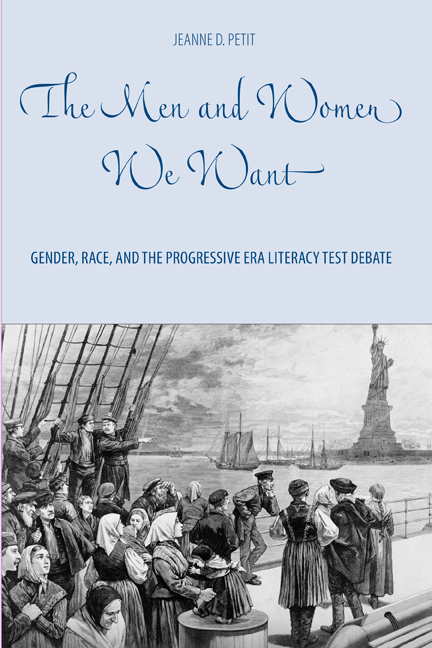
Should immigrants have to pass a literacy test in order to enter the United States? Progressive-Era Americans debated this question for more than twenty years, and by the time the literacy test became law in 1917, the debate had transformed the way Americans understood immigration, and created the logic that shaped immigration restriction policies throughout the twentieth century. Jeanne Petit argues that the literacy test debate was about much more than reading ability or the virtues of education. It also tapped into broader concerns about the relationship between gender, sexuality, race, and American national identity. The congressmen, reformers, journalists, and pundits who supported the literacy test hoped to stem the tide of southern and eastern European immigration. To make their case, these restrictionists portrayed illiterate immigrant men as dissipated, dependent paupers, immigrant women as brood mares who bore too many children, and both as a eugenic threat to the nation's racial stock. Opponents of the literacy test argued that the new immigrants were muscular, virile workers and nurturing, virtuous mothers who would strengthen the race and nation. Moreover, the debaters did not simply battle about what social reformer Grace Abbott called 'the sort of men and women we want.' They also defined as normative the men and women they were - unquestionably white, unquestionably American, and unquestionably fit to shape the nation's future. Jeanne D. Petit is associate professor of history at Hope College.
During the 1992 presidential campaign, candidate William J. Clinton praised Rochester's hospital experimental payment (HEP) program for containing costs and providing access to high quality health care. "If Rochester, New York, can do it with two-thirds of the cost of the rest of us," Clinton asserted, "America can do it too." This book is a detailed case study of a community that devised and implemented a unique, successful, and celebrated hospital cost containment experiment in the 1980s. Author Sarah Liebschutz describes the economic and social culture of Rochester dating to the early part of the twentieth century that provided the fertile soil for regional health planning and the HEP program. This study also examines how the changing economy ultimately stimulated robust competition among health care insurers and providers. What does Rochester's experience tell us about the role communities play in organizing and financing health care? The national government has long played --and will continue to play -- a central role in determining health policy, funding health insurance, and reimbursing health care providers. The responsibility for dealing with the interlocking issues of access, quality, and costs, however, is not exclusively national. State governments shape the health system as they legislate, regulate, and finance such key components of health care as insurance coverage, quality of care, hospitals, and other providers. Communities matter because they organize and deliver health care at the ground level through private and employed health care professionals and public, private, and nonprofit hospitals. They matter because they ultimately determine whether health care in America is available, efficient, and effective. The book draws heavily on files of the Rochester Area Hospitals Corporation, made available specifically to the author, and on extensive interviews with business leaders, hospital trustees, and administrators whose decisions fostered collaboration and then competition.
Sarah F. Liebschutz is Distinguished Service Professor Emerita at the State University of New York, College at Brockport.
From 1959 to 1972 William Glock, as Controller, Music, stamped his personality memorably on BBC Radio, gathering around him a talented staff that included émigrés and experts in Continental music new and old. Among the young recruits was Leo Black, an intelligent musician with an affinity for singers and Austro-German music. In his 28 years at the BBC - years that extended well beyond 1972 - Black learnt the system, worked with leading BBC figures and musicians, produced countless programmes and discovered his own identity. This memoir not only recalls 'the Glock Era and After' in a series of informative, poignant, witty and judicious vignettes, but is also a key text for understanding one of the great ages of British music. Includes illustrations by Milein Cosman.Leo Black is the author of 'Franz Schubert: Music and Belief' and 'Edmund Rubbra: Symphonist', both published by the Boydell Press.
Anton Heiller is one of the twentieth century's most renowned and influential organists. Born in 1923, Heiller was trained in Vienna and rose to prominence quickly, giving his first solo recital at the age of twenty-two. Before concentrating on the organ exclusively, he was a successful conductor of the symphonic repertoire, and from 1945 until his untimely death in 1979, he was professor for organ at the University of Music and Performing Arts in Vienna.His interpretations of Bach, which included registration and articulation, as well as a consideration of the theological underpinnings, would change the way Bach is played. Anton Heiller: Organist, Composer, Conductorprovides an assessment of Heiller's works and teaching, while also examining his complex personality, one torn between strong religious devotion and the world of artistry. Underlying this story here is also the story of church music and organ playing in central Europe in the decades after World War II, and of the then unique crossroads of organ cultures in mid-twentieth-century Europe. Peter Planyavsky was Anton Heiller's successor as an organ professor in Vienna, and Organist of St. Stephan's Cathedral in Vienna from 1969 through 2004. He is also a prolific composer, improviser, and conductor. The book is translated from the original German by Christa Rumsey, also a former student of Heiller.
James Baldwin is a widely taught and anthologized author. His short story "Sonny's Blues" remains a perennial favorite in literature anthologies, and all of his essay collections and novels are still in print. His first essay collection, Notes of a Native Son, is a seminal work that led a new generation of African American writers from beneath the shadow of Richard Wright. The Fire Next Time is widely held as one of the most profound and accurate articulations of black consciousness during the Civil Rights movement. It is difficult to imagine teaching a survey of African American literature or considering the development of black intellectual thought in the twentieth century without mentioning Baldwin. For more than half a century, readers and critics alike have agreed that Baldwin is a major African American writer. What they do not agree on is why. Because of his artistic and intellectual complexity, his work resists easy categorization, and Baldwin scholarship, consequently, spans the critical horizon. Conseula Francis's book examines the major divisions in Baldwin criticism, paying particular attention to the wayeach critical period defines Baldwin and his work for its own purposes. Conseula Francis is Associate Professor of English and Director of African American Studies at the College of Charleston.
As was the case in other parts of the world, the discovery of gold in Wassa in the 1870s stimulated the development of infrastructure for the exploitation of this metal, as well as the implementation of governance mechanisms to keep in check a large wave of unruly immigrants. Yet the slow speed and limited capacity of such advancements in the region set West African mining apart. Many of the earliest entrepreneurs in Wassa during the first gold rush in the 1870s and 1880s were former political officials and local European traders who tried to keep up production in spite of rather costly and irregular means transportation, since their petitions for public investment and services for the mining centers largely fell on deaf ears. Still, they hoped to make a considerable return from local gold deposits using alluvial mining techniques and light stamps that were generally transported to the interior either on the Ankobra river or on the heads of female porters. The construction of a government railway was slow moving. As a result, it took some twenty years for it to connect the area to the coast. Still, this was an accomplishment that played a key role in attracting an influx of significant South African mining capital, which in turn drew in more experienced mining directors and working-class miners from Britain, South Africa, and Australia in the early twentieth century. Also instrumental to the making of the second gold boom, which was referred to as the “jungle boom” in the international press, was the installation of heavy machinery, which brought West African gold-mining capacity up to global technological standards starting in the 1890s.
Debates over the labor question show that if efficient transportation was slow to arrive, proper colonial administration lagged even further behind. Therefore, this chapter introduces the colorful group of entrepreneurs whose ideologies, politics, and cutthroat promotion helped to shape large-scale mining in this loosely governed British protectorate, located far from colonial headquarters in Accra. It attempts to capture the character and background of the most prominent mining men during both boom periods. In the nineteenth century, when lobbying for the mining sector was in its earliest stages, mining magnates held a wide range of opinions on how best to tackle the labor question.
By 1910 the port of Sekondi in the western protectorate of the Gold Coast had already been serving as an entrepôt between Wassa and the expansive Atlantic world for several centuries. Dutch officials initially took an interest in the location because it possessed a good landing beach that was fairly well sheltered from strong winds and because of its close proximity to Wassa, which was known to be a rich source of gold. Although initially only land and water trade routes led to the gold-producing interior region, under the British colonial administration a government railway was constructed, reaching Tarkwa in 1901, Obuase in 1902, Kumase in 1903, and Prestea in 1911. Unlike the cocoa and palm oil trade that determined the success of colonial ports in the eastern protectorate, to the west, the gold trade stood above all else, putting Sekondi in a dominant position as neighboring ports fell into a state of decay. It was a place of comings and goings, not just in trade (other primary exports included timber and rubber) but also in people. When the mechanized gold mines were established in the 1870s, miners from Britain, Australia, and the United States landed there in large numbers by way of a surfboat on their way to Wassa, as did most Liberian contract workers, for whom it was safer to travel along the coast by sea. By the turn of the century, Sekondi began to attract a growing number of migrant workers traveling on foot as well. Although some undertook the risk of a solo voyage, most of them arrived in Sekondi as part of a small gang led by an African labor agent. Sekondi was where agents serving the gold mines usually came to engage new recruits for contract work on the concessions or other types of wage work.
But if a port is the greatest signifier of a region's integration into the world economy, then the story that Sekondi told was one of haphazard incorporation. Although British officials had clearly invested time and money in the port city, its potential had simultaneously been tempered by mediocre expectations and missed opportunities. After a brief stay here during her travels through West Africa, the novelist Mary Gaunt described “a pretty place” straggling “up and down many hills.”
This study provides a number of important insights into the global labor history of imperial gold mining in Wassa, as well as in a wider West African context. It has shone a spotlight on West African male and female laborers and labor agents in the mining sector to highlight their contributions to and positions in the socioeconomic and political transformations that touched their societies during the first decades of colonial rule. Capitalist intensification evoked a variety of responses by local actors. We have seen that mining concessions in Wassa relied on a wide variety of labor relations to keep up production, including contract workers, piece workers and tributary workers. This study demonstrates these laborers’ active and creative engagement with casual and contract work, and the related processes. Indigenous labor agents, responsible for bringing groups of contract men to the mines, negotiated much of the politics of labor control for European employers in the mechanized gold mines. Mine managers did not fully dictate the process of limited class formation, either. Many local and migrant laborers also worked out their potential gains and losses, using their bargaining power to develop a work schedule that fit their lifestyles and priorities. The bargaining power of African mine workers in Wassa also helped them to secure regular cash advances, high wage rates, and better treatment by their employers. They employed a variety of political and economic tools to carve out the best possible future for themselves, a future that tended to involve a continued preoccupation with agricultural production. Rarely were they wage slaves, though the coercive power of the mining firms should not be understated.
Mediators, Contract Men, and Colonial Capital takes a more nuanced view of colonial commerce by illustrating the impact of political culture on economic conditions in the Gold Coast. Although the actions of foreign mining entrepreneurs often indicated a strong intention to limit the process of industrialization (especially as it related to restricting workers’ tactics), the labor market was also shaped by their lack of control and limited influence over their new surroundings. In the context of imperial gold mining, mining magnates encountered different socioeconomic and political obstacles in different parts of the globe.
As we saw in chapter 1, rapid commercial expansion and the loose political relationship between the mines and the colonial administration promoted a special brand of economic pragmatism in West African gold mining. This chapter examines the consequences of these conditions through the lens of the labor market. Although the Gold Coast's emancipation proclamation of 1874 might have helped to bring some individuals into the employment of the mines who otherwise would have been forced to work for their masters, most former slaves did not seek out wage labor as a primary means of supporting themselves. And although the mines drew the large part of their labor force from southern Ghana during the first and second gold booms, many mine managers still viewed local labor as a problem that needed solving. Local Akan men and women tended to work on a casual and flexible basis, which in the eyes of the managers was too costly and inconsistent an option. On the other side of the labor spectrum stood one particular category of employee: the “agreement boy,” or contract man. Most managers agreed that it was vital “to encourage the boys to work on contract.” As one manager in neighboring Asante explained, “We get more work done and its [sic] far cheaper [and] it gives better satisfaction to both parties.” Men working on a contract-basis were favored by the companies because they required less supervision and less immediate capital due to the extended pay system. Furthermore, over the course of time they achieved a level of skill and efficiency that was essential to underground mining. Migrant laborers made up the bulk of this group in the nineteenth century. They were overwhelmingly Liberian Kru laborers, whom foreign employers often referred to as the “Irishmen of West Africa,” due to their humble yet hard work in the burgeoning palm-oil trade, as well as their diligent service in the British Royal Navy's antislavery patrols. They became the mining sector's most valuable workers during its initial decades of existence for their ability “to handle machines, to stoke, and generally to show the other natives both how to work and to exercise care.” Nevertheless, mine managers did not always get what they wanted.
The influx of capital into the Wassa mines reached a new low in 1905, leading many mining companies to cease production, and leaving just a few more-established and technically better-equipped ventures to prove that the industry could indeed pay its way. This period marked the end of the second gold boom in Wassa. The reduction in the number of competing mines did not, however, improve recruitment in the long term. The surplus of labor that had resulted from the closing of the smaller companies was quickly neutralized, because laborers continued to opt for work in the agricultural sector, especially cocoa farming. Therefore, within just a few months’ time, the gold mines found themselves on the verge of another severe labor shortage. For 1906, Frank Cogill, the secretary for mines, reported that as anticipated, “there has been a shortage of labour, which, although not sufficient to stop the mines from working, had the effect of forcing some companies to pay higher wages than those adopted by the Mine Managers’ Association.” This was the moment when the mines and the administration came together to collaborate on a new labor experiment, one made possible by colonial territorial expansion into the north as well as the expansion of the government railway. The discovery of labor-dense pockets in the savanna region of the north brought employers in the gold mines significant relief. Recruiting from these areas, generally directly through chiefs and colonial officials, forcibly detached wages from the demands of the market. As political promises infiltrated the recruitment machinery from the Northern Territories and became a huge motivating factor for local authorities, wage rates no longer had to adhere to the laws of supply and demand. However, in spite of all the cost-cutting measures and deception involved, this pattern of recruitment became the source of sharp political and social conflict.
This study has thus far aimed to show indirect recruitment through African labor agents as a system of voluntary bondage that could be precarious for both recruits, as well as recruiters, albeit in different measure and with different implications. It has done so in order to expand the discussion of the mobilization of African workers after the legal end of slavery, which has been dominated by the theme of colonial forced labor and other forms of mobilization similar to slavery.