Cambridge Editions present the works and correspondence of great thinkers and writers. Introductions, explanatory notes and textual apparatus accompany a reliable version of the text, aiding scholars and students alike.
To save content items to your account,
please confirm that you agree to abide by our usage policies.
If this is the first time you use this feature, you will be asked to authorise Cambridge Core to connect with your account.
Find out more about saving content to .
To save content items to your Kindle, first ensure no-reply@cambridge.org
is added to your Approved Personal Document E-mail List under your Personal Document Settings
on the Manage Your Content and Devices page of your Amazon account. Then enter the ‘name’ part
of your Kindle email address below.
Find out more about saving to your Kindle.
Note you can select to save to either the @free.kindle.com or @kindle.com variations.
‘@free.kindle.com’ emails are free but can only be saved to your device when it is connected to wi-fi.
‘@kindle.com’ emails can be delivered even when you are not connected to wi-fi, but note that service fees apply.
The motivations behind Apollinarius of Laodicea’s Christology are debated by scholars, but it is safe to say that from the beginning he opposed any sort of dualist Christology.1 In Antioch, in whose ecclesiastical affairs Apollinarius was involved since the early 360s, two presbyters connected with the pro-Nicene Meletian faction, Diodore and Flavian, espoused a dyophysite Christology.2 Diodore became bishop of Tarsus in 378 and Flavian bishop of Antioch in 381. It seems that it was not until the late 370s that Apollinarius came into conflict with them, over issues that were as much as ecclesio-political as Christological. Fragments of Apollinarius’s writings against Diodore and Flavian are preserved in three later polemical treatises: Theodoret of Cyrrhus’s Eranistes, Leontius of Byzantium’s Adversus Fraudes Apollinaristarum, and the Doctrina Patrum de Incarnatione Verbi. These treatises mention a number of different Apollinarian sources for the fragments they preserve, but it is unclear if they refer to a single tract by Apollinarius or several. At least one of Apollinarius’s writings against Diodore was addressed to a certain Herakleion who is otherwise unknown (Fragments 117–120). No more than titles are known about the others, however many there were.
Gregory the Great was the Roman pontiff from 590 until his death in 604. In the mid-570s he abandoned a successful career in government in order to become a monk. In 579 or 580 Pope Pelagius II ordained him a deacon and sent him to Constantinople as the papal ambassador. He spent about six years in the imperial capital, where he became the center of a circle of monks and clerics who read the scriptures together. The lectures on the biblical book of Job that he delivered in this setting he later revised for publication as the Moralia in Job, his most famous work and a treasure-house of moral, spiritual, and theological insight. Upon his return to Rome he resumed his monastic life, but was elected pope after the death of Pelagius II in 590.
The date of this text written by Apollinarius of Laodicea (ca. 315–392) is difficult to determine with specificity.1 It should simply be placed in the late 360s or 370s. Here Apollinarius lays out his understanding of the communicatio idiomatum, a Latin phrase that refers to the transference of traits in the incarnate Christ. As Apollinarius presents it here, the communicatio idiomatum permits a theologian to both observe and speak of the divinity sharing in the body’s characteristics and the body sharing in the divinity’s characteristics with respect to the incarnate Christ. Apollinarius notes that the conjunction of the two natures in Christ (see 4 below) results in a single, fundamental, undivided, and indivisible union between what is “same-in-substance” with God and what is “same-in-substance” with humanity. This “double consubstantiality,” as it is called – that is, Christ is homoousios with God and homoousios with humanity – is the Christological mechanism, so to speak, that allows for each nature to share in the qualities of the other without the philosophical or theological implications of sharing.
Theodore was a native of Antioch where he was trained in rhetoric by Libanius before entering the ascetical school led by Diodore (later bishop of Tarsus). He was ordained a priest by Flavian of Antioch in 383 and then in 392 was consecrated bishop of Mopsuestia. In the course of his long episcopal tenure Theodore came to be regarded as one of the foremost theologians and exegetes of the pro-Nicene cause. In addition to numerous biblical commentaries on books of the Old and New Testaments, he produced a set of catechetical homilies explaining the Nicene Creed and the Lord’s Prayer, polemical treatises such as Against Eunomius and Dispute with the Macedonians, as well as other works. Theodore’s On the Incarnation was also polemical, according to the late fifth-century Gennadius of Marseilles:
Theodore, presbyter of the Antiochene church, a man prudent in knowledge and skillful in speech, wrote fifteen books On the Incarnation of the Lord against the Apollinarians and Eunomians, containing as many as fifteen thousand verses, in which he showed by the clearest reasoning and by the testimonies of scripture that just as the Lord Jesus had the fullness of deity, so too he had the fullness of humanity. He taught also that a human being consists only of two substances, that is soul and body, and that mind and spirit are not different substances, but inborn faculties of the soul through which it is inspired and is rational and makes the body capable of sensation. Moreover, the fourteenth book of this work is properly devoted to discussing the uncreated and alone incorporeal and all-ruling nature of the holy Trinity and also the rationality of creatures, which he explains insightfully on the authority of the holy scriptures. But in the fifteenth volume he confirms and strengthens the whole body of his work by citing the traditions of the fathers.1
According to Gennadius, then, Theodore wrote the massive On the Incarnation before his appointment as bishop while he was still a presbyter; thus his work represents a pro-Nicene Christological outlook of the 380s or early 390s. This was the period in which pro-Nicenes were actively confronting the Christologies of the Apollinarians and Heteroousians (also called Eunomians) as live options, such as was done by Gregory of Nazianzus and Gregory of Nyssa. And herein lies the importance of this work: it is a crucial non-Cappadocian witness to emerging pro-Nicene Christology as it developed in response to the perceived threats of Apollinarius and Eunomius but decades before dyophysite language became problematized through Nestorius. We see in Theodore, then, a Christology that is very much a work-in-progress as he attempts to work out the categories, concepts, and contours with which to articulate his understanding of Christ.
The Cambridge Edition of Early Christian Writings provides the definitive anthology of early Christian texts from ca. 100 CE to ca. 650 CE. Its volumes reflect the cultural, intellectual, and linguistic diversity of early Christianity, and are organized thematically on the topics of God, Practice, Christ, Community, Reading, and Creation. The series expands the pool of source material to include not only Greek and Latin writings, but also Syriac and Coptic texts. Additionally, the series rejects a theologically normative view by juxtaposing texts that were important in antiquity but later deemed 'heretical' with orthodox texts. The translations are accompanied by introductions, notes, suggestions for further reading, and scriptural indices. The third volume focuses on early Christian reflection on Christ as God incarnate from the first century to ca. 450 CE. It will be an invaluable resource for students and academic researchers in early Christian studies, history of Christianity, theology and religious studies, and late antique Roman history.
This translation of The Science of Logic (also known as 'Greater Logic') includes the revised Book I (1832), Book II (1813) and Book III (1816). Recent research has given us a detailed picture of the process that led Hegel to his final conception of the System and of the place of the Logic within it. We now understand how and why Hegel distanced himself from Schelling, how radical this break with his early mentor was, and to what extent it entailed a return (but with a difference) to Fichte and Kant. In the introduction to the volume, George Di Giovanni presents in synoptic form the results of recent scholarship on the subject, and, while recognizing the fault lines in Hegel's System that allow opposite interpretations, argues that the Logic marks the end of classical metaphysics. The translation is accompanied by a full apparatus of historical and explanatory notes.
Hegel's Encyclopaedia Logic constitutes the foundation of the system of philosophy presented in his Encyclopaedia of the Philosophical Sciences. Together with his Science of Logic, it contains the most explicit formulation of his enduringly influential dialectical method and of the categorical system underlying his thought. It offers a more compact presentation of his dialectical method than is found elsewhere, and also incorporates changes that he would have made to the second edition of the Science of Logic if he had lived to do so. This volume presents it in a new translation with a helpful introduction and notes. It will be a valuable reference work for scholars and students of Hegel and German idealism, as well as for those who are interested in the post-Hegelian character of contemporary philosophy.
George Berkeley (1685–1753), Bishop of Cloyne, was an Irish philosopher and divine who pursued a number of grand causes, contributing to the fields of economics, mathematics, political theory and theology. He pioneered the theory of 'immaterialism', and his work ranges over many philosophical issues that remain of interest today. This volume offers a complete and accurate edition of Berkeley's extant correspondence, including letters written both by him and to him, supplemented by extensive explanatory and critical notes. Alexander Pope famously said 'To Berkeley every virtue under heaven', and a careful reading of the letters reveals a figure worthy of admiration, sheds new light on his personal and intellectual life, and provides insight into the broad historical and philosophical currents of his time. The volume will be an invaluable resource for philosophers, modern historians and those interested in Anglo-Irish culture.
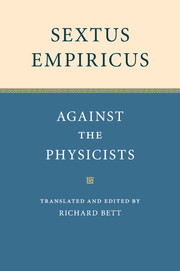
Sextus Empiricus' Against the Physicists examines numerous topics central to ancient Greek inquiries into the nature of the physical world, covering subjects such as god, cause and effect, whole and part, bodies, place, motion, time, number, coming into being and perishing and is the most extensive surviving treatment of these topics by an ancient Greek sceptic. Sextus scrutinizes the theories of non-sceptical thinkers and generates suspension of judgement through the assembly of equally powerful opposing arguments. Richard Bett's edition provides crucial background information about the text and elucidation of difficult passages. His accurate and readable translation is supported by substantial interpretative aids, including a glossary and a list of parallel passages relating Against the Physicists to other works by Sextus. This is an indispensable edition for advanced students and scholars studying this important work by an influential philosopher.
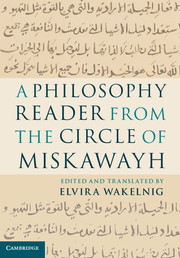
This volume presents the first complete edition of Oxford, MS Marsh 539, a hitherto unpublished philosophy reader compiled anonymously in the eastern Islamic world in the eleventh century. The compilation consists of texts on metaphysics, physiology and ethics, providing excerpts from Arabic versions of Greek philosophical works (Aristotle, Plotinus, Galen) and works by Arabic authors (Qusta ibn Luqa, Farabi, Miskawayh). It preserves fragments of Greek-Arabic translations lost today, including Galen's On My Own Opinions, the Summa Alexandrinorum, and Themistius on Aristotle's Book Lambda. The philosophy reader provides a unique insight into philosophical activity of the place and time of the well-known philosopher Miskawayh, showing us which works had entered the mainstream and were considered necessary for philosophers to know. Elvira Wakelnig's volume includes a new facing-page English translation and a rich commentary which identifies the source texts and examines the historical and philosophical context of each passage.
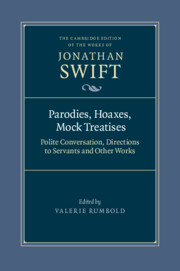
Swift's parodies are among his most fascinating works, but perhaps require most explication for the modern reader. Valerie Rumbold brings a new depth and detail to the editing of Swift's Bickerstaff papers, 'Polite Conversation', 'Directions to Servants' and other works on language and conduct. Highlights include a fresh investigation of the political and print contexts of the Bickerstaff papers, full commentaries on such smaller works as 'A Modest Defence of Punning' and 'On Barbarous Denominations in Ireland', identification and explanation of many additional sayings in 'Polite Conversation', and a detailed contextualisation of 'Directions to Servants' in contemporary domestic theory and practice. A substantial thematic Introduction is supplemented by an individual headnote and full annotation to each work. The Textual Introduction explores the publishing strategies adopted by Swift and his booksellers, and a separate Textual Account of each work presents and discusses changes in the texts over time.
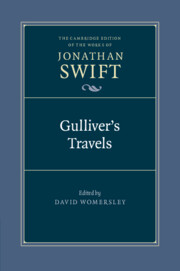
Gulliver's Travels is one of the few works of English literature which is also a landmark in world literature. Jonathan Swift's account of Lemuel Gulliver's adventures in the fantastical societies of 'remote nations' was an instant best-seller on publication in 1726 and has remained in the public imagination ever since, as both a satiric fantasy and an analysis of the human condition. This scholarly edition offers an authoritative text, based on the widest possible historical collation of the many editions published in Swift's lifetime; a detailed introduction and textual apparatus; and appendices and illustrations presenting important ancillary material with new clarity. Extensive notes and commentary open out the many layers of meaning and allusion in the text, identify new sources and parallels and offer wide-ranging historical background information. An important addition to the Cambridge Swift Edition, this volume will be indispensable for scholars and students of eighteenth-century literature and ideas.
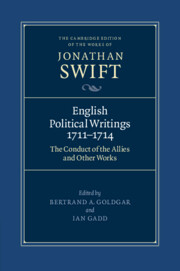
The years 1711 to 1714 saw some of Swift's most brilliant and powerful political pamphleteering. Writing for the Tory government, he did more to settle the fate of parties and the nation than any literary figure, before or since. This volume collects together major defences of the government's position, including The Conduct of the Allies and The Publick Spirit of the Whigs, vigorous attacks on his opponents, short satirical broadsides, and brief contributions to periodicals. It also includes some little known work not present in previous editions of Swift. This is the first fully annotated edition of these works. A comprehensive introduction, drawing on contemporary literary and historical scholarship, is supported by detailed explanatory notes on each text. It is also the first edition to identify and collate all relevant contemporary editions and provide a full account of the textual history of each work.
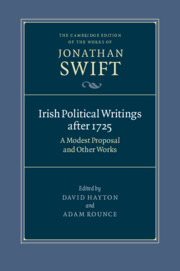
This latest volume of The Cambridge Edition of the Works of Jonathan Swift is the first fully annotated edition of Swift's Irish prose writings from 1726 to 1737. Works in this volume include the famous A Modest Proposal, the acerbic A Short View of the State of Ireland, Swift's contributions to The Intelligencer, and other prose pieces of satire, polemic and intervention into contemporary Irish politics. Most of these works have never previously been published with full scholarly annotation, or with a complete and textually authoritative apparatus. This volume offers a comprehensive introduction, setting Swift's writings of the period into their full historical, political and economic context. In addition to a critical introduction and appendices, there is also an up-to-date bibliography. The volume enables Swift's role as a political and social commentator in the years after the publication of Gulliver's Travels to be understood with new clarity.
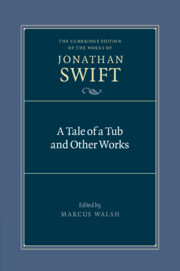
This volume contains the three works which together make up Jonathan Swift's early satiric and intellectual masterpiece, A Tale of a Tub: the Tale itself, The Battel of the Books, and The Mechanical Operation of the Spirit. Incorporating much new knowledge, this 2010 edition provides the first full scholarly treatment of this important work for fifty years. The introduction discusses publication, composition, and authorship; sources, analogues and generic models; reception; and religious, scientific and literary contexts (including the ancients and moderns controversy). Detailed explanatory notes address many previously unexplained issues in this famously rich and difficult work. Texts have been fully collated and edited according to modern principles and are accompanied with a textual introduction and full textual apparatus. Illustrations include title pages, the eight engravings from the fifth edition, and original designs for these engravings. Extensive associated contemporary materials, including Edmund Curll's Key and William Wotton's Observations, are provided.
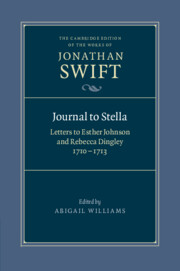
The Journal to Stella, Jonathan Swift's letters to Esther Johnson, or 'Stella', and Rebecca Dingley, written between September 1710 and June 1713, offers an extraordinary commentary on Swift's experiences in London during the most politically active and exciting years of his career and evidence of his evolving relationship with the two women. This edition seeks for the first time both to situate the letters alongside Swift's other works and to place them within their original political, historical and cultural contexts. It brings together a combination of printed work and manuscript to present the most complete and accessible text possible, enhanced by the use of the latest digital image analysis techniques to reinstate previously indecipherable material. In addition to a new critical introduction and appendices, there is also a biographical appendix derived from recently available resources.
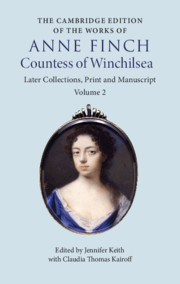
This is the first ever complete critical edition of the writings of Anne Finch, Countess of Winchilsea (1661–1720), including work printed in her lifetime and material left in manuscript form at her death. Textual analysis, based on print and manuscript copies in repositories across the United Kingdom and United States, reveals her revision processes and uses of manuscript and print. Extensive commentary clarifies her techniques, sources, contexts, and diction. A detailed essay traces the history of her works' reception and transmission. The result is a complete view of her achievements that will promote more accurate assessments of her contributions to literary and cultural shifts, including perspectives on literary value, women's equality, religion, and affairs of state. This second volume provides established texts of Finch's later collections in print and manuscript form, Miscellany Poems, on Several Occasions (1713) and The Wellesley Manuscript, as well as uncollected poems and letters.
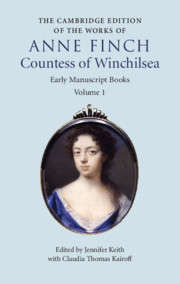
This is the first ever complete critical edition of the writings of Anne Finch, Countess of Winchilsea (1661–1720), including work printed in her lifetime and material left in manuscript form at her death. Textual analysis, based on print and manuscript copies in repositories across the United Kingdom and the United States, reveals her revision processes and uses of manuscript and print. Extensive commentary clarifies her techniques, sources, contexts, and diction. A detailed essay traces the history of her works' reception and transmission. The result is a complete view of her achievements that will promote more accurate assessments of her contributions to literary and cultural shifts, including perspectives on literary value, women's equality, religion, and affairs of state. This first volume provides established texts of Finch's early manuscript books, including Poems on Several Subjects and Miscellany Poems with Two Plays written under her pen name, Ardelia.
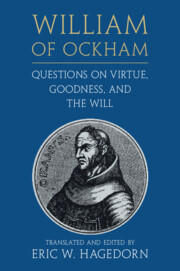
William of Ockham (d. 1347) was among the most influential and the most notorious thinkers of the late Middle Ages. In the twenty-seven questions translated in this volume, most never before published in English, he considers a host of theological and philosophical issues, including the nature of virtue and vice, the relationship between the intellect and the will, the scope of human freedom, the possibility of God's creating a better world, the role of love and hatred in practical reasoning, whether God could command someone to do wrong, and more. In answering these questions, Ockham critically engages with the ethical thought of such predecessors as Aristotle, Augustine, Thomas Aquinas, and John Duns Scotus. Students and scholars of both philosophy and historical theology will appreciate the accessible translations and ample explanatory notes on the text.