Refine search
Actions for selected content:
4480 results in Cambridge Editions
29 - 3 June 1737. Cleland’s Appointment as Secretary for Portuguese Affairs
- from The Correspondence
-
- Book:
- The Cambridge Edition of the Correspondence of John Cleland
- Published online:
- 25 May 2024
- Print publication:
- 13 June 2024, pp 100-100
-
- Chapter
- Export citation
108 - 2 September 1766. Cleland to Thomas Pichon
- from The Correspondence
-
- Book:
- The Cambridge Edition of the Correspondence of John Cleland
- Published online:
- 25 May 2024
- Print publication:
- 13 June 2024, pp 280-287
-
- Chapter
- Export citation
26 - 11 March 1736. Memorandum from William Billers. ‘Despatch of 11th March 1735/6’
- from The Correspondence
-
- Book:
- The Cambridge Edition of the Correspondence of John Cleland
- Published online:
- 25 May 2024
- Print publication:
- 13 June 2024, pp 97-97
-
- Chapter
- Export citation
112 - [1768–1769]. Cleland to Sir John Hussey Delaval
- from The Correspondence
-
- Book:
- The Cambridge Edition of the Correspondence of John Cleland
- Published online:
- 25 May 2024
- Print publication:
- 13 June 2024, pp 299-299
-
- Chapter
- Export citation
72 - 27 June [1753]. Extract of a Letter from Samuel Foote to Sir Francis Blake Delaval
- from The Correspondence
-
- Book:
- The Cambridge Edition of the Correspondence of John Cleland
- Published online:
- 25 May 2024
- Print publication:
- 13 June 2024, pp 184-185
-
- Chapter
- Export citation
46 - [1749]. Cleland to Ralph Griffiths
- from The Correspondence
-
- Book:
- The Cambridge Edition of the Correspondence of John Cleland
- Published online:
- 25 May 2024
- Print publication:
- 13 June 2024, pp 134-135
-
- Chapter
- Export citation
Index
-
- Book:
- The Vicar of Wakefield
- Published online:
- 30 May 2024
- Print publication:
- 13 June 2024, pp 310-320
-
- Chapter
- Export citation
104 - 8 February 1765. Cleland to Sir John Hussey Delaval
- from The Correspondence
-
- Book:
- The Cambridge Edition of the Correspondence of John Cleland
- Published online:
- 25 May 2024
- Print publication:
- 13 June 2024, pp 268-270
-
- Chapter
- Export citation
28 - February 1737. Cleland’s Appointment as Supervisor of Mahim Custom House
- from The Correspondence
-
- Book:
- The Cambridge Edition of the Correspondence of John Cleland
- Published online:
- 25 May 2024
- Print publication:
- 13 June 2024, pp 99-99
-
- Chapter
- Export citation
66 - [c. Late November] 1752. Edward Dickinson to Cleland
- from The Correspondence
-
- Book:
- The Cambridge Edition of the Correspondence of John Cleland
- Published online:
- 25 May 2024
- Print publication:
- 13 June 2024, pp 173-173
-
- Chapter
- Export citation
55 - 20 March 1750. Examination of Ralph Griffiths before Lovel Stanhope for Publishing Memoirs of Fanny Hill
- from The Correspondence
-
- Book:
- The Cambridge Edition of the Correspondence of John Cleland
- Published online:
- 25 May 2024
- Print publication:
- 13 June 2024, pp 150-150
-
- Chapter
- Export citation
136 - 1 January 1793. James Boswell’s Journal Entry
- from The Correspondence
-
- Book:
- The Cambridge Edition of the Correspondence of John Cleland
- Published online:
- 25 May 2024
- Print publication:
- 13 June 2024, pp 356-357
-
- Chapter
- Export citation
126 - 8 November 1775. Cleland to Edward Jerningham
- from The Correspondence
-
- Book:
- The Cambridge Edition of the Correspondence of John Cleland
- Published online:
- 25 May 2024
- Print publication:
- 13 June 2024, pp 334-336
-
- Chapter
- Export citation
93 - 16 December 1760. Cleland to Sir Francis Blake Delaval ()
- from The Correspondence
-
- Book:
- The Cambridge Edition of the Correspondence of John Cleland
- Published online:
- 25 May 2024
- Print publication:
- 13 June 2024, pp 250-251
-
- Chapter
- Export citation
23 - 29 February 1736. Extract of a Letter from John Horne to John Braddyll
- from The Correspondence
-
- Book:
- The Cambridge Edition of the Correspondence of John Cleland
- Published online:
- 25 May 2024
- Print publication:
- 13 June 2024, pp 95-95
-
- Chapter
- Export citation
90 - 11 April 1758. Cleland to Thomas Pichon
- from The Correspondence
-
- Book:
- The Cambridge Edition of the Correspondence of John Cleland
- Published online:
- 25 May 2024
- Print publication:
- 13 June 2024, pp 234-236
-
- Chapter
- Export citation
76 - 23 October 1755. Cleland to Edward Dickinson
- from The Correspondence
-
- Book:
- The Cambridge Edition of the Correspondence of John Cleland
- Published online:
- 25 May 2024
- Print publication:
- 13 June 2024, pp 197-200
-
- Chapter
- Export citation
123 - 26 May 1772. Cleland to David Garrick
- from The Correspondence
-
- Book:
- The Cambridge Edition of the Correspondence of John Cleland
- Published online:
- 25 May 2024
- Print publication:
- 13 June 2024, pp 326-328
-
- Chapter
- Export citation
36 - 5 September 1740. Cleland to the President and Council
- from The Correspondence
-
- Book:
- The Cambridge Edition of the Correspondence of John Cleland
- Published online:
- 25 May 2024
- Print publication:
- 13 June 2024, pp 109-109
-
- Chapter
- Export citation
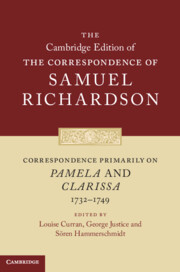
Correspondence Primarily on Pamela and Clarissa (1732–1749)
-
- Published online:
- 06 June 2024
- Print publication:
- 27 June 2024
