Cambridge Editions present the works and correspondence of great thinkers and writers. Introductions, explanatory notes and textual apparatus accompany a reliable version of the text, aiding scholars and students alike.
To save content items to your account,
please confirm that you agree to abide by our usage policies.
If this is the first time you use this feature, you will be asked to authorise Cambridge Core to connect with your account.
Find out more about saving content to .
To save content items to your Kindle, first ensure no-reply@cambridge.org
is added to your Approved Personal Document E-mail List under your Personal Document Settings
on the Manage Your Content and Devices page of your Amazon account. Then enter the ‘name’ part
of your Kindle email address below.
Find out more about saving to your Kindle.
Note you can select to save to either the @free.kindle.com or @kindle.com variations.
‘@free.kindle.com’ emails are free but can only be saved to your device when it is connected to wi-fi.
‘@kindle.com’ emails can be delivered even when you are not connected to wi-fi, but note that service fees apply.
Transition from popular moral philosophy to the metaphysics of morals
If so far we have drawn our concept of duty from the common use of our practical reason, it is by no means to be inferred from this that we have treated it as an experiential concept. Rather, if we attend to our experience of the behaviour of human beings we meet frequent and, as we ourselves concede, just complaints that no reliable example can be cited of the disposition to act from pure duty; that, though much may be done that conforms with what duty commands, still it is always doubtful whether it is actually done from duty and thus has a moral worth. That is why there have been philosophers in every age who have absolutely denied the actuality of this disposition in human actions, and attributed everything to a more or less refined self-love, without however calling into doubt the correctness of the concept of morality because of this; rather, with intimate regret they made mention of the frailty and impurity of a human nature that is indeed noble enough to take an idea so worthy of respect as its prescription, but at the same time too weak to follow it, and that uses reason, which should serve it for legislation, only to take care of the interest of inclinations, whether singly or, at most, in their greatest compatibility with one another.
Translators of philosophical texts inevitably obscure the author's arguments. The least they can do to lift the ‘veil of translation’ is to present text and translation side by side. In this book, this is done for Kant's Grundlegung zur Metaphysik der Sitten for the first time in its English-language history. I hope that it will encourage English speakers to study the German original, and thus bridge the divide between those working on Kant's ethics in both linguistic and philosophical traditions.
As the purpose of this volume is the clear and transparent presentation of the Groundwork itself, supplementary material has been kept to a minimum. This introduction explains the principles of the edition and the translation, particularly the constitution of the German text. In addition, the book contains a full bilingual index (which can also serve as an English–German glossary), a brief critical apparatus and editorial notes that explain matters of linguistic detail. These notes rarely stray into philosophically controversial territory. They do not serve the purpose of a guide to Kant's ethical thought. Interpretative and philosophical issues are discussed in my Kant's ‘Groundwork of the Metaphysics of Morals’: A Commentary (Cambridge University Press, 2007), which in many ways complements this edition as its sister volume.
The German text on the left-hand side of the double page is taken from the second original edition of the Groundwork, published in Riga by Johann Friedrich Hartknoch in 1786.
Transition from common to philosophical moral rational cognition
It is impossible to think of anything at all in the world, or indeed even beyond it, that could be taken to be good without limitation, except a good will. Understanding, wit, judgement and whatever else the talents of the mind may be called, or confidence, resolve and persistency of intent, as qualities of temperament, are no doubt in many respects good and desirable; but they can also be extremely evil and harmful if the will that is to make use of these gifts of nature, and whose distinctive constitution is therefore called character, is not good. It is just the same with gifts of fortune. Power, riches, honour, even health, and the entire well-being and contentment with one's condition, under the name of happiness, inspire confidence and thereby quite often overconfidence as well, unless a good will is present to correct and make generally purposive their influence on the mind, and with it also the whole principle for acting; not to mention that a rational impartial spectator can nevermore take any delight in the sight of the uninterrupted prosperity of a being adorned with no feature of a pure and good will, and that a good will thus appears to constitute the indispensable condition even of the worthiness to be happy.
Ancient Greek philosophy was divided into three sciences: physics, ethics and logic. This division is perfectly suitable to the nature of the matter, and there is no need to amend it, except perhaps just to add its principle, partly so as to assure oneself in this way of its completeness, partly to be able to determine correctly the necessary subdivisions.
All rational cognition is either material and considers some object, or formal and occupied merely with the form of the understanding and of reason itself, and with the universal rules of thinking as such, regardless of differences among its objects. Formal philosophy is called logic, whereas material philosophy, which has to do with determinate objects and the laws to which they are subject, is once again twofold. For these laws are either laws of nature, or of freedom. The science of the first is called physics, that of the other is ethics; the former is also called doctrine of nature, the latter doctrine of morals.
Logic can have no empirical part, i.e. one in which the universal and necessary laws of thinking would rest on grounds taken from experience; for in that case it would not be logic, i.e. a canon for the understanding, or for reason, that holds and must be demonstrated in all thinking.
Transition from the metaphysics of morals to the critique of pure practical reason
The concept of freedom is the key to the explanation of the autonomy of the will
A will is a kind of causality of living beings in so far as they are rational, and freedom would be that property of such a causality, as it can be efficient independently of alien causes determining it; just as natural necessity is the property of the causality of all nonrational beings to be determined to activity by the influence of alien causes.
The explication of freedom stated above is negative and therefore unfruitful for gaining insight into its essence; but there flows from it a positive concept of freedom, which is so much the richer and more fruitful. Since the concept of causality carries with it that of laws according to which, by something that we call a cause, something else, namely the consequence, must be posited: freedom, though it is not a property of the will according to natural laws, is not lawless because of that at all, but must rather be a causality according to immutable laws, but of a special kind; for otherwise a free will would be an absurdity. Natural necessity was a heteronomy of efficient causes; for every effect was possible only according to the law that something else determines the efficient cause to causality; what else, then, can freedom of the will be, but autonomy, i.e. the property of the will of being a law to itself?
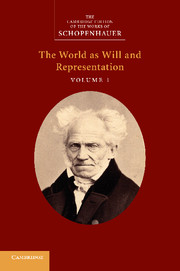
First published in 1818, The World as Will and Representation contains Schopenhauer's entire philosophy, ranging through epistemology, metaphysics, philosophy of mind and action, aesthetics and philosophy of art, to ethics, the meaning of life and the philosophy of religion, in an attempt to account for the world in all its significant aspects. It gives a unique and influential account of what is and is not of value in existence, the striving and pain of the human condition and the possibility of deliverance from it. This translation of the first volume of what later became a two-volume work reflects the eloquence and power of Schopenhauer's prose and renders philosophical terms accurately and consistently. It offers an introduction, glossary of names and bibliography, and succinct editorial notes, including notes on the revisions of the text which Schopenhauer made in 1844 and 1859.
[‘It dwells in us, not in the underworld, nor in the heavenly stars: All this is brought to pass by the living spirit in us.’ Agrippa von Nettesheim]
In the First Book we considered representation only as such, which is to say only with respect to its general form. Of course when it comes to abstract representations (concepts), we are familiar with their content as well, since they acquire this content and meaning only through their connection to intuitive representation and would be worthless and empty without it. This is why we will have to focus exclusively on intuitive representation in order to learn anything about its content, its more precise determinations, or the configurations it presents to us. We will be particularly interested in discovering the true meaning of intuitive representation; we have only ever felt this meaning before, but this has ensured that the images do not pass by us strange and meaningless as they would otherwise necessarily have done; rather, they speak and are immediately understood and have an interest that engages our entire being.
We turn to mathematics, natural science and philosophy, each of which raises our hope that it might shed some light on the problem. – But first we find that philosophy is a many-headed monster with each head speaking a different language.
Georg Friedrich Wilhelm Hegel (1770–1831) is one of the great figures of German Idealism along with Immanuel Kant (1724–1804), JohannGottlieb Fichte (1762–1814) and Friedrich Wilhelm Joseph Schelling (1775–1854). Hegel's most famous publication is undoubtedly the Phenomenology of Spirit, which appeared in 1807 just after he had left his teaching position at theUniversity of Jena. In 1800 his friend Schelling, with whom he had been a student at Tübingen, had invited Hegel to join him in Jena, where they taught side by side until 1803, when Schelling left for southern Germany. When French troops underNapoleon entered Jena inOctober 1806,Hegel's situation became too precarious for him to stay. The university was closed, Hegel's position there was relatively insecure, and his salary (which Goethe had been able to procure for him) was too small to make ends meet. As much as Hegel desired to continue in an academic setting, he was forced to spend the next decade of his life outside the university, first in a temporary job as editor of the Bamberger Zeitung, a newspaper that appeared in Bamberg, Bavaria, and then as professor and headmaster of the Gymnasium in Nuremberg, Bavaria.
The Nuremberg years (1808–16) are the gestation period of Hegel's mature philosophy. During this time, he wrote and published the Science of Logic (appearing in two volumes comprising three books, in 1812–13 and 1816) and began to work out the contours of his comprehensive philosophical system. Like his contemporaries, Hegel was convinced that any philosophy had to take the form of a system, i.e. it had to be a comprehensive, complete body of knowledge organized around a central principle, such that all propositions were rigorously derived in a progressive line of argument and all parts methodically connected to each other. In 1807 he intended the Phenomenology of Spirit to be ‘the first part of the system’, to be followed by a second part comprising a logic (i.e. a general ontology) and a philosophy of nature and of spirit. While this second part of the system was never published in its originally intended form, the first volume of the Science of Logic came out as the first instalment of the system's second part, but because it had grown to such dimensions Hegel decided to publish it separately, without the philosophies of nature and of spirit.
What I propose to do here is to specify how this book is to be read so as to be understood. – It aims to convey a single thought. But in spite of all my efforts, I could not find a shorter way of conveying the thought than the whole of this book. – I believe it is the idea that people have sought out for such a long time under the heading of philosophy, which is why scholars of history have thought it to be as impossible to discover as the philosophers' stone, although Pliny had already told them: ‘how much has been considered impossible before it has been done?’ (Natural History, 7, 1).
As this one thought is considered from different sides, it reveals itself respectively as what has been called metaphysics, what has been called ethics, and what has been called aesthetics; and it is only natural that it be all of these, if it really is what I claim it to be.
A system of thoughts must always have an architectonic coherence, i.e. a coherence in which one part always supports another without the second supporting the first, so the foundation stone will ultimately support all the parts without itself being supported by any of them, and the summit will be supported without itself supporting anything. A single thought, on the other hand, however comprehensive it might be, must preserve the most perfect unity.