To save content items to your account,
please confirm that you agree to abide by our usage policies.
If this is the first time you use this feature, you will be asked to authorise Cambridge Core to connect with your account.
Find out more about saving content to .
To save content items to your Kindle, first ensure no-reply@cambridge.org
is added to your Approved Personal Document E-mail List under your Personal Document Settings
on the Manage Your Content and Devices page of your Amazon account. Then enter the ‘name’ part
of your Kindle email address below.
Find out more about saving to your Kindle.
Note you can select to save to either the @free.kindle.com or @kindle.com variations.
‘@free.kindle.com’ emails are free but can only be saved to your device when it is connected to wi-fi.
‘@kindle.com’ emails can be delivered even when you are not connected to wi-fi, but note that service fees apply.
In this chapter, we study limiting theorems for the 2D Navier-Stokes system with random perturbations. To simplify the presentation, we shall confine ourselves to the case of spatially regular white noise; however, all the results remain true for random kick forces. The first section is devoted to the derivation of the strong law of large numbers (SLLN), the law of the iterated logarithm (LIL), and the central limit theorem (CLT). Our approach is based on the reduction of the problem to similar questions for martingales and an application of some general results on SLLN, LIL, and CLT. In Section 4.2, we study the relationship between stationary distributions and random attractors. Roughly speaking, it is proved that the support of the random probability measure obtained by the disintegration of the unique stationary distribution is a random point attractor for the RDS in question. The third section deals with the stationary distributions for the Navier-Stokes system perturbed by a random force depending on a parameter. We first prove that the stationary measures continuously depend on spatially regular white noise. We next consider high-frequency random kicks and show that, under suitable normalisation, the corresponding family of stationary measures converges weakly to the unique stationary distribution corresponding to the white-noise perturbation. Finally, in Section 4.4, we discuss the physical relevance of the results of this chapter.
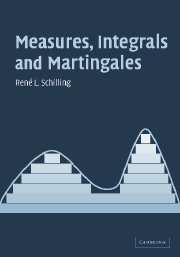
This book, first published in 2005, introduces measure and integration theory as it is needed in many parts of analysis and probability theory. The basic theory - measures, integrals, convergence theorems, Lp-spaces and multiple integrals - is explored in the first part of the book. The second part then uses the notion of martingales to develop the theory further, covering topics such as Jacobi's generalized transformation Theorem, the Radon-Nikodym theorem, Hardy-Littlewood maximal functions or general Fourier series. Undergraduate calculus and an introductory course on rigorous analysis are the only essential prerequisites, making this text suitable for both lecture courses and for self-study. Numerous illustrations and exercises are included and these are not merely drill problems but are there to consolidate what has already been learnt and to discover variants, sideways and extensions to the main material. Hints and solutions can be found on the author's website, which can be reached from www.cambridge.org/9780521615259. This book forms a sister volume to René Schilling's other book Counterexamples in Measure and Integration (www.cambridge.org/9781009001625).
Now available in a fully revised and updated second edition, this well established textbook provides a straightforward introduction to the theory of probability. The presentation is entertaining without any sacrifice of rigour; important notions are covered with the clarity that the subject demands. Topics covered include conditional probability, independence, discrete and continuous random variables, basic combinatorics, generating functions and limit theorems, and an introduction to Markov chains. The text is accessible to undergraduate students and provides numerous worked examples and exercises to help build the important skills necessary for problem solving.
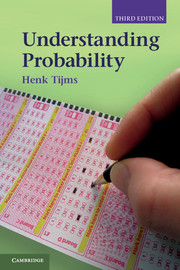
Understanding Probability is a unique and stimulating approach to a first course in probability. The first part of the book demystifies probability and uses many wonderful probability applications from everyday life to help the reader develop a feel for probabilities. The second part, covering a wide range of topics, teaches clearly and simply the basics of probability. This fully revised third edition has been packed with even more exercises and examples and it includes new sections on Bayesian inference, Markov chain Monte-Carlo simulation, hitting probabilities in random walks and Brownian motion, and a new chapter on continuous-time Markov chains with applications. Here you will find all the material taught in an introductory probability course. The first part of the book, with its easy-going style, can be read by anybody with a reasonable background in high school mathematics. The second part of the book requires a basic course in calculus.
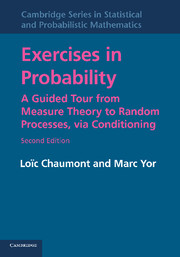
Derived from extensive teaching experience in Paris, this second edition now includes over 100 exercises in probability. New exercises have been added to reflect important areas of current research in probability theory, including infinite divisibility of stochastic processes, past-future martingales and fluctuation theory. For each exercise the authors provide detailed solutions as well as references for preliminary and further reading. There are also many insightful notes to motivate the student and set the exercises in context. Students will find these exercises extremely useful for easing the transition between simple and complex probabilistic frameworks. Indeed, many of the exercises here will lead the student on to frontier research topics in probability. Along the way, attention is drawn to a number of traps into which students of probability often fall. This book is ideal for independent study or as the companion to a course in advanced probability theory.
Originally, the main body of these exercises was developed for, and presented to, the students in the Magistère des Universités Parisiennes between 1984 and 1990; the audience consisted mainly of students from the Écoles Normales, and the spirit of the Magistère was to blend “undergraduate probability” (≟ random variables, their distributions, and so on …) with a first approach to “graduate probability” (≟ random processes). Later, we also used these exercises, and added some more, either in the Préparation à l'Agrégation de Mathématiques, or in more standard Master courses in probability.
In order to fit the exercises (related to the lectures) in with the two levels alluded to above, we systematically tried to strip a number of results (which had recently been published in research journals) of their random processes apparatus, and to exhibit, in the form of exercises, their random variables skeleton.
Of course, this kind of reduction may be done in almost every branch of mathematics, but it seems to be a quite natural activity in probability theory, where a random phenomenon may be either studied on its own (in a “small” probability world), or as a part of a more complete phenomenon (taking place in a “big” probability world); to give an example, the classical central limit theorem, in which only one Gaussian variable (or distribution) occurs in the limit, appears, in a number of studies, as a one-dimensional “projection” of a central limit theorem involving processes, in which the limits may be several Brownian motions, the former Gaussian variable appearing now as the value at time 1, say, of one of these Brownian motions.