Refine search
Actions for selected content:
3044 results in Probability theory and stochastic processes
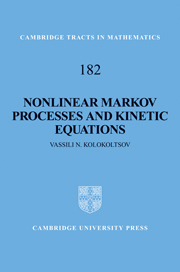
Nonlinear Markov Processes and Kinetic Equations
-
- Published online:
- 05 July 2014
- Print publication:
- 15 July 2010
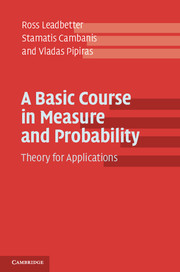
A Basic Course in Measure and Probability
- Theory for Applications
-
- Published online:
- 05 June 2014
- Print publication:
- 30 January 2014
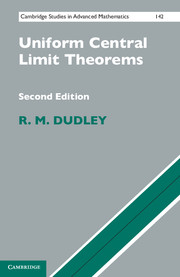
Uniform Central Limit Theorems
-
- Published online:
- 05 June 2014
- Print publication:
- 24 February 2014
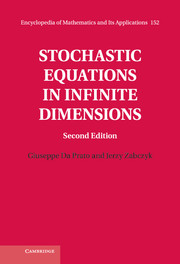
Stochastic Equations in Infinite Dimensions
-
- Published online:
- 05 May 2014
- Print publication:
- 17 April 2014
3 - Stochastic processes
- from PART ONE - FOUNDATIONS
-
- Book:
- Stochastic Equations in Infinite Dimensions
- Published online:
- 05 May 2014
- Print publication:
- 17 April 2014, pp 65-79
-
- Chapter
- Export citation
14 - Some recent developments
- from PART THREE - PROPERTIES OF SOLUTIONS
-
- Book:
- Stochastic Equations in Infinite Dimensions
- Published online:
- 05 May 2014
- Print publication:
- 17 April 2014, pp 392-405
-
- Chapter
- Export citation
13 - Survey of specific equations
- from PART THREE - PROPERTIES OF SOLUTIONS
-
- Book:
- Stochastic Equations in Infinite Dimensions
- Published online:
- 05 May 2014
- Print publication:
- 17 April 2014, pp 368-391
-
- Chapter
- Export citation
Index
-
- Book:
- Stochastic Equations in Infinite Dimensions
- Published online:
- 05 May 2014
- Print publication:
- 17 April 2014, pp 491-493
-
- Chapter
- Export citation
PART THREE - PROPERTIES OF SOLUTIONS
-
- Book:
- Stochastic Equations in Infinite Dimensions
- Published online:
- 05 May 2014
- Print publication:
- 17 April 2014, pp 233-234
-
- Chapter
- Export citation
Contents
-
- Book:
- Stochastic Equations in Infinite Dimensions
- Published online:
- 05 May 2014
- Print publication:
- 17 April 2014, pp v-xii
-
- Chapter
- Export citation
4 - The stochastic integral
- from PART ONE - FOUNDATIONS
-
- Book:
- Stochastic Equations in Infinite Dimensions
- Published online:
- 05 May 2014
- Print publication:
- 17 April 2014, pp 80-118
-
- Chapter
- Export citation
Appendix C - Nuclear and Hilbert–Schmidt operators
-
- Book:
- Stochastic Equations in Infinite Dimensions
- Published online:
- 05 May 2014
- Print publication:
- 17 April 2014, pp 436-439
-
- Chapter
- Export citation
PART ONE - FOUNDATIONS
-
- Book:
- Stochastic Equations in Infinite Dimensions
- Published online:
- 05 May 2014
- Print publication:
- 17 April 2014, pp 13-14
-
- Chapter
- Export citation
Introduction: motivating examples
-
- Book:
- Stochastic Equations in Infinite Dimensions
- Published online:
- 05 May 2014
- Print publication:
- 17 April 2014, pp 1-12
-
- Chapter
- Export citation
Frontmatter
-
- Book:
- Stochastic Equations in Infinite Dimensions
- Published online:
- 05 May 2014
- Print publication:
- 17 April 2014, pp i-iv
-
- Chapter
- Export citation
9 - Markov property and Kolmogorov equation
- from PART THREE - PROPERTIES OF SOLUTIONS
-
- Book:
- Stochastic Equations in Infinite Dimensions
- Published online:
- 05 May 2014
- Print publication:
- 17 April 2014, pp 235-281
-
- Chapter
- Export citation
PART TWO - EXISTENCE AND UNIQUENESS
-
- Book:
- Stochastic Equations in Infinite Dimensions
- Published online:
- 05 May 2014
- Print publication:
- 17 April 2014, pp 119-120
-
- Chapter
- Export citation
Appendix D - Dissipative mappings
-
- Book:
- Stochastic Equations in Infinite Dimensions
- Published online:
- 05 May 2014
- Print publication:
- 17 April 2014, pp 440-445
-
- Chapter
- Export citation
7 - Existence and uniqueness for nonlinear equations
- from PART TWO - EXISTENCE AND UNIQUENESS
-
- Book:
- Stochastic Equations in Infinite Dimensions
- Published online:
- 05 May 2014
- Print publication:
- 17 April 2014, pp 186-219
-
- Chapter
- Export citation
Appendix B - Some results on control theory
-
- Book:
- Stochastic Equations in Infinite Dimensions
- Published online:
- 05 May 2014
- Print publication:
- 17 April 2014, pp 428-435
-
- Chapter
- Export citation
