To save content items to your account,
please confirm that you agree to abide by our usage policies.
If this is the first time you use this feature, you will be asked to authorise Cambridge Core to connect with your account.
Find out more about saving content to .
To save content items to your Kindle, first ensure no-reply@cambridge.org
is added to your Approved Personal Document E-mail List under your Personal Document Settings
on the Manage Your Content and Devices page of your Amazon account. Then enter the ‘name’ part
of your Kindle email address below.
Find out more about saving to your Kindle.
Note you can select to save to either the @free.kindle.com or @kindle.com variations.
‘@free.kindle.com’ emails are free but can only be saved to your device when it is connected to wi-fi.
‘@kindle.com’ emails can be delivered even when you are not connected to wi-fi, but note that service fees apply.
The visual observations for the following guide were carried out by the author during two principal time periods: 1992–2001 and 2006–2010. In 1992, a computer printout of the Herschel catalogue was obtained from David and Brenda Branchett of the Astronomical League. The list had been generated by Father Lucian Kemble to facilitate an ongoing project to observe the entire Herschel catalogue with modern amateur telescopes.
All objects in this guide were located by the starhopping method, whereby the observer uses star charts to proceed from a known location to a new target. The present author’s procedure was to record observations on a preprinted form. In addition to identifying the target, the date and time observed, viewing conditions, location, telescope and magnification used, a written description of the object was included and further supported by a field sketch with surrounding stars placed as accurately as possible. Later, each observation was compared with a Digitized Sky Survey (DSS) image of the object in question. If the star patterns and general appearance of the object matched the DSS image, the object was recorded as seen. In the overwhelming majority of cases, the first attempt was successful. However, there were occasional faint objects or objects located in crowded fields that were not successfully recorded the first time. If the DSS image indicated a negative observation, the procedure was repeated until success was attained.
It is the evening of 5 September 1784. As darkness descends on the village of Datchet, the bustling activity of the day slowly draws to a close. A few gentlemen, mostly in pairs, walk the streets at a leisurely pace, taking their evening constitutionals, quietly discussing the day’s events. Their way is lit by a few widely spaced lamps, but these will be extinguished shortly; no need to waste precious fuel lighting streets long after everyone has gone to bed. The doors of the village pub open and close with diminishing regularity as the last of the patrons leave and make their way home. By 9:30 p.m. the village is largely quiet, save for the occasional bark of a dog.
It is a beautiful, star-lit night with a slight breeze and the air is crisp, suggesting that the cool days of autumn are not far off. After several days of cloud the moonless skies are clear and the brilliant summer Milky Way arches overhead, seen in all its glory. A short way from the village centre stands a solid two-storey house with a low stone wall extending away down the road. The house is dark save for the light of a single lamp near an open window on the second floor. In the garden the silhouette of a curious structure can be seen rising into the night sky, a peculiar construction of slanted spars and cross-beams, integrated with a pair of ladders on both sides. It appears to be more than 20 feet high and in the centre is a considerable tube, like a cannon but far larger, pointed almost vertically into the sky. There is a small platform off to the side of the tube near the top and one can see that there is a man standing there, leaning over the tube in the darkness. He is silent for a while but then calls out quietly to the ground below and all of a sudden the structure moves ever so slightly, turning on the casters supporting it. There is another man, this one standing at the base of the structure, who next turns a hand crank slowly just above his head. He stops immediately upon a second command and the night is again silent for several minutes.
This book makes extensive use of images from the Digitized Sky Survey (DSS) and the author wishes to thank Lynn Kozloski, Space Telescope Science Institute, Scott Kardel, California Institute of Technology, and Sue Tritton, Royal Observatory Edinburgh, for their permission to use images originally obtained by the Oschin Schmidt Telescope of Palomar Observatory and the United Kingdom Schmidt Telescope of the Anglo-Australian Observatory in the catalogue portion of this book.
We extend our appreciation and thanks to Andreas Maurer and the Antique Telescope Society for permission to use material from their publication A Compendium of All Known William Herschel Telescopes in the chapter entitled ‘The telescope maker’. Mr Maurer also graciously provided the photograph of the 10-foot telescope built by William Herschel and presented to Göttingen University, as well as the photograph of the replica of the 25-foot Spanish telescope.
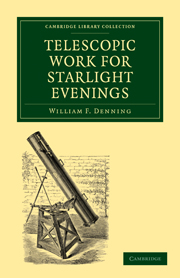
William F. Denning (1848–1931) was a British astronomer famous for his planetary observations and meteor studies. Elected president of the Liverpool Astronomical Society in 1887, he wrote a series of articles on telescopes for the society's journal, which were brought together and republished in 1891 under the title Telescopic Work for Starlight Evenings. Intended as a contribution to popular astronomy, this book provides a varied introduction to telescopes and their usage. The opening essay traces the development of the telescope from antiquity, through Galileo and Newton's contributions in the seventeenth century, to contemporary progress in astronomy. Other chapters provide practical advice for conducting planetary observation and detailed studies of particular planets, as well as facts and figures about meteors and how to compute their orbit. This book provides a fascinating insight into the evolution of astronomy and will be a valuable resource for historians of science and amateur astronomers.
The Secret Deepis the fourth title in my Deep-Sky Companions series – the other three books are Deep-Sky Companions: The Messier Objects, Deep-Sky Companions: The Caldwell Objects, and Deep-Sky Companions: Hidden Treasures. Like the third companion, The Secret Deep is an important work because it brings to light a new list of 109 deep-sky objects visible in small telescopes under a dark sky. None of the objects in the Secret Deep list appear in the Messier, Caldwell, or Hidden Treasures catalogues; I've included an additional 20 objects in Appendix B. Owners of this series, then, have at their fingertips more than 450 deep-sky objects to explore.
All the Secret Deep objects are visible from mid-northern latitudes, though five or fewer are best seen from more southerly locations in the Northern Hemisphere or further south. Still, the most southerly object in the Secret Deep list – globular cluster NGC 2298 in Puppis – lies at a declination of −36° exactly, so it is only 1¼° further south than open cluster M7 in Scorpius, the most southerly Messier object. From the latitude of New York City, NGC 2298 will be 9° above the southern horizon when highest.
I have taken great care to select objects visible through my new 5-inch Tele Vue f/5 refractor (see Chapter 1) under a clear, dark sky. As with some objects in the Hidden Treasures list, several of the Secret Deep objects are surprisingly bright – including some open star clusters visible in binoculars and to the unaided eyes, a few galaxies more apparent than the dimmest Messier ones, and a couple of planetary nebulae with central stars you can spy through large binoculars.
Beauty is a manifestation of secret natural laws, which otherwise would have been hidden from us forever.
Johann Wolfgang von Goethe (1749–1832)
I have been stargazing for nearly half a century. But I have yet to see all the sky's bright telescopic wonders. I don't mind. I'm in no rush. Unlike time and tide, the deep-sky objects we seek seem to hang around and wait for us to care. I suspect we all care. But I also understand that the task of seeking out these wonders without some guidance can be overwhelming. I felt that way recently when I forgot my star atlas on one very clear night. The stars shined down in magnificent splendor, the Milky Way appeared rich and pure, a marvel to behold. But I also felt a sense of loss, in that, without an atlas in hand, I didn't know where to point my telescope to find new wonders. The fact is, when it comes to taking any journey, guidance helps.
That's why I write these books. By sharing with you lists of celestial objects that have inspired me over the years, I hope to chart a course for you through the stars, to help you see its deep-sky splendors and enrich your time under the night sky. Besides, half the fun of any journey is sharing what we've learned along the way. This book is my latest message to you about yet another “romp” through the heavens and the wonders I have seen.
Founded in 1911, the AAVSO boasts over 1200 members and observers and is the world's largest non-profit organization dedicated to variable star observation. This timely book marks the AAVSO's centennial year, presenting an authoritative and accurate history of this important association. Writing in an engaging and accessible style, the authors move chronologically through five eras of the AAVSO, discussing the evolution of its structure and purpose. Throughout the text, the main focus is on the thousands of individuals whose contributions have made the AAVSO's progress possible. Describing a century of interaction between amateur and professional astronomers, the authors celebrate the collaborative relationships that have existed over the years. As the definitive history of the first hundred years of the AAVSO, this text has broad appeal and will be of interest to amateur and professional astronomers, as well as historians and sociologists of science in general.
Now in its fourth edition, this highly regarded book is ideal for those who wish to solve a variety of practical and recreational problems in astronomy using a scientific calculator or spreadsheet. Updated and extended, this new edition shows you how to use spreadsheets to predict, with greater accuracy, solar and lunar eclipses, the positions of the planets, and the times of sunrise and sunset. Suitable for worldwide use, this handbook covers orbits, transformations and general celestial phenomena, and is essential for anyone wanting to make astronomical calculations for themselves. With clear, easy-to-follow instructions for use with a pocket calculator, shown alongside worked examples, it can be enjoyed by anyone interested in astronomy, and will be a useful tool for software writers and students studying introductory astronomy. High-precision spreadsheet methods for greater accuracy are available at www.cambridge.org/practicalastronomy.
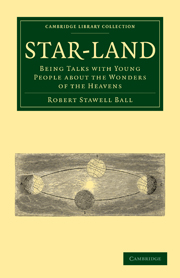
Sir Robert Stawell Ball's Star-Land of 1889 is based on some of his Christmas Lectures at the Royal Institution during his time as royal astronomer of Ireland, a post he held from 1874 to 1892. These lectures were aimed at a young audience in order to introduce them to the subject, and fire their interest in the wonders of the universe. This volume includes lectures on the sun, the moon, the inner and giant planets, comets and shooting stars, and stars. It also contains a chapter on the observation and naming of stars. Ball was a renowned public lecturer, with commissions across Britain, Ireland and the United States, where his anecdotal and conversational style won him much popularity. The author of several frequently reprinted science books, he was knighted in 1886 and in 1892 became Lowendean professor of astronomy at Cambridge and the director of the university observatory.