To save content items to your account,
please confirm that you agree to abide by our usage policies.
If this is the first time you use this feature, you will be asked to authorise Cambridge Core to connect with your account.
Find out more about saving content to .
To save content items to your Kindle, first ensure no-reply@cambridge.org
is added to your Approved Personal Document E-mail List under your Personal Document Settings
on the Manage Your Content and Devices page of your Amazon account. Then enter the ‘name’ part
of your Kindle email address below.
Find out more about saving to your Kindle.
Note you can select to save to either the @free.kindle.com or @kindle.com variations.
‘@free.kindle.com’ emails are free but can only be saved to your device when it is connected to wi-fi.
‘@kindle.com’ emails can be delivered even when you are not connected to wi-fi, but note that service fees apply.
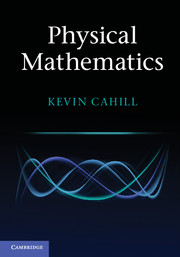
Unique in its clarity, examples and range, Physical Mathematics explains as simply as possible the mathematics that graduate students and professional physicists need in their courses and research. The author illustrates the mathematics with numerous physical examples drawn from contemporary research. In addition to basic subjects such as linear algebra, Fourier analysis, complex variables, differential equations and Bessel functions, this textbook covers topics such as the singular-value decomposition, Lie algebras, the tensors and forms of general relativity, the central limit theorem and Kolmogorov test of statistics, the Monte Carlo methods of experimental and theoretical physics, the renormalization group of condensed-matter physics and the functional derivatives and Feynman path integrals of quantum field theory.
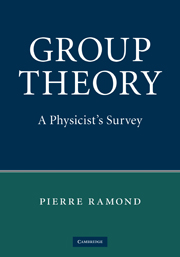
Group theory has long been an important computational tool for physicists, but, with the advent of the Standard Model, it has become a powerful conceptual tool as well. This book introduces physicists to many of the fascinating mathematical aspects of group theory, and mathematicians to its physics applications. Designed for advanced undergraduate and graduate students, this book gives a comprehensive overview of the main aspects of both finite and continuous group theory, with an emphasis on applications to fundamental physics. Finite groups are extensively discussed, highlighting their irreducible representations and invariants. Lie algebras, and to a lesser extent Kac–Moody algebras, are treated in detail, including Dynkin diagrams. Special emphasis is given to their representations and embeddings. The group theory underlying the Standard Model is discussed, along with its importance in model building. Applications of group theory to the classification of elementary particles are treated in detail.
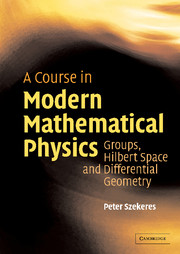
This book, first published in 2004, provides an introduction to the major mathematical structures used in physics today. It covers the concepts and techniques needed for topics such as group theory, Lie algebras, topology, Hilbert space and differential geometry. Important theories of physics such as classical and quantum mechanics, thermodynamics, and special and general relativity are also developed in detail, and presented in the appropriate mathematical language. The book is suitable for advanced undergraduate and beginning graduate students in mathematical and theoretical physics, as well as applied mathematics. It includes numerous exercises and worked examples, to test the reader's understanding of the various concepts, as well as extending the themes covered in the main text. The only prerequisites are elementary calculus and linear algebra. No prior knowledge of group theory, abstract vector spaces or topology is required.
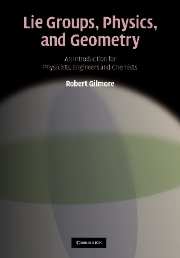
Describing many of the most important aspects of Lie group theory, this book presents the subject in a 'hands on' way. Rather than concentrating on theorems and proofs, the book shows the applications of the material to physical sciences and applied mathematics. Many examples of Lie groups and Lie algebras are given throughout the text. The relation between Lie group theory and algorithms for solving ordinary differential equations is presented and shown to be analogous to the relation between Galois groups and algorithms for solving polynomial equations. Other chapters are devoted to differential geometry, relativity, electrodynamics, and the hydrogen atom. Problems are given at the end of each chapter so readers can monitor their understanding of the materials. This is a fascinating introduction to Lie groups for graduate and undergraduate students in physics, mathematics and electrical engineering, as well as researchers in these fields.
The third edition of this highly acclaimed undergraduate textbook is suitable for teaching all the mathematics for an undergraduate course in any of the physical sciences. As well as lucid descriptions of all the topics and many worked examples, it contains over 800 exercises. New stand-alone chapters give a systematic account of the 'special functions' of physical science, cover an extended range of practical applications of complex variables, and give an introduction to quantum operators. Further tabulations, of relevance in statistics and numerical integration, have been added. In this edition, half of the exercises are provided with hints and answers and, in a separate manual available to both students and their teachers, complete worked solutions. The remaining exercises have no hints, answers or worked solutions and can be used for unaided homework; full solutions are available to instructors on a password-protected web site, www.cambridge.org/9780521679718.
All students taking laboratory courses within the physical sciences and engineering will benefit from this book, whilst researchers will find it an invaluable reference. This concise, practical guide brings the reader up-to-speed on the proper handling and presentation of scientific data and its inaccuracies. It covers all the vital topics with practical guidelines, computer programs (in Python), and recipes for handling experimental errors and reporting experimental data. In addition to the essentials, it also provides further background material for advanced readers who want to understand how the methods work. Plenty of examples, exercises and solutions are provided to aid and test understanding, whilst useful data, tables and formulas are compiled in a handy section for easy reference.
This tutorial-style textbook develops the basic mathematical tools needed by first and second year undergraduates to solve problems in the physical sciences. Students gain hands-on experience through hundreds of worked examples, self-test questions and homework problems. Each chapter includes a summary of the main results, definitions and formulae. Over 270 worked examples show how to put the tools into practice. Around 170 self-test questions in the footnotes and 300 end-of-section exercises give students an instant check of their understanding. More than 450 end-of-chapter problems allow students to put what they have just learned into practice. Hints and outline answers to the odd-numbered problems are given at the end of each chapter. Complete solutions to these problems can be found in the accompanying Student Solutions Manual. Fully-worked solutions to all problems, password-protected for instructors, are available at www.cambridge.org/foundation.
The simulation of physical systems requires a simplified, hierarchical approach which models each level from the atomistic to the macroscopic scale. From quantum mechanics to fluid dynamics, this book systematically treats the broad scope of computer modeling and simulations, describing the fundamental theory behind each level of approximation. Berendsen evaluates each stage in relation to its applications giving the reader insight into the possibilities and limitations of the models. Practical guidance for applications and sample programs in Python are provided. With a strong emphasis on molecular models in chemistry and biochemistry, this 2007 book will be suitable for advanced undergraduate and graduate courses on molecular modeling and simulation within physics, biophysics, physical chemistry and materials science. It will also be a useful reference to all those working in the field. Additional resources for this title including solutions for instructors and programs are available online at www.cambridge.org/9780521835275.
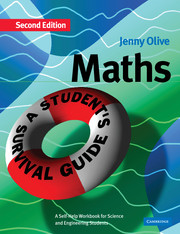
This friendly self-help workbook covers mathematics essential to first-year undergraduate scientists and engineers. In the second edition of this highly successful textbook the author has completely revised the existing text and added a totally new chapter on vectors. Mathematics underpins all science and engineering degrees, and this may cause problems for students whose understanding of the subject is weak. In this book Jenny Olive uses her extensive experience of teaching and helping students by giving a clear and confident presentation of the core mathematics needed by students starting science or engineering courses. The book contains almost 800 exercises, with detailed solutions given in the back to allow students who get stuck to see exactly where they have gone wrong. Topics covered include trigonometry and hyperbolic functions, sequences and series (with detailed coverage of binomial series), differentiation and integration, complex numbers, and vectors.
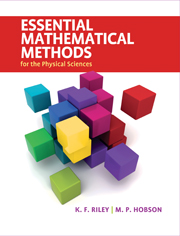
The mathematical methods that physical scientists need for solving substantial problems in their fields of study are set out clearly and simply in this tutorial-style textbook. Students will develop problem-solving skills through hundreds of worked examples, self-test questions and homework problems. Each chapter concludes with a summary of the main procedures and results and all assumed prior knowledge is summarized in one of the appendices. Over 300 worked examples show how to use the techniques and around 100 self-test questions in the footnotes act as checkpoints to build student confidence. Nearly 400 end-of-chapter problems combine ideas from the chapter to reinforce the concepts. Hints and outline answers to the odd-numbered problems are given at the end of each chapter, with fully-worked solutions to these problems given in the accompanying Student Solutions Manual. Fully-worked solutions to all problems, password-protected for instructors, are available at www.cambridge.org/essential.
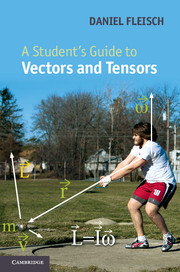
Vectors and tensors are among the most powerful problem-solving tools available, with applications ranging from mechanics and electromagnetics to general relativity. Understanding the nature and application of vectors and tensors is critically important to students of physics and engineering. Adopting the same approach used in his highly popular A Student's Guide to Maxwell's Equations, Fleisch explains vectors and tensors in plain language. Written for undergraduate and beginning graduate students, the book provides a thorough grounding in vectors and vector calculus before transitioning through contra and covariant components to tensors and their applications. Matrices and their algebra are reviewed on the book's supporting website, which also features interactive solutions to every problem in the text where students can work through a series of hints or choose to see the entire solution at once. Audio podcasts give students the opportunity to hear important concepts in the book explained by the author.
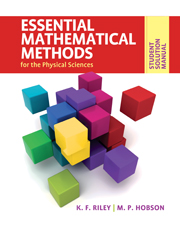
This Student Solution Manual provides complete solutions to all the odd-numbered problems in Essential Mathematical Methods for the Physical Sciences. It takes students through each problem step-by-step, so they can clearly see how the solution is reached, and understand any mistakes in their own working. Students will learn by example how to select an appropriate method, improving their problem-solving skills.
Computer simulation is an indispensable research tool in modeling, understanding and predicting nanoscale phenomena. However, the advanced computer codes used by researchers are too complicated for graduate students wanting to understand computer simulations of physical systems. This book gives students the tools to develop their own codes. Describing advanced algorithms, the book is ideal for students in computational physics, quantum mechanics, atomic and molecular physics, and condensed matter theory. It contains a wide variety of practical examples of varying complexity to help readers at all levels of experience. An algorithm library in Fortran 90, available online at www.cambridge.org/9781107001701, implements the advanced computational approaches described in the text to solve physical problems.
First published in 2007, this second edition describes the computational methods used in theoretical physics. New sections were added to cover finite element methods and lattice Boltzmann simulation, density functional theory, quantum molecular dynamics, Monte Carlo simulation, and diagonalisation of one-dimensional quantum systems. It covers many different areas of physics research and different computational methodologies, including computational methods such as Monte Carlo and molecular dynamics, various electronic structure methodologies, methods for solving partial differential equations, and lattice gauge theory. Throughout the book the relations between the methods used in different fields of physics are emphasised. Several new programs are described and can be downloaded from www.cambridge.org/9781107677135. The book requires a background in elementary programming, numerical analysis, and field theory, as well as undergraduate knowledge of condensed matter theory and statistical physics. It will be of interest to graduate students and researchers in theoretical, computational and experimental physics.
Building on his highly successful textbook on C++, David Yevick provides a concise yet comprehensive one-stop course in three key programming languages, C++, Java and Octave (a freeware alternative to MATLAB). Employing only public-domain software, this book presents a unique overview of numerical and programming techniques, including object-oriented programming, elementary and advanced topics in numerical analysis, physical system modelling, scientific graphics, software engineering and performance issues. Compact, transparent code in all three programming languages is applied to the fundamental equations of quantum mechanics, electromagnetics, mechanics and statistical mechanics. Uncommented versions of the code that can be immediately modified and adapted are provided online for the more involved programs. This compact, practical text is an invaluable introduction for students in all undergraduate- and graduate-level courses in the physical sciences or engineering that require numerical modelling, and also a key reference for instructors and scientific programmers.
The new edition of this highly acclaimed textbook contains several major additions, including more than four hundred new exercises (with hints and answers). To match the mathematical preparation of current senior college and university entrants, the authors have included a preliminary chapter covering areas such as polynomial equations, trigonometric identities, coordinate geometry, partial fractions, binomial expansions, induction, and the proof of necessary and sufficient conditions. Elsewhere, matrix decompositions, nearly-singular matrices and non-square sets of linear equations are treated in detail. The presentation of probability has been reorganised and greatly extended, and includes all physically important distributions. New topics covered in a separate statistics chapter include estimator efficiency, distributions of samples, t- and F-tests for comparing means and variances, applications of the chi-squared distribution, and maximum likelihood and least-squares fitting. In other chapters the following topics have been added: linear recurrence relations, curvature, envelopes, curve-sketching, and more refined numerical methods.
Material properties emerge from phenomena on scales ranging from Angstroms to millimeters, and only a multiscale treatment can provide a complete understanding. Materials researchers must therefore understand fundamental concepts and techniques from different fields, and these are presented in a comprehensive and integrated fashion for the first time in this book. Incorporating continuum mechanics, quantum mechanics, statistical mechanics, atomistic simulations and multiscale techniques, the book explains many of the key theoretical ideas behind multiscale modeling. Classical topics are blended with new techniques to demonstrate the connections between different fields and highlight current research trends. Example applications drawn from modern research on the thermo-mechanical properties of crystalline solids are used as a unifying focus throughout the text. Together with its companion book, Continuum Mechanics and Thermodynamics (Cambridge University Press, 2011), this work presents the complete fundamentals of materials modeling for graduate students and researchers in physics, materials science, chemistry and engineering.
Mathematical methods are essential tools for all physical scientists. This second edition provides a comprehensive tour of the mathematical knowledge and techniques that are needed by students in this area. In contrast to more traditional textbooks, all the material is presented in the form of problems. Within these problems the basic mathematical theory and its physical applications are well integrated. The mathematical insights that the student acquires are therefore driven by their physical insight. Topics that are covered include vector calculus, linear algebra, Fourier analysis, scale analysis, complex integration, Green's functions, normal modes, tensor calculus and perturbation theory. The second edition contains new chapters on dimensional analysis, variational calculus, and the asymptotic evaluation of integrals. This book can be used by undergraduates and lower-level graduate students in the physical sciences. It can serve as a stand-alone text, or as a source of problems and examples to complement other textbooks.
This Student Solution Manual provides complete solutions to all the odd-numbered problems in Foundation Mathematics for the Physical Sciences. It takes students through each problem step-by-step, so they can clearly see how the solution is reached, and understand any mistakes in their own working. Students will learn by example how to arrive at the correct answer and improve their problem-solving skills.