Refine search
Actions for selected content:
237178 results in Physics and Astronomy

A numerical investigation of airfoil tonal noise reduction by roughness elements
-
- Journal:
- Journal of Fluid Mechanics / Volume 1015 / 25 July 2025
- Published online by Cambridge University Press:
- 21 July 2025, A11
-
- Article
-
- You have access
- Open access
- HTML
- Export citation
-
In a combined experimental and numerical effort, we investigate the generation and reduction of airfoil tonal noise. The means of noise control are streak generators in the form of cylindrical roughness elements. These elements are placed periodically along the span of the airfoil at the mid-chord streamwise position. Experiments are performed for a wide range of Reynolds numbers and angles of attack in a companion work (Alva et al., AIAA Aviation Forum, 2023). In the present work, we concentrate on numerical investigations for a further investigation of selected cases. We have performed wall-resolved large-eddy simulations for a NACA 0012 airfoil at zero angle of attack and Mach 0.3. Two Reynolds numbers ( ${0.8\times 10^{5}}$ and ${1.0 \times 10^{5}}$) have been investigated, showing acoustic results consistent with experiments at the same Reynolds but lower Mach numbers. Roughness elements attenuate tones in the acoustic field and, for the higher Reynolds number, suppress them. Through Fourier decomposition and spectral proper orthogonal decomposition analysis of streamwise velocity data, dominating structures have been identified. Further, the coupling between the structures generated by the surface roughness and the instability modes (Kelvin–Helmholtz) of the shear layer has been identified through stability analysis, suggesting stabilisation mechanisms by which the sound generation by the airfoil is reduced by the roughness elements.


Uncovering the forcing statistics in stochastic linear models for compressible wall-bounded turbulence
-
- Journal:
- Journal of Fluid Mechanics / Volume 1015 / 25 July 2025
- Published online by Cambridge University Press:
- 21 July 2025, A40
-
- Article
-
- You have access
- Open access
- HTML
- Export citation
-
Modelling the nonlinear forcing is critical for linear models based on resolvent or input–output analyses. For compressible wall-bounded turbulence, little is known on what the real forcing looks like due to limited data, so the prediction agrees more qualitatively than quantitatively with direct numerical simulations (DNSs). Here, we present detailed forcing statistics of stochastic linear models, derived from elaborate DNS datasets for channel flows with bulk Mach number reaching 3. These statistics directly explain the success and failure of current models and provide guidance for further improvements. The benchmark linearised Navier–Stokes (LNS) and eLNS models are considered; the latter is assisted by eddy-viscosity-related terms. First, we prove the self-consistency of the models by using DNS-computed forcing as the input. Second, we present the spectral distributions of the forcing and its components. Third, we quantify the acoustic components, absent in incompressible cases, within the linear models. We reveal that the LNS forcing can exhibit relatively high coherence and low rank, very different from the modelled diagonal full-rank forcing. The eddy-viscosity-related term is not partial modelling of the LNS forcing; contrarily, the former is much larger than the latter, serving to disrupt the low-rank feature, enhance diagonal dominance and increase robustness across scales. The scales narrow in either horizontal direction are most susceptible to acoustic modes, while the others are little affected ( ${\lt}2\,\%$ in energy). Furthermore, the extended strong Reynolds analogy is assessed in predicting the density and temperature components.


Wake-induced vibration of an inelastic cylinder
-
- Journal:
- Journal of Fluid Mechanics / Volume 1015 / 25 July 2025
- Published online by Cambridge University Press:
- 21 July 2025, A46
-
- Article
- Export citation
The zonal-flow residual does not tend to zero in the limit of small mirror ratio
-
- Journal:
- Journal of Plasma Physics / Volume 91 / Issue 4 / August 2025
- Published online by Cambridge University Press:
- 21 July 2025, E102
-
- Article
-
- You have access
- Open access
- HTML
- Export citation
Evidence for the spin-kick alignment of pulsars from the statistics of their magnetic inclinations
-
- Journal:
- Publications of the Astronomical Society of Australia / Volume 42 / 2025
- Published online by Cambridge University Press:
- 21 July 2025, e106
-
- Article
-
- You have access
- Open access
- HTML
- Export citation

Wake merging and turbulence transition downstream of side-by-side porous discs
-
- Journal:
- Journal of Fluid Mechanics / Volume 1015 / 25 July 2025
- Published online by Cambridge University Press:
- 21 July 2025, A39
-
- Article
-
- You have access
- Open access
- HTML
- Export citation
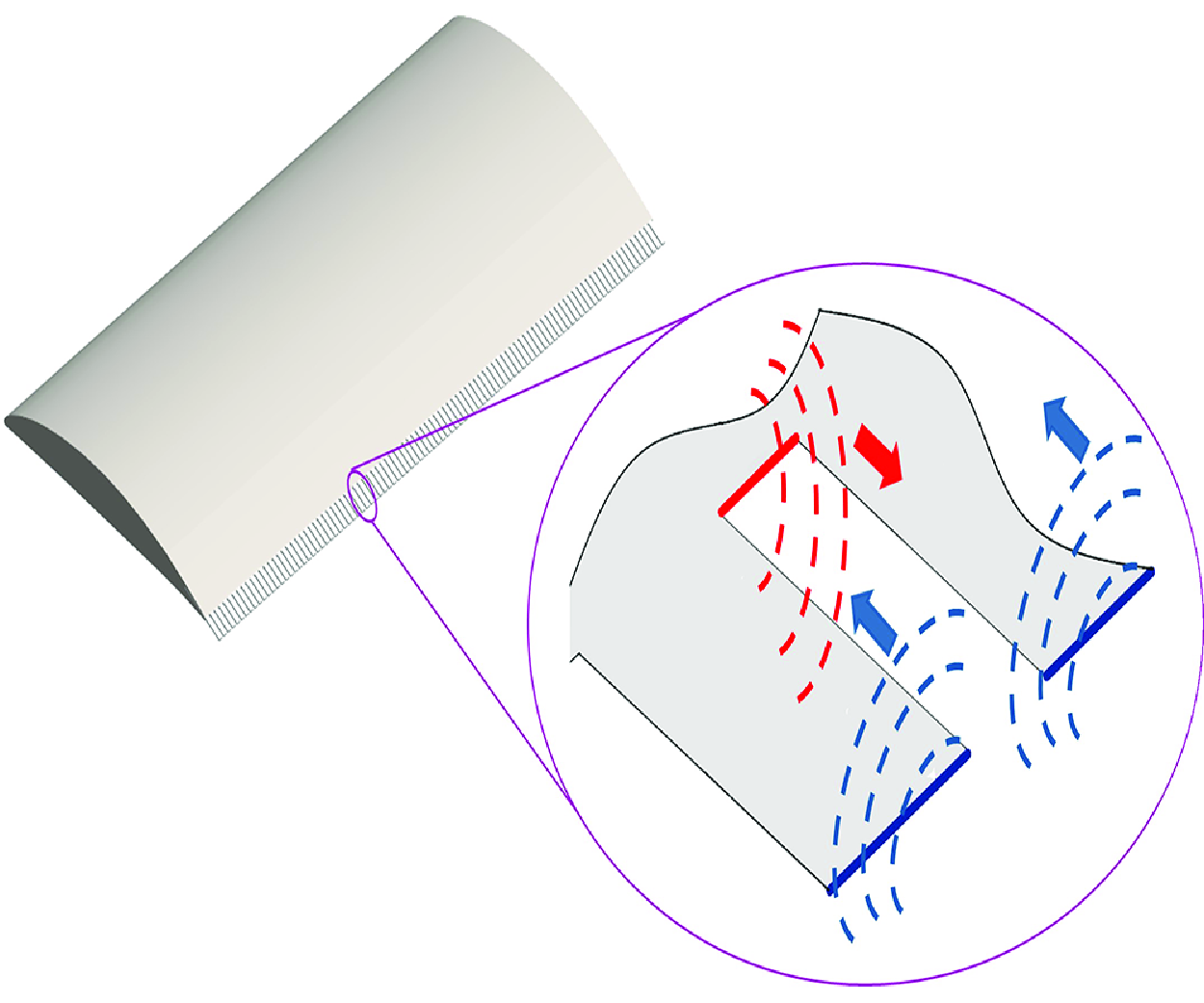
On the slit trailing edges for aerofoil self-noise reduction
-
- Journal:
- Journal of Fluid Mechanics / Volume 1015 / 25 July 2025
- Published online by Cambridge University Press:
- 21 July 2025, A43
-
- Article
-
- You have access
- Open access
- HTML
- Export citation
-
This paper presents an experimental and analytical investigation into the use of trailing edge slits for the reduction of aerofoil trailing edge noise. The noise reduction mechanism is shown to be fundamentally different from conventional trailing edge serrations, relying on destructive interference from highly compact and coherent sources generated at either ends of the slit. This novel approach is the first to exploit the coherence intrinsic to the boundary layer turbulence. Furthermore, the study demonstrates that trailing edge slits not only achieve superior noise reductions compared with sawtooth serrations of the same amplitude at certain conditions, but also offer frequency-tuning capability for noise reduction. Noise reduction is driven by the destructive interference between acoustic sources at the root and tip of the slit, which radiate with a phase difference determined by the difference in times taken for the boundary layer flow to convect between the root and tip. Maximum noise reductions occur at frequencies where the phase difference between these sources is $180^\circ$. The paper also presents a detailed parametric study into the variation in noise reductions due to the slit length, slit wavelength and slit root width. Additionally, a simple two-source analytic model is proposed to explain the observed results. Wind tunnel measurements of the unsteady flow field around the trailing edge slits are also presented, providing insights into the underlying flow physics.

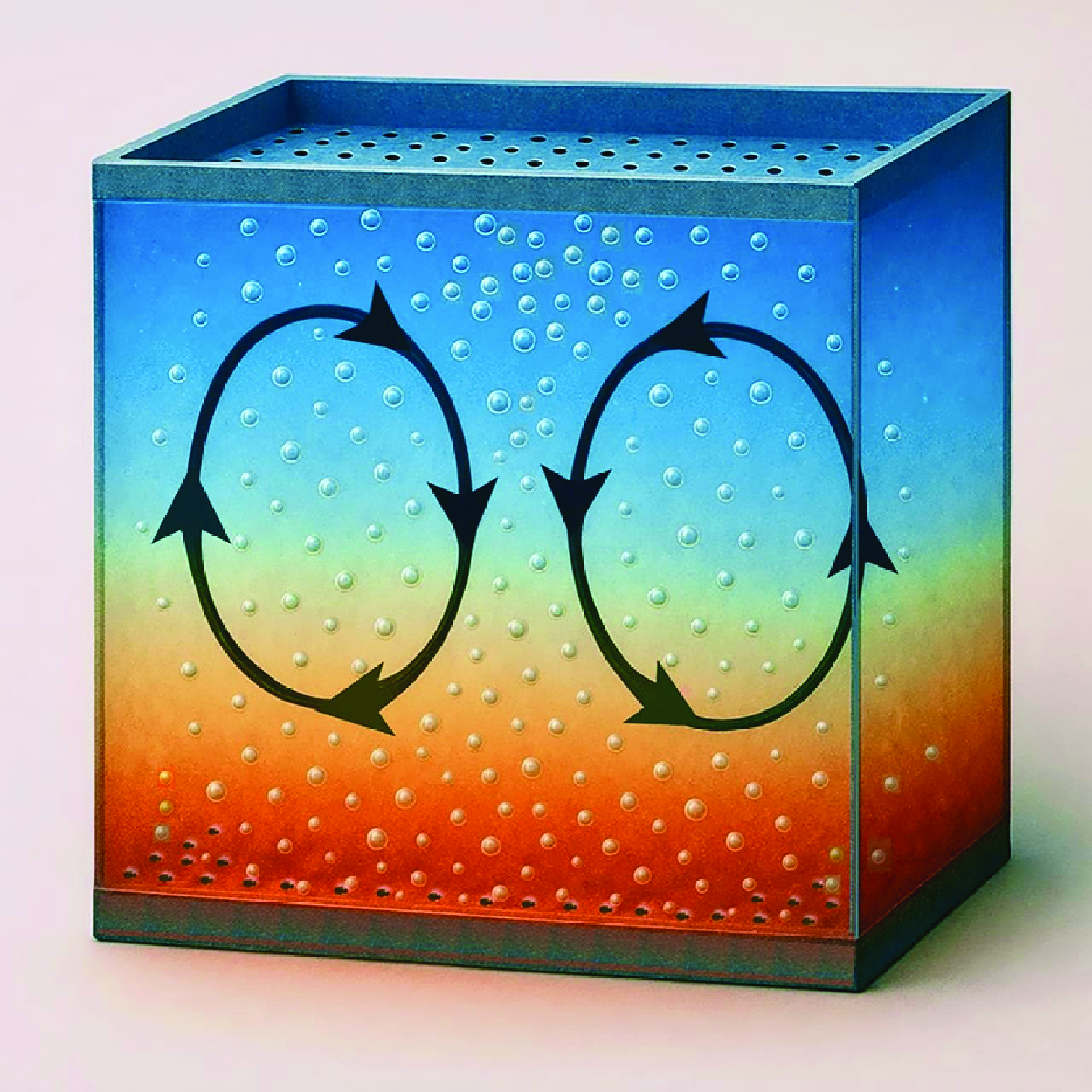
Impact of particle injection velocity on the stability of the particulate Rayleigh–Bénard system
-
- Journal:
- Journal of Fluid Mechanics / Volume 1015 / 25 July 2025
- Published online by Cambridge University Press:
- 21 July 2025, R2
-
- Article
- Export citation
Density jump as a function of the field for parallel relativistic collisionless shocks
-
- Journal:
- Journal of Plasma Physics / Volume 91 / Issue 4 / August 2025
- Published online by Cambridge University Press:
- 21 July 2025, E106
-
- Article
-
- You have access
- Open access
- HTML
- Export citation
-
Collisionless shocks are frequently analysed using the magnetohydrodynamic (MHD) formalism, even though the required collisionality hypothesis is not fulfilled. In a previous work (Bret & Narayan, 2018 J. Plasma Phys. vol. 84, p. 905840604), we presented a model of collisionless shock displaying an important departure from the expected MHD behaviour, in the case of a strong flow aligned magnetic field. This model was non-relativistic. Here, it is extended to the relativistic regime, considering zero upstream pressure and upstream Lorentz factor $\gg 1$. The result agrees satisfactorily with Particle-in-Cell simulations and shows a similar, and important, departure from the MHD prediction. In the strong field regime, the density jump $r$, seen in the downstream frame, behaves like $r \sim 2 + 1/\gamma _{\mathrm{up}}$, while MHD predicts 4 ( $\gamma _{\mathrm{up}}$ is the Lorentz factor of the upstream measured in the downstream frame). Only pair plasmas are considered.


Transient and steady convection in two dimensions
-
- Journal:
- Journal of Fluid Mechanics / Volume 1015 / 25 July 2025
- Published online by Cambridge University Press:
- 21 July 2025, A42
-
- Article
-
- You have access
- Open access
- HTML
- Export citation
-
We simulate thermal convection in a two-dimensional square box using the no-slip condition on all boundaries, and isothermal bottom and top walls, and adiabatic sidewalls. We choose 0.1 and 1 for the Prandtl number $Pr$ and vary the Rayleigh number $Ra$ between $10^6$ and $10^{12}$. We particularly study the temporal evolution of integral transport quantities towards their steady states. Perhaps not surprisingly, the velocity field evolves more slowly than the thermal field, and its steady state – which is nominal in the sense that large-amplitude low-frequency oscillations persist around plausible averages – is reached exponentially. We study these oscillation characteristics. The transient time for the velocity field to achieve its nominal steady state increases almost linearly with the Reynolds number. For large $Ra$, the Reynolds number itself scales almost as $Ra^{2/3}\, Pr^{-1}$, and the Nusselt number as $Ra^{2/7}$.


Comparing analytically propulsion by pitching and heaving flexible foils near the first two natural modes
-
- Journal:
- Journal of Fluid Mechanics / Volume 1015 / 25 July 2025
- Published online by Cambridge University Press:
- 18 July 2025, A35
-
- Article
-
- You have access
- Open access
- HTML
- Export citation
Hydrogen boron fusion in confined geometries
-
- Journal:
- High Power Laser Science and Engineering / Volume 13 / 2025
- Published online by Cambridge University Press:
- 18 July 2025, e72
-
- Article
-
- You have access
- Open access
- HTML
- Export citation
-
High-energy, short-pulse laser-driven proton–boron (p–11B) fusion has attracted growing interest due to its aneutronic character and potential for clean energy generation. In this study, we report on two experimental campaigns carried out at the LFEX laser facility using petawatt-class laser systems (energy $\sim$1.2–1.4 kJ, pulse duration 2.7 ps, peak intensity $\sim$(2–3) × 1019 W/cm2). The experiments explored the influence of complex target geometries – including spherical, cylindrical and wedge-shaped configurations – on α-particle yield. Our results demonstrate that spherical targets can enhance α-particle production by up to two orders of magnitude compared to planar targets of identical composition and also lead to a noticeable shift of the α-particle energy spectrum toward higher values. Furthermore, we implemented a novel diagnostic technique for unambiguous α-particle detection using a CR-39 detector integrated into a Thomson parabola spectrometer. Particle-in-cell simulations performed with the Smilei code provide additional insight into the role of self-generated magnetic fields in modulating particle dynamics. These simulations highlight the critical interplay among target geometry, confinement effects and fusion efficiency. Overall, our findings underscore the potential of optimized target designs to significantly enhance fusion yield and α-particle output in p–11B fusion, with promising implications for the development of laser-driven α-particle sources and advanced clean energy concepts.


Manipulation of single-mode perturbation growth driven by co-directional rarefaction and shock waves
-
- Journal:
- Journal of Fluid Mechanics / Volume 1015 / 25 July 2025
- Published online by Cambridge University Press:
- 18 July 2025, A36
-
- Article
- Export citation

Natural convection of linear entangled polymer in a differentially heated cavity
-
- Journal:
- Journal of Fluid Mechanics / Volume 1015 / 25 July 2025
- Published online by Cambridge University Press:
- 18 July 2025, A32
-
- Article
- Export citation
-
This paper numerically investigates the heat transport and bifurcation of natural convection in a differentially heated cavity filled with entangled polymer solution combined with the boundary layer and kinetic energy budget analysis. The polymers are described by the Rolie-Poly model, which effectively captures the rheological response of entangled polymers. The results indicate that the competition between its shear-thinning and elasticity dominates the flow structures and heat transfer rate. The addition of polymers tends to enhance the heat transfer as the polymer viscosity ratio ( $\beta$) decreases or the relaxation time ratio ( $\xi$) increases. The amount of heat transfer enhancement (HTE) behaves non-monotonically, which first increases significantly and then remains almost constant or decreases slightly with the Weissenberg number ( $Wi$). The critical $Wi$ gradually increases with the increasing $\xi$, where the maximum HTE reaches approximately $64.9\,\%$ at $\beta = 0.1$. It is interesting that even at low Rayleigh numbers, the flow transitions from laminar to periodic flows in scenarios with strong elasticity. The bifurcation is subcritical and exhibits a typical hysteresis loop. Then, the bifurcation routes driven by inertia and elasticity are examined by direct numerical simulations. These results are illustrated by time histories, Fourier spectra analysis and spatial structures observed at varying time intervals. The kinetic energy budget indicates that the stretch of the polymers leads to great energy exchange between polymers and flow structures, which plays a crucial role in the hysteresis phenomenon. This dynamic behaviour contributes to the strongly self-sustained and self-enhancing processes in the flow.


Stokes waves in rotational flows: internal stagnation and overhanging profiles
-
- Journal:
- Journal of Fluid Mechanics / Volume 1015 / 25 July 2025
- Published online by Cambridge University Press:
- 18 July 2025, A30
-
- Article
-
- You have access
- Open access
- HTML
- Export citation

Reverse streaming generated by a free-moving magnet
-
- Journal:
- Journal of Fluid Mechanics / Volume 1015 / 25 July 2025
- Published online by Cambridge University Press:
- 18 July 2025, A28
-
- Article
-
- You have access
- Open access
- HTML
- Export citation
Effect of temperature-anisotropic hot protons on proton cyclotron instability in the Earth’s outer magnetosphere: a moment-based quasilinear approach
-
- Journal:
- Journal of Plasma Physics / Volume 91 / Issue 4 / August 2025
- Published online by Cambridge University Press:
- 18 July 2025, E100
-
- Article
-
- You have access
- Open access
- HTML
- Export citation
-
The presence of multi-component protons with their distinct features is confirmed by various space missions in the Earth’s outer magnetosphere regions. Isotropic cold protons and anisotropic hot protons significantly influence/modify the dispersion behaviour of various modes and instabilities and regulate the magnetospheric dynamics effectively. Our present study pays attention to the left-hand-polarised proton cyclotron mode, which gets unstable in the large proton temperature anisotropy condition, i.e. $T_{\perp p}\gt T_{\parallel p}$. Such favourable thermal conditions for protons are extensively observed during the compression of the solar wind against the Earth’s magnetic field. To reveal the wave dynamics in more detail, i.e. time-scale variations in the cold and hot proton temperatures and resulting wave-energy density, we further allow the time evolution of our model bi-Maxwellian distribution function in response to the proton cyclotron instability. Based on velocity-moment techniques, we formulated a set of equations comprising an instantaneous dispersion relation, dynamical perpendicular and parallel temperature relations and a wave-energy density equation. For the graphical illustrations of our mathematical results, we choose initial conditions that are relevant to magnetospheric space environments and reported in various experimental studies. Our exact numerical analysis shows the notable impact of hot proton temperature anisotropy and relative density on the real frequency, growth rate, evolution of initial distributions and wave-energy density of the proton cyclotron instability. Such detailed outcomes will be quite helpful for global/local magnetospheric experimental and simulation studies.

The shear Alfvén continuum of quasisymmetric stellarators
-
- Journal:
- Journal of Plasma Physics / Volume 91 / Issue 4 / August 2025
- Published online by Cambridge University Press:
- 18 July 2025, E101
-
- Article
-
- You have access
- Open access
- HTML
- Export citation
Wave coupling and propagation from a fast-wave antenna in the lower hybrid range of frequencies
-
- Journal:
- Journal of Plasma Physics / Volume 91 / Issue 4 / August 2025
- Published online by Cambridge University Press:
- 18 July 2025, E103
-
- Article
-
- You have access
- Open access
- HTML
- Export citation
Thulium fiber lasers with longitudinally modified concentration
-
- Journal:
- High Power Laser Science and Engineering / Volume 13 / 2025
- Published online by Cambridge University Press:
- 18 July 2025, e71
-
- Article
-
- You have access
- Open access
- HTML
- Export citation
