Refine search
Actions for selected content:
237161 results in Physics and Astronomy
High-Power Near-Single-Mode Fiber Laser Based on the Low-NA Confined-Doped Fiber: Numerical Investigation and 6.74 kW Experimental Validation
-
- Journal:
- High Power Laser Science and Engineering / Accepted manuscript
- Published online by Cambridge University Press:
- 26 September 2025, pp. 1-9
-
- Article
-
- You have access
- Open access
- Export citation

Early dynamics of the collapse of a wedge-shaped depression on a water free surface
-
- Journal:
- Journal of Fluid Mechanics / Volume 1019 / 25 September 2025
- Published online by Cambridge University Press:
- 26 September 2025, A51
-
- Article
- Export citation

A gas-dynamic model for the dynamics of galloping detonations
-
- Journal:
- Journal of Fluid Mechanics / Volume 1020 / 10 October 2025
- Published online by Cambridge University Press:
- 26 September 2025, R2
-
- Article
-
- You have access
- Open access
- HTML
- Export citation

Destabilisation of leading-edge shear layer behind wall-mounted long prisms
-
- Journal:
- Journal of Fluid Mechanics / Volume 1020 / 10 October 2025
- Published online by Cambridge University Press:
- 26 September 2025, A3
-
- Article
-
- You have access
- Open access
- HTML
- Export citation
-
This numerical investigation focuses on the mechanisms, flow topology and onset of Kelvin–Helmholtz instabilities (KHIs), that drive the leading-edge shear-layer destabilisation in the wake of wall-mounted long prisms. Large-eddy simulations are performed at ${\textit{Re}} = 2.5\times 10^3, 5\times 10^3$ and $1\times 10^4$ for prisms with a range of aspect ratio (AR, height-to-width) between $0.25$ and $1.5$, and depth ratios (DR, length-to-width) of $1{-}4$. Results show that shear-layer instabilities enhance flow irregularity and modulate spanwise vortex structures. The onset of KHI is strongly influenced by depth ratio, such that long prisms ( ${\textit{DR}}= 4$) experience earlier initiation compared with shorter ones ( ${\textit{DR}}= 1$). At higher Reynolds numbers, the onset of KHI shifts upstream towards the leading-edge, intensifying turbulence kinetic energy and increasing flow irregularity, especially for long prisms. The results further show that in this configuration, energy transfer from the secondary recirculation region contributes to the destabilisation of the leading-edge shear layer by reinforcing low-frequency modes. A feedback mechanism is identified wherein energetic flow structures propagate upstream through reverse boundary-layer flow, re-energising the leading-edge shear layer. Quantification using probability density functions reveals rare, intense upstream energy convection events, driven by this feedback mechanism. These facilitate the destabilisation process regardless of Reynolds number. This study provides a comprehensive understanding of the destabilisation mechanisms for leading-edge shear layers in the wake of wall-mounted long prisms.


Bending–compression coupling in extensible slender microswimmers
-
- Journal:
- Journal of Fluid Mechanics / Volume 1020 / 10 October 2025
- Published online by Cambridge University Press:
- 25 September 2025, A1
-
- Article
-
- You have access
- Open access
- HTML
- Export citation
Determining ideal fields for Epoch of Reionisation science using the 21 cm line
-
- Journal:
- Publications of the Astronomical Society of Australia / Volume 42 / 2025
- Published online by Cambridge University Press:
- 25 September 2025, e135
-
- Article
-
- You have access
- Open access
- HTML
- Export citation
-
The upcoming Square Kilometre Array Low Frequency (SKA-Low) interferometer will have the required sensitivity to detect the 21 cm line from neutral hydrogen during the Epoch of Reionisation (EoR). In preparation, we investigated the suitability of different fields for EoR science with the 21 cm line, using existing observations of candidate fields from the Murchison Widefield Array (MWA). Various image and calibration metrics were extracted from archival MWA observations centred on $z \sim 6.8$. We explore the usefulness of these metrics and compare their behaviour between different fields of interest. In addition, a theoretical approach to quantifying the impact of different fields on the power spectrum is also provided. Gain uncertainties were calculated based on the positions of the calibrators within the beam. These uncertainties were then propagated into visibilities to produce cylindrical power spectra for various fields. Using these metrics in combination with the power spectra, we confirm that EoR0 ( $\text{R.A.} = 0\,\mathrm{deg}$, $\text{Dec} = {-}27.0\,\mathrm{deg}$) is an ideal EoR field and discuss the interesting behaviour of other fields.


Spontaneous generation of helical flows by salt fingers
-
- Journal:
- Journal of Fluid Mechanics / Volume 1020 / 10 October 2025
- Published online by Cambridge University Press:
- 25 September 2025, R1
-
- Article
-
- You have access
- Open access
- HTML
- Export citation

The influence of Langmuir circulation and its modulation by an oscillating along-shelf current on the dynamics of cross-shelf flows
-
- Journal:
- Journal of Fluid Mechanics / Volume 1019 / 25 September 2025
- Published online by Cambridge University Press:
- 25 September 2025, R5
-
- Article
-
- You have access
- Open access
- HTML
- Export citation
-
Cross-shelf transport in the inner continental shelf is governed by wind, wave and tidal interactions, but the role of Langmuir circulation (LC), induced by wave–current interaction and modulated by tides, has remained under-studied in this setting. We develop a Reynolds-averaged Navier–Stokes (RANS) model incorporating the Craik–Leibovich vortex force to resolve LC, coupled with a mass-conserving undertow and oscillating along-shelf tidal currents, and compare results against field data from the Martha’s Vineyard Coastal Observatory (MVCO). Under strong wave forcing (significant wave height $H_{\textit{sig}} = 2.12\,\mathrm{m}$ and significant wave period $T_w = 5.8\,\mathrm{s}$), LC persists throughout the tidal cycle, reducing vertical shear in the tidally averaged cross-shelf velocity profile compared with simulations excluding LC. During peak tidal velocity (reaching $25\,\mathrm{cm\,s^{-1}}$ with period of $ 12.42\,\mathrm{h}$), LC is temporarily suppressed but reforms rapidly as tidal energy declines, sustaining high vertical mixing. Conversely, under weak wave forcing ( $H_{\textit{sig}} = 0.837\,\mathrm{m}$, $T_w = 4.3\,\mathrm{s}$), tidal currents persistently suppress LC, resulting in a cross-shelf undertow profile with greater vertical shear compared with strong-wave conditions. Model–observation comparisons show that only simulations including both the Craik–Leibovich vortex force and tidal forcing reproduce the observed undertow structure at MVCO. These results demonstrate that accurate prediction of cross-shelf transport at tidal and subtidal time scales requires resolving both the generation and disruption of LC by tides.


Swarming bubbles stir and spread
-
- Journal:
- Journal of Fluid Mechanics / Volume 1020 / 10 October 2025
- Published online by Cambridge University Press:
- 25 September 2025, F1
-
- Article
-
- You have access
- HTML
- Export citation
-
A Lagrangian description of bubble swarms has largely eluded both experimental and numerical efforts. Now, in a tour de force of deep-learning-enabled optical tracking measurements, Huang et al. (2025 J. Fluid. Mech. 1014, R1) have managed to follow the three-dimensional trajectories of $10^5$ deforming and overlapping bubbles within a swarm, perhaps for long enough to witness their approach to the diffusive limit. Their results reveal that bubble swarms exhibit a dispersion law strikingly reminiscent of classical Taylor dispersion in isotropic turbulence, but with an earlier, undulatory transition from the ballistic-to-diffusive regime. Huang et al. (2025 J. Fluid Mech. 1014, R1), have helped close the loop on our understanding of Lagrangian bubble dispersion – from self-stirring swarms to bubbles in isotropic turbulence.

Untapped: Veloce detects calcium in the atmosphere of WASP-189b
-
- Journal:
- Publications of the Astronomical Society of Australia / Volume 42 / 2025
- Published online by Cambridge University Press:
- 25 September 2025, e134
-
- Article
-
- You have access
- Open access
- HTML
- Export citation
-
High-resolution transmission spectroscopy has become a powerful tool for detecting atomic and ionic species in the atmospheres of ultra-hot Jupiters. In this study, we demonstrate for the first time that the Australian-built Veloce spectrograph on the 3.9-m Anglo-Australian Telescope can resolve atmospheric signatures from transiting exoplanets. We observed a single transit of the ultra-hot Jupiter WASP-189b – a favourable target given its extreme irradiation and bright host star – and applied the cross-correlation technique using standardised templates. We robustly detect ionised calcium ( $\mathrm{Ca}^{+}$) and find evidence for hydrogen (H), sodium (Na), magnesium (Mg), neutral calcium (Ca), titanium (Ti), ionised titanium ( $\mathrm{Ti}^{+}$), ionised iron ( $\mathrm{Fe}^{+}$), neutral iron (Fe), and ionised strontium ( $\mathrm{Sr}^{+}$). The strongest detection was achieved in the red arm of Veloce, consistent with expectations due to the prominent $\mathrm{Ca}^{+}$ triplet at wavelengths around 850–870 nm. Our results validate Veloce’s capability for high-resolution atmospheric studies, highlighting it as an accessible, flexible facility to complement larger international telescopes. If future observations stack multiple transits, Veloce has the potential to reveal atmospheric variability, phase-dependent spectral changes, and detailed chemical compositions of highly irradiated exoplanets.


On absolute continuity and maximal Garsia entropy for self-similar measures with algebraic contraction ratio
-
- Journal:
- Mathematical Proceedings of the Cambridge Philosophical Society / Volume 180 / Issue 1 / January 2026
- Published online by Cambridge University Press:
- 24 September 2025, pp. 145-190
- Print publication:
- January 2026
-
- Article
- Export citation
-
We consider the self-similar measure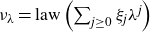 $\nu_\lambda=\text{law}\left(\sum_{j \geq 0} \xi_j \lambda^j\right)$ on $\mathbb{R}$, where $|\lambda| \lt 1$ and the $\xi_j \sim \nu$ are independent, identically distributed with respect to a measure $\nu$ finitely supported on $\mathbb{Z}$. One example of such a measure is a Bernoulli convolution. It is known that for certain combinations of algebraic $\lambda$ and $\nu$ uniform on an interval, $\nu_\lambda$ is absolutely continuous and its Fourier transform has power decay; in the proof, it is exploited that for these combinations, a quantity called the Garsia entropy $h_{\lambda}(\nu)$ is maximal.
In this paper, we show that the phenomenon of $h_{\lambda}(\nu)$ being maximal is equivalent to absolute continuity of a self-affine measure $\mu_\lambda$, which is naturally associated to $\lambda$ and projects onto $\nu_\lambda$. We also classify all combinations for which this phenomenon occurs: we find that if an algebraic $\lambda$ without a Galois conjugate of modulus exactly one has a $\nu$ such that $h_{\lambda}(\nu)$ is maximal, then all Galois conjugates of $\lambda$ must be smaller in modulus than one and $\nu$ must satisfy a certain finite set of linear equations in terms of $\lambda$. Lastly, we show that in this case, the measure $\mu_\lambda$ is not only absolutely continuous but also has power Fourier decay, which implies the same for $\nu_\lambda$.


Complex transition pathways in boiling and cavitation
-
- Journal:
- Journal of Fluid Mechanics / Volume 1019 / 25 September 2025
- Published online by Cambridge University Press:
- 23 September 2025, A53
-
- Article
-
- You have access
- Open access
- HTML
- Export citation

Turbulent dam-break waves of Newtonian and non-Newtonian fluids
-
- Journal:
- Journal of Fluid Mechanics / Volume 1019 / 25 September 2025
- Published online by Cambridge University Press:
- 23 September 2025, A58
-
- Article
-
- You have access
- Open access
- HTML
- Export citation
-
The paper uses three-dimensional large eddy simulation (LES) to investigate the structure and propagation of dam break waves of non-Newtonian fluids described by a power-law rheology. Simulations are also conducted for the limiting case of a dam-break wave of Newtonian fluid (water). Turbulent dam-break waves are found to have a two-layer structure and to generate velocity streaks beneath the region in which the flow is strongly turbulent and lobes at the front. The bottom part of the wave resembles a boundary layer and contains a log-law sublayer, while the streamwise velocity is close to constant inside the top layer. The value of the von Kármán constant is found to reach the standard value (i.e. $\kappa$ ≈ 0.4) associated with turbulent boundary layers of Newtonian fluids only inside the strongly turbulent region near the front of Newtonian dam-break waves. Much higher values of the slope of the log law are predicted for non-Newtonian dam-break waves (i.e. $\kappa$ ≈ 0.28) and in the regions of weak turbulence of Newtonian waves. LES shows that a power-law relationship can well describe the temporal evolution of the front position during the acceleration and deceleration phases, and that increasing the shear-thinning behaviour of the fluid increases the speed of the front. The numerical experiments are then used to investigate the predictive abilities of shallow water equation (SWE) models. The paper also proposes a novel one-dimensional (1-D) SWE model which accounts for the bottom friction by employing a friction coefficient regression valid for power-law fluids in the turbulent regime. An analytical approximate solution is provided by splitting the current into an outer region, where the flow is considered inviscid and friction is neglected, and an inner turbulent flow region, close to the wave front. The SWE numerical and analytical solutions using a turbulent friction factor are found to be in better agreement with LES compared with the agreement shown by an SWE numerical model using a laminar friction coefficient. The paper shows that inclusion of turbulence effects in SWE models used to predict high-Reynolds-number Newtonian and non-Newtonian dam break flows results is more accurate predictions.


A compressible Reynolds-averaged mixing model considering turbulent composition and heat fluxes
-
- Journal:
- Journal of Fluid Mechanics / Volume 1019 / 25 September 2025
- Published online by Cambridge University Press:
- 23 September 2025, A56
-
- Article
- Export citation
-
In typical nature and engineering scenarios, such as supernova explosion and inertial confinement fusion, mixing flows induced by hydrodynamic interfacial instabilities are essentially compressible. Despite their significance, accurate predictive tools for these compressible flows remain scarce. For engineering applications, the Reynolds-averaged Navier–Stokes (RANS) simulation stands out as the most practical approach due to its outstanding computational efficiency. However, existing RANS studies focus primarily on cases where the compressible effect plays an insignificant role in mixing development, with quite limited attention given to scenarios with significant compressibility influence. Moreover, most of the existing RANS mixing models demonstrate significantly inaccurate predictions for the latter. This study develops a novel compressible RANS mixing model by incorporating physical compressibility corrections into the $K$–
$K$– $L$–
$L$– $\gamma$ mixing transition model recently proposed by Xie et al. (J. Fluid Mech. 1002, 2025, A31). Specifically, taking the density-stratified Rayleigh–Taylor mixing flows as representative compressible cases, we first analyse the limitations of the existing model for compressible flows, based on high-fidelity data and local instability criteria. Subsequently, the equation of state for a perfect gas is employed to derive comprehensive compressibility corrections. The crucial turbulent composition and heat fluxes are integrated into the closure of the key turbulent mass flux term of the turbulent kinetic energy equation. These corrections enable the model to accurately depict compressible mixing flows. Systematic validations confirm the efficacy of the proposed modelling scheme. This study offers a promising strategy for modelling compressible mixing flows, paving the way for more accurate predictions in complex scenarios.


Quasi-continuous-wave diode-pumped microchip yellow-orange lasers with peak-power over 100-watt
-
- Journal:
- High Power Laser Science and Engineering / Accepted manuscript
- Published online by Cambridge University Press:
- 23 September 2025, pp. 1-29
-
- Article
-
- You have access
- Open access
- Export citation

Efficiency of turbulence
-
- Journal:
- Journal of Fluid Mechanics / Volume 1019 / 25 September 2025
- Published online by Cambridge University Press:
- 23 September 2025, A55
-
- Article
-
- You have access
- Open access
- HTML
- Export citation

Explicit theory of moving contact lines
- Part of
-
- Journal:
- Journal of Fluid Mechanics / Volume 1019 / 25 September 2025
- Published online by Cambridge University Press:
- 23 September 2025, A52
-
- Article
- Export citation

Autophoretic skating along permeable surfaces
-
- Journal:
- Journal of Fluid Mechanics / Volume 1019 / 25 September 2025
- Published online by Cambridge University Press:
- 23 September 2025, A57
-
- Article
-
- You have access
- Open access
- HTML
- Export citation

Analysis of flow-wall deformation coupling in high Reynolds number compliant wall boundary layers
-
- Journal:
- Journal of Fluid Mechanics / Volume 1019 / 25 September 2025
- Published online by Cambridge University Press:
- 23 September 2025, A54
-
- Article
-
- You have access
- Open access
- HTML
- Export citation
Thermodynamics and collisionality in firehose-susceptible high- $\beta$ plasmas
-
- Journal:
- Journal of Plasma Physics / Volume 91 / Issue 5 / October 2025
- Published online by Cambridge University Press:
- 23 September 2025, E136
-
- Article
-
- You have access
- Open access
- HTML
- Export citation
-
We study the evolution of collisionless plasmas that, due to their macroscopic evolution, are susceptible to the firehose instability, using both analytic theory and hybrid-kinetic particle-in-cell simulations. We establish that, depending on the relative magnitude of the plasma $\beta$, the characteristic time scale of macroscopic evolution and the ion-Larmor frequency, the saturation of the firehose instability in high- $\beta$ plasmas can result in three qualitatively distinct thermodynamic (and electromagnetic) states. By contrast with the previously identified ‘ultra-high-beta’ and ‘Alfvén-inhibiting’ states, the newly identified ‘Alfvén-enabling’ state, which is realised when the macroscopic evolution time $\tau$ exceeds the ion-Larmor frequency by a $\beta$-dependent critical parameter, can support linear Alfvén waves and Alfvénic turbulence because the magnetic tension associated with the plasma’s macroscopic magnetic field is never completely negated by anisotropic pressure forces. We characterise these states in detail, including their saturated magnetic-energy spectra. The effective collision operator associated with the firehose fluctuations is also described; we find it to be well approximated in the Alfvén-enabling state by a simple quasi-linear pitch-angle scattering operator. The box-averaged collision frequency is $\nu _{\textrm {eff}} \sim \beta /\tau$, in agreement with previous results, but certain subpopulations of particles scatter at a much larger (or smaller) rate depending on their velocity in the direction parallel to the magnetic field. Our findings are essential for understanding low-collisionality astrophysical plasmas including the solar wind, the intracluster medium of galaxy clusters and black hole accretion flows. We show that all three of these plasmas are in the Alfvén-enabling regime of firehose saturation and discuss the implications of this result.


