Refine search
Actions for selected content:
27943 results in Astrophysics
Frontmatter
-
- Book:
- Case Studies in Star Formation
- Published online:
- 11 April 2023
- Print publication:
- 13 April 2023, pp i-iv
-
- Chapter
- Export citation
13 - ATLASGAL PDRs
- from Part V - Photodissociation
-
- Book:
- Case Studies in Star Formation
- Published online:
- 11 April 2023
- Print publication:
- 13 April 2023, pp 205-215
-
- Chapter
- Export citation
2 - Two LMSFR Surveys Using IRAM and ALMA
- from Part II - Low-Mass Star Formation (LMSF)
-
- Book:
- Case Studies in Star Formation
- Published online:
- 11 April 2023
- Print publication:
- 13 April 2023, pp 27-45
-
- Chapter
- Export citation
List of Acronyms
-
- Book:
- Case Studies in Star Formation
- Published online:
- 11 April 2023
- Print publication:
- 13 April 2023, pp xv-xvi
-
- Chapter
- Export citation
Appendices
-
- Book:
- Case Studies in Star Formation
- Published online:
- 11 April 2023
- Print publication:
- 13 April 2023, pp 295-298
-
- Chapter
- Export citation
A monitoring campaign (2013–2020) of ESA’s Mars Express to study interplanetary plasma scintillation
-
- Journal:
- Publications of the Astronomical Society of Australia / Volume 40 / 2023
- Published online by Cambridge University Press:
- 12 April 2023, e013
-
- Article
-
- You have access
- Open access
- HTML
- Export citation
-
The radio signal transmitted by the Mars Express (MEX) spacecraft was observed regularly between the years 2013–2020 at X-band (8.42 GHz) using the European Very Long Baseline Interferometry (EVN) network and University of Tasmania’s telescopes. We present a method to describe the solar wind parameters by quantifying the effects of plasma on our radio signal. In doing so, we identify all the uncompensated effects on the radio signal and see which coronal processes drive them. From a technical standpoint, quantifying the effect of the plasma on the radio signal helps phase referencing for precision spacecraft tracking. The phase fluctuation of the signal was determined for Mars’ orbit for solar elongation angles from 0 to 180 deg. The calculated phase residuals allow determination of the phase power spectrum. The total electron content of the solar plasma along the line of sight is calculated by removing effects from mechanical and ionospheric noises. The spectral index was determined as $-2.43 \pm 0.11$ which is in agreement with Kolmogorov’s turbulence. The theoretical models are consistent with observations at lower solar elongations however at higher solar elongation ( $>$160 deg) we see the observed values to be higher. This can be caused when the uplink and downlink signals are positively correlated as a result of passing through identical plasma sheets.


CosmoDRAGoN simulations—I. Dynamics and observable signatures of radio jets in cosmological environments
-
- Journal:
- Publications of the Astronomical Society of Australia / Volume 40 / 2023
- Published online by Cambridge University Press:
- 12 April 2023, e014
-
- Article
-
- You have access
- Open access
- HTML
- Export citation
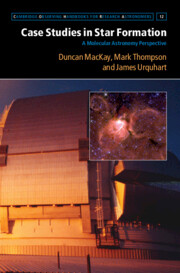
Case Studies in Star Formation
- A Molecular Astronomy Perspective
-
- Published online:
- 11 April 2023
- Print publication:
- 13 April 2023
The Hi in Ring Galaxies Survey (Hi-RINGS)—Effects of the bar on the Hi gas in ring galaxies
-
- Journal:
- Publications of the Astronomical Society of Australia / Volume 40 / 2023
- Published online by Cambridge University Press:
- 11 April 2023, e018
-
- Article
- Export citation
-
We present a new high-resolution neutral atomic hydrogen (Hi) survey of ring galaxies using the Australia Telescope Compact Array (ATCA). We target a sample of 24 ring galaxies from the Buta (1995) Southern Ring Galaxy Survey Catalogue in order to study the origin of resonance-, collisional- and interaction-driven ring galaxies. In this work, we present an overview of the sample and study their global and resolved Hi properties. In addition, we also probe their star formation properties by measuring their star formation rates (SFR) and their resolved SFR surface density profiles. We find that a majority of the barred galaxies in our sample are Hi-deficient, alluding to the effects of the bar in driving their Hi deficiency. Furthermore, for the secularly evolving barred ring galaxies in our sample, we apply Lindblad’s resonance theory to predict the location of the resonance rings and find very good agreement between predictions and observations. We identify rings of Hi gas and/or star formation co-located at one or the other major resonances. Lastly, we measure the bar pattern speed ( $\Omega_{\textrm{bar}}$) for a sub-sample of our galaxies and find that the values range from 10–90 $\textrm{km s}^{-1}$kpc $^{-1}$, in good agreement with previous studies.


The Southern-sky MWA Rapid Two-metre (SMART) pulsar survey—II. Survey status, pulsar census, and first pulsar discoveries
-
- Journal:
- Publications of the Astronomical Society of Australia / Volume 40 / 2023
- Published online by Cambridge University Press:
- 11 April 2023, e020
-
- Article
-
- You have access
- Open access
- HTML
- Export citation
-
In Paper I, we presented an overview of the Southern-sky MWA Rapid Two-metre (SMART) survey, including the survey design and search pipeline. While the combination of MWA’s large field-of-view and the voltage capture system brings a survey speed of ${\sim} 450\, {\textrm{deg}}^{2}\,\textrm{h}^{-1}$, the progression of the survey relies on the availability of compact configuration of the Phase II array. Over the past few years, by taking advantage of multiple windows of opportunity when the compact configuration was available, we have advanced the survey to 75% of the planned sky coverage. To date, about 10% of the data collected thus far have been processed for a first-pass search, where 10 min of observation is processed for dispersion measures out to 250 ${\textrm{pc cm}}^{-3}$, to realise a shallow survey that is largely sensitive to long-period pulsars. The ongoing analysis has led to two new pulsar discoveries, as well as an independent discovery and a rediscovery of a previously incorrectly characterised pulsar, all from ${\sim} 3\% $ of the data for which candidate scrutiny is completed. In this sequel to Paper I, we describe the strategies for further detailed follow-up including improved sky localisation and convergence to timing solution, and illustrate them using example pulsar discoveries. The processing has also led to re-detection of 120 pulsars in the SMART observing band, bringing the total number of pulsars detected to date with the MWA to 180, and these are used to assess the search sensitivity of current processing pipelines. The planned second-pass (deep survey) processing is expected to yield a three-fold increase in sensitivity for long-period pulsars, and a substantial improvement to millisecond pulsars by adopting optimal de-dispersion plans. The SMART survey will complement the highly successful Parkes High Time Resolution Universe survey at 1.2–1.5 GHz, and inform future large survey efforts such as those planned with the low-frequency Square Kilometre Array (SKA-Low).


9 - Ex-Stars
-
- Book:
- Stellar Structure and Evolution
- Published online:
- 02 May 2023
- Print publication:
- 06 April 2023, pp 209-230
-
- Chapter
- Export citation
2 - Tensors
-
- Book:
- A General Relativity Coursebook
- Published online:
- 03 May 2023
- Print publication:
- 06 April 2023, pp 19-42
-
- Chapter
- Export citation
4 - Stellar Energy Transport
-
- Book:
- Stellar Structure and Evolution
- Published online:
- 02 May 2023
- Print publication:
- 06 April 2023, pp 64-88
-
- Chapter
- Export citation
9 - A Guide to Further Reading
-
- Book:
- A General Relativity Coursebook
- Published online:
- 03 May 2023
- Print publication:
- 06 April 2023, pp 179-191
-
- Chapter
- Export citation
Reviews
-
- Book:
- A General Relativity Coursebook
- Published online:
- 03 May 2023
- Print publication:
- 06 April 2023, pp ii-ii
-
- Chapter
- Export citation
3 - Matter in Space-Time
-
- Book:
- A General Relativity Coursebook
- Published online:
- 03 May 2023
- Print publication:
- 06 April 2023, pp 43-52
-
- Chapter
- Export citation
Further Reading, Bibliography, and Figure Credits
-
- Book:
- Stellar Structure and Evolution
- Published online:
- 02 May 2023
- Print publication:
- 06 April 2023, pp 309-319
-
- Chapter
- Export citation
Index
-
- Book:
- A General Relativity Coursebook
- Published online:
- 03 May 2023
- Print publication:
- 06 April 2023, pp 195-197
-
- Chapter
- Export citation
Contents
-
- Book:
- Stellar Structure and Evolution
- Published online:
- 02 May 2023
- Print publication:
- 06 April 2023, pp vii-x
-
- Chapter
- Export citation
8 - Gravitational Waves
-
- Book:
- A General Relativity Coursebook
- Published online:
- 03 May 2023
- Print publication:
- 06 April 2023, pp 151-178
-
- Chapter
- Export citation
