Refine search
Actions for selected content:
3659 results in Opera
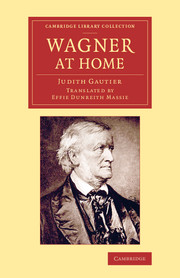
Wagner at Home
-
- Published online:
- 05 June 2015
- Print publication:
- 13 November 2014
- First published in:
- 1910
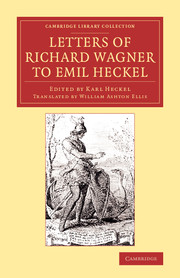
Letters of Richard Wagner to Emil Heckel
- With a Brief History of the Bayreuth Festivals
-
- Published online:
- 05 June 2015
- Print publication:
- 13 November 2014
- First published in:
- 1899
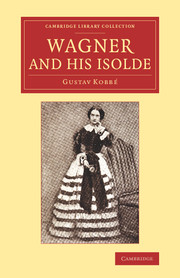
Wagner and his Isolde
-
- Published online:
- 05 June 2015
- Print publication:
- 13 November 2014
- First published in:
- 1905
Preface
-
- Book:
- Understanding the Leitmotif
- Published online:
- 05 June 2015
- Print publication:
- 14 May 2015, pp xviii-xxii
-
- Chapter
- Export citation
9 - The modern-day leitmotif: associative themes in contemporary film music
- from Part III - Leitmotifs in context
-
- Book:
- Understanding the Leitmotif
- Published online:
- 05 June 2015
- Print publication:
- 14 May 2015, pp 255-300
-
- Chapter
- Export citation
Part III - Leitmotifs in context
-
- Book:
- Understanding the Leitmotif
- Published online:
- 05 June 2015
- Print publication:
- 14 May 2015, pp 157-300
-
- Chapter
- Export citation
Part I - Musical themes
-
- Book:
- Understanding the Leitmotif
- Published online:
- 05 June 2015
- Print publication:
- 14 May 2015, pp 31-76
-
- Chapter
- Export citation
Contents
-
- Book:
- Understanding the Leitmotif
- Published online:
- 05 June 2015
- Print publication:
- 14 May 2015, pp vii-vii
-
- Chapter
- Export citation
7 - The paradigm of Wagner's Ring
- from Part III - Leitmotifs in context
-
- Book:
- Understanding the Leitmotif
- Published online:
- 05 June 2015
- Print publication:
- 14 May 2015, pp 159-212
-
- Chapter
- Export citation
Copyright page
-
- Book:
- Understanding the Leitmotif
- Published online:
- 05 June 2015
- Print publication:
- 14 May 2015, pp iv-iv
-
- Chapter
- Export citation
Index
-
- Book:
- Understanding the Leitmotif
- Published online:
- 05 June 2015
- Print publication:
- 14 May 2015, pp 322-332
-
- Chapter
- Export citation
2 - Motive, phrase, melody, and theme
- from Part I - Musical themes
-
- Book:
- Understanding the Leitmotif
- Published online:
- 05 June 2015
- Print publication:
- 14 May 2015, pp 33-55
-
- Chapter
- Export citation
Contents
-
- Book:
- Understanding the Leitmotif
- Published online:
- 05 June 2015
- Print publication:
- 14 May 2015, pp viii-xvi
-
- Chapter
- Export citation
Bibliography
-
- Book:
- Understanding the Leitmotif
- Published online:
- 05 June 2015
- Print publication:
- 14 May 2015, pp 301-321
-
- Chapter
- Export citation
Contents
-
- Book:
- Understanding the Leitmotif
- Published online:
- 05 June 2015
- Print publication:
- 14 May 2015, pp xvii-xvii
-
- Chapter
- Export citation
4 - The phenomenon of musical association
- from Part II - Musical association
-
- Book:
- Understanding the Leitmotif
- Published online:
- 05 June 2015
- Print publication:
- 14 May 2015, pp 79-108
-
- Chapter
- Export citation
6 - From Nibelheim to Hollywood: the associativity of harmonic progression
- from Part II - Musical association
-
- Book:
- Understanding the Leitmotif
- Published online:
- 05 June 2015
- Print publication:
- 14 May 2015, pp 131-156
-
- Chapter
- Export citation
3 - Thematic development, thematic identity: musical themes and the prototype model
- from Part I - Musical themes
-
- Book:
- Understanding the Leitmotif
- Published online:
- 05 June 2015
- Print publication:
- 14 May 2015, pp 56-76
-
- Chapter
- Export citation
Dedication
-
- Book:
- Understanding the Leitmotif
- Published online:
- 05 June 2015
- Print publication:
- 14 May 2015, pp v-vi
-
- Chapter
- Export citation
5 - Piece specifics, cultural generics, and associative layering
- from Part II - Musical association
-
- Book:
- Understanding the Leitmotif
- Published online:
- 05 June 2015
- Print publication:
- 14 May 2015, pp 109-130
-
- Chapter
- Export citation
