To save content items to your account,
please confirm that you agree to abide by our usage policies.
If this is the first time you use this feature, you will be asked to authorise Cambridge Core to connect with your account.
Find out more about saving content to .
To save content items to your Kindle, first ensure no-reply@cambridge.org
is added to your Approved Personal Document E-mail List under your Personal Document Settings
on the Manage Your Content and Devices page of your Amazon account. Then enter the ‘name’ part
of your Kindle email address below.
Find out more about saving to your Kindle.
Note you can select to save to either the @free.kindle.com or @kindle.com variations.
‘@free.kindle.com’ emails are free but can only be saved to your device when it is connected to wi-fi.
‘@kindle.com’ emails can be delivered even when you are not connected to wi-fi, but note that service fees apply.
Research on rap music in Germany has focused on questions of transnationalism, ethnicity and gender. This chapter advances studies of German rap through an analysis of the rap song and music video “Ich bin Schwarz” (I am Black, 2016) by the popular female rap duo SXTN. Drawing on intersectional, feminist, and hip-hop studies scholarship, we conduct a close reading of the visuals, lyrics, and signifying practices that are mediated in the cultural text. We argue that “Ich bin Schwarz” promotes a new version of a self-empowered, humorous, and unapologetic Black female German identity by remixing the popular German music genre Neue Deutsche Welle (New German Wave), subverting racist and sexist imaginations of Afrodiasporic womanhood, and continuing hip-hop’s political legacy against right-wing extremism in Germany. Ultimately, “Ich bin Schwarz” contributes to a growing body of performances in rap music and larger popular culture that destabilise white-dominated notions of German national identity.
Drill YouTube music videos are contradictory – nihilistic and collective, empty and humanizing, negatively assessing marginalization and societal nihilism, performing those scripts as a placebo for pain and humiliation, and also shaping popular culture in that image. This chapter explores drill YouTube music videos as cultural form, for what they tell us about the historical transformation of black diasporic sound culture, contemporary popular culture and its alternative cultural politics. Through an analysis of drill music videos, it identifies a shift away from sound culture towards video-music, and therein a shift to the networked and platformed moving image, and to narrative. This requires a reevaluation of the role of sound in alternative cultural politics and in black diasporic popular culture, and asks that drill video-music be evaluated on its contingent cultural terms, not on the terms of other cultural and musical moments.
Rap music is stereotypically perceived, discussed and policed as the soundtrack to “Black criminality”. Blamed for glamourising, glorifying and even causing violence in major cities around the world, rap is usually approached as the source rather than the target of violence. Writing against legal penal logics that obscure how rappers are victimised by the police, prosecutors and judges, this chapter offers an overview of how rap music is criminalised. UK drill music takes centre stage here, as the most recent rap subgenre to bear the brunt of such criminalisation, showing how “race”, crime and Black expressive culture(s) are interpreted as a public safety threat. The chapter argues that rap music tells us more about how and why it is racially criminalised, and encourages a more critical take on this issue than law-and-order rhetoric and politics allow.
Writings on hip hop education from hip-hop’s golden age onwards have often concerned themselves with the relationship between educational institutions, pedagogic practices and spaces and the vernacular identities and multicultural literacies of their disadvantaged students. This parallels and is related to the contentious educational debates that erupted during the so-called US culture wars of the 1990s concerning race, cultural identity, relevance and value. Accordingly, the chapter argues that a chief source of hip-hop education’s legitimacy derives from an abiding insistence amongst its practitioners and advocates that the more ostensibly “positive” and “conscious” examples of rap, in keeping with the black cultural continuum, express hip-hop’s inherent didacticism. I describe and examine these issues and their methodological and pedagogic claims – past and present – against a backdrop of moral panic that has long dogged rap music but also supplied it with critical impetus. The final section of the chapter offers a case-study of a recent British hip-hop education programme that seeks to make use of UK drill music to develop the capacities of educationally disaffected school-age young people.
Grime music emerged at the turn of the millennium in the United Kingdom. Performed by MCs and DJs, it is a vital and vibrant form with unrelenting energy. This chapter focuses on live collective performance in grime music. In particular, it explores the spaces where grime is performed, paying attention to the specificity of these contexts, and their impact on group practice. It is split into three sections. Firstly, it positions grime as genre, demonstrating how antecedent forms—principally hip-hop and Jamaican dancehall—inform its collaborative, yet competitive nature. Secondly, it will offer an overview of these key arenas (radio, raves, record shops), unpacking how grime thrived within a “Black Public sphere” outside of heavy censorship and racialised policing of mainstream public fora. Finally, it will focus on a performance that captures grime’s improvisatory framework. Taken from 2007, this acclaimed “Birthday Set” for East London MC Ghetts possesses many hallmarks of grime performance. The analysis addresses competitiveness within MCs, intergeneric allusions (lyrical or otherwise), and the DJ’s technical cachet. This chapter therefore demonstrates dense interconnectivity within grime’s contexts for performance, offering insight into the ways in which the live domain acts as the pivotal ground for new creative work.
This chapter explores the rap debates of philosophical aesthetics, where early academic discourse on rap was at its most active. Rap aestheticians (led by Richard Shusterman) accentuated rap’s nature as an “art form”. The chapter examines the key issues within this debate, including the aesthetic experience of rap, flow (Mtume ya Salaam), the need for public support (and Herbert Grabes’ criticism of this position), and rap’s affinities with the Harlem Renaissance (Marvin Gladney). Rap’s engagement with other cultural practices, like driving and everyday culture, was discussed very early within philosophical aesthetics. Right from the beginning the debate was very international, with many of the authors coming from the Nordic Countries (Esa Sironen, Stefán Snaevarr, Martti Honkanen). It argues that there is still a lot to learn from aesthetic discussions on rap, and these philosophical debates are an interesting historical phenomenon, which rap scholars should know more about.
This chapter focuses on the drill music genre, a subgenre of gangsta rap that was born in Chicago’s underground hip hop scene in the early 2010s. Using observation and interviews with drill artists, their managers and other support workers, it discusses the relational practices of hip-hop youth on social media. The chapter examines their work on social media toward acquiring “clout”– a digital form of influence described by emerging musicians as allowing them to leverage digital tools in building social and professional status, amplify authenticity, cultivate relations with fans, and connect to friends and other cultural producers. It analyses the practice of “capping” (strategic deception, exaggeration of toughness, desirability to women and financial wealth) as a relational strategy that respondents utilized to acquire clout. The chapter argues that capping is an example of how race, class, gender and geography influence the digital interactions of young people and how the social media practices of drill rappers add significantly to the understanding of the counterpublics arising from globalising social media.
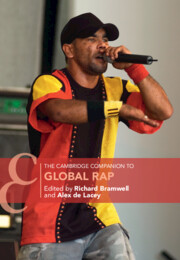
Rap has remapped the way we think about music. For more than fifty years its poetics, performance and political power has resonated across the globe. This Companion offers an array of perspectives on the form, from the fields of sociology, linguistics, musicology, psychology, literary studies, education and law, unpacking how this versatile form of oral communication has permeated nearly every aspect of daily life. Taking a decidedly global perspective, these accounts draw from practice in Australia, China, France, Germany, Jamaica, India and Tanzania; exploring how the form has taken hold in particular contexts, and what this can tell us about the medium itself and the environments in which it was repurposed. An indispensable resource for students and researchers, the collection provides an introduction to global rap studies as well as insights into the some of the most important and exciting new developments in this field.
In the nineteenth century Western art music advanced towards a peak of sonorous magnificence, perhaps reached in 1848 at Paris when Hector Berlioz conducted an ensemble of 1,022 performers. The guitar, however, continued to sound at the level of a small continuo group for an Italian opera of the 1640s. During the 1800s the guitar’s reputation was deeply affected, often for the better, by its evocation of past sonorities that the ear was prepared to relinquish but the historical imagination could not bear entirely to forgo. Various attempts were nonetheless made to strengthen the sound by external and internal changes, some of them well received in their day, but no increase in the size or depth of the guitar’s body, no change in the pattern of the internal bracing and no addition of extra strings fundamentally enlarged its scope. Not suited to the new concert halls in which provincial towns and cities invested much of their civic pride, the guitar fared no better amidst the din of the music halls either, according to the guitarist and vaudeville comedian Ernest Shand (1868–1924). The editor of Shand’s compositions finds that ‘interest in the instrument was all but gone’ by the 1890s when Shand was unable to make a living from his composing, playing and teaching.
Catharina Pratten was the only exponent of the guitar to make a lifelong career from the instrument in Britain. A living link with the ‘Great Vogue’ for the guitar of the 1830s, she composed companionable solo pieces designed for the amateur, arranged songs, published methods, and taught a wide range of pupils, including some form the aristocracy, during almost the entire Victorian period. The considerable revival of interest in Madame Pratten during recent years, however, is in danger once more of the underestimating the importance of accompanied song to the Victorian fortunes of the guitar. About half of her many publications comprise guitar-accompanied vocal music including settings of nursery rhymes, opera favourites and English ballads. Although this was not the part of her legacy most valued by the coterie of advanced pupils she left behind, it undoubtedly inspired many who sought the services of this unique female musical entrepreneur.