To save content items to your account,
please confirm that you agree to abide by our usage policies.
If this is the first time you use this feature, you will be asked to authorise Cambridge Core to connect with your account.
Find out more about saving content to .
To save content items to your Kindle, first ensure no-reply@cambridge.org
is added to your Approved Personal Document E-mail List under your Personal Document Settings
on the Manage Your Content and Devices page of your Amazon account. Then enter the ‘name’ part
of your Kindle email address below.
Find out more about saving to your Kindle.
Note you can select to save to either the @free.kindle.com or @kindle.com variations.
‘@free.kindle.com’ emails are free but can only be saved to your device when it is connected to wi-fi.
‘@kindle.com’ emails can be delivered even when you are not connected to wi-fi, but note that service fees apply.
In the final chapter Alyn Shipton considers the free jazz innovations of Ornette Coleman. Spiralling out from an interview with Coleman in Paris, he explores the wider universe of this music including 'Free Jazz', Prime Time and the later quartets. Later musical colleagues including Geri Allen, Wallace Roney and Charnett Moffett explore his continuing innovations and Howard Shore gives an insight into the making of the soundtrack to the movie Naked Lunch. Theorists George Russell and Gunther Schuller contribute their views on this maverick improviser.
This chapter explores the world of Count Basie, starting in the early days with Buddy Tate and Sweets Edison, looking at the mid-period octet with Clark Terry and Buddy Rich, and continuing to the 'New Testament' band. Shipton's interviews cover many Basie alumni, including Al Grey, Bennie Powell and Grover Mitchell from the trombone section, Joe Wilder from the trumpets, and Butch Miles and Louie Bellson from the rhythm team. Singer Carmen Bradford tells the story of how she joined the band, and the experience of singing with Basie.
This is the first of three chapters focusing on swing big bands. Armstrong's career is traced from the 1920s in Chicago when Doc Cheatham subbed for him, through to his work with the All Stars. Cheatham gives a vivid picture of Louis in 1920s Chicago and Lawrence Lucie recalls his 1940s big band, including film appearances with singer Velma Middleton. Arvell Shaw recalls how he joined the big band, but follows this through to the All Stars. There are memories of Sidney Bechet in Boston, and musicians such as Roy Haynes, Kenny Clarke and Dexter Gordon working with Louis. The chapter then moves on to singer Jewekl Brown who compares her experiences to her predecessor Velma Middleton, who died on tour in Africa. Barney Bigard, whose autobiography Shipton published, gives his caustic views on Velma's tragic death.
Charlie Parker is the focus of this account of Dizzy Gillespie's band in California in 1945-6. Shipton talks to survivors of the sextet – Milt Jackson, Sten Levey and Ray Brown, as well as those who heard the band there such as Clora Bryant, Teddy Edwards and Roy Porter. He traces the development of bebop back to New York, discussing this music with pianist Sir Charles Thompson, a lifelong friend of Buck Clayton who brought Buck, Parker and Dexter Gordon together for a record in 1945. Bassist Jimmy Woode recalls working with Parker in Boston, and Teddy Edwards brings the Los Angeles scene to life.
Oscar Peterson looks back at his career from early days in Montreal to the international touring of his trio (and later his quartet). Shipton talks in detail to Peterson, whose autobiography he published, but also to key memnbers of his trios, including Ray Brown, Ed Thigpen and Niels-Henning Ørsted Pedersen. The chapter discuses how the band featured on Jazz at the Philharmonic concerts and also how it worked in the studio for Norman Granz, including sessions with Ella Fitzgerald.
The chapter reflects on the birth of jazz-rock fusion, looking at both sides of the Atlantic. In the UK Graham Bond employs Jack Bruce, Ginger Baker and John McLaughlin. Ian Carr's Nucleus creates a new blend of free jazz and rock rhythms and Jon Hiseman explores simllar territory with Colosseum. The chapter explores the creation of Tony Williams' Lifetime, and goes on to look at Mahavishnu and Billy Cobham's various bands. Miles' and Williams' band members add their reminiscences.
Jackie McLean and Sonny Rollins take the same starting point of the early 1950s Miles Davis band, but then follow their stories through independently. Jackie talks of Richie Powell and the Cilfford Brown / Max Roach Band in which Sonny later played. Sonny reflects on a myriad of different ideas, from Elmo Hope and Ernie Henry to Pete LaRoca and Henry Grimes, looking in detail at his trios. Considering social protest, Sonny leads in to discussions with Abbey Lincoln about the era of We Insist! Freedom Now. Rollins then follows his career path through to the 2000s.
A conversation with Dr John (Mac Rebennack) sets the scene for surveying a cross-section of New Orleans music in the years just prior to Hurrcane Katrina and the irrevocable changes it wrought on the city and its music. On his album Nawlins, Dr John inolved many of the musicians who crossed boundaries between jazz, blues and funk. As well as drummers Smokey Johnson and Herman Ernest III, the discussion covers such pianists as Dave Williams, Cousin Joe and Eddie Bo. It then moves on to consider the Mardi Gras Indians, their marching traditions, and their songs. Shipton describes meeting and working with Danny Barker who did much to preserve this music, and then presents a brief survey of its development.
This chapter mainly focuses on the life and work of Blue Lu Barker, wife of Danny Barker, who was a major blues and jazz singer in the 1930s and 1940s, who continued her career in New Orleans into the 1970s. Starting out as a singer and dancer, she came to New York as a teenager, chaperoned by the legendary clarinettist Lorenzo Tio Jr. She cut her first discs for Decca, including an all-star cast with such musicians as Benny Carter and Henry Allen. The Texan pianist Sammy Price also played on her records. She gives an insider's view of living with 'Show people' in New York, including the drummer Paul Barbarin, who later worked on her records after she signed to Capitol. She discusses making records in New York, Los Angeles and New Orleans. Her career is compared to that of the contemporary singer Topsy Chapman, who started out singing gospel but starred in the show One Mo Time. Chapman discusses the imprtance of festivals in a singer's career.
This is the beginning of Alyn Shipton's personal journey, starting with building a record collection in his schooldays, covering Fats Waller, Muggsy Spanier, and Artie Shaw. He hears the Ken Colyer band at 16, having already started playing the bass with various bands in Surrey and Hampshire. He cheekily invites Colyer to guest with his group, and ends up joining Colyer's band (with whom he records). He combines research into Colyer and such associates as the singer Rosina Scudder, with a widening appreciation of jazz. On the one hand, he plays with and gets to know Mike Westbrook and Lol Coxhill. On the other, he becomes lifelong friends with reseracher and trumpeter John Chilton and critic and singer George Melly. He plays in London with Mike Casimir's band first meeting such Americans as Kid Thomas and Alvin Alcorn.
Through Danny Barker, Shipton is introduced to trumpeter Buck Clayton, beginning a friendship that ultimately leads to Shipton inheriting some of Clayton's music and forming a band in his memory. But Clayton prompts Shipton into writing and researching a book about Fats Waller. Shipton meets as many Waller band survivors as possible, including guitarist Al Casey (with whom he tours in the UK), trumpeters Jabbo Smith and Bill Coleman, saxophonist Franz Jackson, and significantly, drummer Harry Dial. This chapter gives background to Shipton's book on Waller, and brings alive the era of 1930s New York and of swing bands on the road.
After Gillespie's return fron California, the big band he formed had a rhythm section of John Lewis, Ray Brown, Milt Jackson and Kenny Clarke. This chapter explores how that quartet became the MJQ and developed into one of the most influential jazz groups of the 1950s to the 1980s. Shipton discusses basses with Percy Heath and the difficulties of playing both piano and vibes with Milt Jackson.
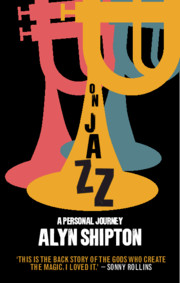
Few musical genres inspire the passionate devotion of jazz. Its mystique goes far beyond the melodies and rhythms, with its key players and singers discussed by aficionados with a respect that borders on reverence. Some books on jazz offer little more than theory or dry facts, thereby relinquishing the 'essence' of the music. This book is different. One of the most influential and internationally known writers on the subject describes, through vivid personal contacts, reminiscences and zesty anecdotes, his life in jazz as a player, broadcaster and observer. Alyn Shipton recalls friendships with legendary musicians, while revealing fresh discoveries about such luminaries as Fats Waller, Louis Armstrong, Count Basie, Duke Ellington, Charlie Parker, Abbey Lincoln and Geri Allen. On Jazz powerfully evokes the atmosphere of clubs and dancehalls, and takes us behind the scenes and up onto the stage, so that this electrifying world is unforgettably spotlighted as never before.
The first hip-hop recordings arrived in Dar es Salaam in the mid-1980s when films like Wild Style and Breakin’, which featured early hip-hop recordings in their soundtracks, were being shown in the city. High import duties ensured that hip-hop recordings were scarce and principally available to wealthier Tanzanians, who consequently formed many of the early rap groups. Following the liberalization of the media in the early 1990s, there has been a proliferation of new musical genres collectively defined as muziki wa kizazi kipya (music of the new generation). This loose set of genres such as hip-hop, bongo flava, R’n’B, reggae, and zouk are mostly associated with youth. The new generation that performs these genres entered adulthood during structural adjustment reforms and is marked by their appropriation of style, form, and fashion from the transnational circulation of popular musical forms.
As these genres have become popular, rapping has become a widespread cultural practice among young people. It has produced musical stars as well as unrecorded maandagraundi (or underground) rappers. The most popular rappers have become not only national or regional stars but also continent-wide celebrities regularly performing on TV channels such as Channel O and MTV Africa and at TV spectacles such as the Big Brother Africa. By contrast, underground rappers define themselves through their exclusion from these transnational circuits of commercial musical production, distribution, and dissemination. Central to the practice of underground rapping are unplanned settlements commonly referred to as uswahilini, which provide space for underground rapping practice and performance. Informal spaces of sociality referred to as maskani (dwelling or abode) or kijiweni (little stone) act as the primary informal performance spaces for aspiring underground rappers. The young men who spend time at maskani in uswahilini are largely underemployed (popularly referred to as daywaka) or engaged in mishe-mishe (looking for money).
In this chapter I will argue that underground rapping provides a space for young people in Tanzania to engage with the world conceptually, philosophically, and discursively. Underground rappers draw on both the transnational signs and symbols of hip-hop as well as local creative, political, and imaginative discourses to empower themselves as social actors.