To save content items to your account,
please confirm that you agree to abide by our usage policies.
If this is the first time you use this feature, you will be asked to authorise Cambridge Core to connect with your account.
Find out more about saving content to .
To save content items to your Kindle, first ensure no-reply@cambridge.org
is added to your Approved Personal Document E-mail List under your Personal Document Settings
on the Manage Your Content and Devices page of your Amazon account. Then enter the ‘name’ part
of your Kindle email address below.
Find out more about saving to your Kindle.
Note you can select to save to either the @free.kindle.com or @kindle.com variations.
‘@free.kindle.com’ emails are free but can only be saved to your device when it is connected to wi-fi.
‘@kindle.com’ emails can be delivered even when you are not connected to wi-fi, but note that service fees apply.
Upper extremity (UE) trauma is a common finding in patients presenting to the Emergency Department (ED), found in 31.6% of patients reported to the National Trauma Data Base,1 and occurring with an estimated incidence of 1,130 upper extremity injuries per 100,000 persons per year.2
Thoracolumbar trauma involves a spectrum of injuries, from stable and unstable bony injury to spinal cord compression and spinal cord lesions. Thoracolumbar trauma most often results from motor vehicle collisions; however, falls and violent crimes also constitute a modest proportion. The general population experiences up to 64 cases of thoracolumbar injury per 100,000 people, though only a minor portion of these injuries lead to serious neurological deficit.1
According to the United States Eye Injury Registry, eye injury is the leading cause of monocular blindness, and there are approximately 2.4 million eye injuries occurring annually in the US, resulting in 500,000 years of lost eyesight annually.1 These injuries occur more often in males (>70%), and 95% of occupational injuries occur in males.2,3 This chapter will describe the approach to the patient with eye trauma in the emergency department (ED), including how to perform a detailed history and physical examination related to eye injuries, as well as covering the traumatic presentations in Table 9.1.
Trauma is the fourth leading cause of death overall in the United States and the number one cause of death for ages 1 to 44 – second only to heart disease and cancer in those older than 45 (CDC).1 As the disease burden from infectious diseases declines and secondary prevention of chronic conditions improves, the relative importance of the practice of trauma care becomes even more apparent. Though safety engineering has improved across many industries (one need only consider examples such as crosswalk and bike lane planning, football helmet technology, and motor vehicle computerized improvements), trauma remains a significant threat to life and limb in emergency medicine.
Injury to the neck can have significant consequences. Given the number of vital structures confined to a relatively small space, it is not surprising that trauma to the neck accounts for some of the highest rates of mortality in trauma patients.1 The three categories of neck trauma include blunt, penetrating, and strangulation or hanging, each with different associated injuries.
The genitourinary (GU) system includes the kidneys, ureters, bladder, urethra, penis, scrotum, and female genitalia. Of the 27.7 million patients per year presenting to emergency departments (ED) for traumatic injury, about 10% of these traumas primarily involve the GU system, and another 10–15% of patients with abdominal trauma will have GU injuries as well.1 GU trauma patients are predominantly young (80% less than the age of 45 years) and male (85% of all patients).2 Delays or missed diagnosis of GU trauma can result in increased morbidity and mortality due to preventable complications with long term consequences.3
While elderly patients comprise a small percentage of total major trauma patients (8–12%), they represent a disproportionate percentage of trauma mortalities and costs (15–30%, Figures 6.1 and 6.2).
Trauma evaluation and management often focuses on protocols, especially in adults. In children, however, special considerations are made based on epidemiology, physiology, and mechanisms of injury on the location affected.
The terms “missed injury” and “delayed diagnosis” have undergone evolution in their academic meaning over the last several decades of trauma care. Missed injury is typically reserved for an unidentified injury for which the opportune moment for intervention has passed. A delayed diagnosis is the term given to injuries not identified on the primary or secondary survey of the initial trauma evaluation. There is obvious overlap in the ways these terms are employed throughout trauma care, and specific institutions may possess their own interpretations. Many emergency medicine texts list a missed injury as one that is discovered after the patient has left the Emergency Department (ED), whether discharged home or admitted. This version of the “missed injury definition” would include possible injuries which were suspected in the ED (not truly “missed”), though not officially found due to appropriate delays in imaging while more acute issues are being resolved in the operating room (OR) or Intensive Care Unit (ICU). The national trauma database of the American College of Surgeons defines missed injury as an “injury-related diagnosis discovered after initial workup is completed and admission diagnosis is determined.”1 Delayed diagnosis was proposed to describe diagnoses that were not found on primary and secondary survey. The tertiary survey was intended to identify many of these injuries,2 though some literature still defines injuries found during the tertiary survey as “delayed.”3,4 In any case, the use of a tertiary survey should be employed in all trauma evaluations, as it leads to a reduction in clinically significant initially unidentified injuries.5 Trauma surgery has also created leveling algorithms based on the mechanism of injury to help activate appropriate resources for trauma patients. Finally, multiple evidence-based decision tools (i.e. Ottawa knee rules, Canadian head computed tomography rules, etc.) exist to help delineate imaging decisions.
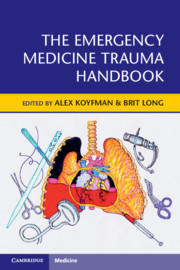
Trauma is a leading cause of death and disability around the world, and the leading cause of death in those aged under forty-five years. Conditions such as airway obstruction, hemorrhage, pneumothorax, tamponade, bowel rupture, vascular injury, and pelvic fracture can cause death if not appropriately diagnosed and managed. This essential book provides emergency physicians with an easy-to-use reference and source for traumatic injury evaluation and management in the emergency department. It covers approaches to common, life-threatening, and traumatic diseases in the emergency department, for use on shift and as a reference for further learning. Each chapter includes a succinct overview of common traumatic injuries, with evaluation and management pearls and pitfalls. Highly illustrated with images from one of the busiest trauma centers in the US, and featuring expert contributions from a diverse set of attending physicians, this is an essential text for all emergency medicine practitioners.
Leading and Managing Health Services: An Australasian Perspective provides a comprehensive overview of leadership and management in health services with a particular focus on the Australasian context. This text aims to help students develop leadership and management skills, and to critically analyse the issues they will face in practical health service settings. The book features a contemporary approach to learning, in line with the Health LEADS Australia framework which focuses on five key leadership attributes: Leads self, Engages systems, Achieves outcomes, Drives innovations and Shapes systems. Further, it offers a rich pedagogy both in the text and companion website. Chapters include case studies to provide examples of management and leadership issues in healthcare settings, and a wealth of reflective, short answer and multiple-choice questions to extend student learning. Written by respected Australian academics and industry experts, this text will equip health professional students with practical skills to successfully manage change and innovation.
Public Health: Local and Global Perspectives provides students with a comprehensive overview of Australian and international public health issues and contexts. It introduces the discipline of public health and aims to deepen students' understanding of the determinants of health, historical and theoretical perspectives of public health, current health research and evidence-based practice. This fully revised and expanded edition includes new chapters on ethics in public health, planning and evaluation, individual behavioural change, gender-based health inequalities and public health approaches to drug use. Each chapter features a strong pedagogical foundation, including learning objectives, key terms, illustrative case studies, tutorial exercises, further reading and comprehensive summaries that equip students with a deeper understanding of key concepts. Written by an accomplished author team led by Pranee Liamputtong, Public Health remains an essential learning resource.
Chronic conditions have a substantial impact on life and health care. Health systems need to adapt to address these shifting health priorities, while nurses require specialised skills to implement changes and create better client outcomes. Chronic Care Nursing: A Framework for Practice provides a comprehensive and accessible overview of the role of the nurse in managing chronic conditions across a variety of settings in Australia and New Zealand. The first part of the book outlines two essential approaches to chronic care management - the Chronic Care Model and the World Health Organization's Innovative Care for Chronic Conditions Framework - while the second part covers key conditions within chronic care nursing. The second edition has been fully updated to include the latest research, and features new chapters covering self-management and empowerment; living with mental health issues; chronic bowel conditions; and eye, ear and dental health.