To save content items to your account,
please confirm that you agree to abide by our usage policies.
If this is the first time you use this feature, you will be asked to authorise Cambridge Core to connect with your account.
Find out more about saving content to .
To save content items to your Kindle, first ensure no-reply@cambridge.org
is added to your Approved Personal Document E-mail List under your Personal Document Settings
on the Manage Your Content and Devices page of your Amazon account. Then enter the ‘name’ part
of your Kindle email address below.
Find out more about saving to your Kindle.
Note you can select to save to either the @free.kindle.com or @kindle.com variations.
‘@free.kindle.com’ emails are free but can only be saved to your device when it is connected to wi-fi.
‘@kindle.com’ emails can be delivered even when you are not connected to wi-fi, but note that service fees apply.
This exciting volume is the first scholarly edition of The Memoirs of Sherlock Holmes. Includes the only current textual apparatus collated from different iterations of the stories along with a detailed introduction and an essay on the text based on contemporary scholarship.
In Peter's Letters to his Kinsfolk (1819) the young John Gibson Lockhart (under the guise of an elderly Welsh physician) portrayed and analysed the society of Regency Glasgow and Edinburgh in terms of German nationalist and Romantic criticism. Focusing on the networks of the law, the church, the universities, fine art, antiquarianism, literature, theatre, and periodical culture he provided a series of brilliant, sometimes serious and sometimes satirical, portraits of the most notable characters of the day and the institutions they represented, and his text is accompanied by a series of portrait engravings and of vignettes of significant moments in his tour. This edition presents the first complete text of this widely-allusive work published since 1819, together with the substantial notes that a modern reader requires to understand it fully. The editorial apparatus also comprises a detailed index and an essay on the contemporary illustrations.
The History of Matthew Wald (1824) is John Gibson Lockhart's fourth and final novel and perhaps his most focused, stylistically successful fiction. The title character tells his own story, which is set in the context of, and carefully interwoven with, the larger historical, social, and political events and circumstances of Scotland in the eighteenth and early nineteenth centuries. Matthew Wald exemplifies Lockhart's idea that the novel should portray the 'human mind under the influence of not one, but many of its passions-ambition-love-revenge-remorse' and should reflect the historical and social truth of the age. This scholarly edition includes an Introduction that discusses the literary and historical contexts of the narrative and the novel's early reception and textual history. Detailed Explanatory Notes complement the Introduction to provide the modern reader with the resources to re-evaluate Lockhart's place in the history of the Scottish novel and Romantic fiction.
We share with Shakespeare, it seems, the assumption that to be human is to be an interpreter of oneself, others and the world - seeking but not always arriving at understanding. Shakespeare, the Reformation and the Interpreting Self explores this perspective on human subjectivity. This study reads the complex, compelling representations of the self as an interpreter (and misinterpreter) of reality in Shakespeare's 'problem plays' alongside an intellectual history that links the culture-shaping theological hermeneutics of the playwright's day to the similarly influential philosophical hermeneutics of our times. What is it to be an interpreting self? This book's critical approach brings to the fore questions about the self's finitude, agency, motivations, self-knowledge and ethical relation to others, questions that were of great relevance in Shakespeare's England and which continue to resonate in our present-day dilemmas and debates about human experience and human being.
During Katherine Mansfield's life she experienced the effects of abortion, miscarriage, gonorrhoea, peritonitis, rheumatism and tuberculosis, and would take up a peripatetic existence constantly in search of more favourable climates. The First World War of 1914-1918 and the influenza pandemic of 1918-20 informed the zeitgeist of her times. This volume of essays explores the extent to which this resonant context of disease and death shaped Mansfield's literary output and her modes of thinking. Illness both stimulated and limited Mansfield's creativity - she would write to fund her medical care while simultaneously limited by her poor health, writing in 1922: 'The real point is I shall have to make as much money as I can on my next book - my path is so dotted with doctors'. As explored in this volume, her personal writings document the increasing influence of tubercular literary predecessors such as Anton Chekhov and John Keats, while her stories function compellingly as dialogue with loved ones who have been lost - her brother, her mother, her grandmother - endowing them with life in the process.
Filling a significant gap in the history of the Scottish press and in Scottish social history, this book draws on a range of sources. It examines the great expansion of Scottish newspapers, following the removal of the 'taxes on knowledge' through to the mid-twentieth century.
W. Hamish Fraser provides the historical basis for meaningful, in-depth study of many different aspects of the Scottish press and adds a new dimension to Scottish historical studies. Through an extensive search of newspapers, the use of local history material and of the limited business and organisational records that are available, he gathers little-known information on the world of Scottish journalism and on the people who provided the mass of the population with their news and tried to shape their attitudes. By focusing on different regions, he moves away from earlier rather sweeping generalisations on a key part of the media in Scotland, and he assesses the extent of continuity and change in a crucial century.
This book investigates generic change in early modern theatre across multiple genres, unlike much other scholarship, attempting to understand change and innovation in terms of competition within the dramatic field. It draws on the work of Bakhtin and Bourdieu as well as theatre history, book history, and literary criticism to advance its argument about generic change and innovation.
This book argues that Shakespeare turned staging problems into opportunities for complex characterization by mobilizing the semiotic potential of playhouse architecture, stage space, gestures, stage properties, performance style and audience participation. These features of production result in allegorical projections of the characters' thoughts, in a way that reflects early modern fascination with the hidden workings of the human mind.
What happens when we redirect our lines of reading along new lines, borders, and orientations-those that fail to fit neatly into the cardinal directions of North, South, East, and West? What is, who stands for, and where exactly is the 'Orient' in British Romantic poetry? To where does the 'Orient' lead? Romanticism and the Poetics of Orientation responds by tracing shifting orientations-cultural, geographical, aesthetic, racial, and gendered- through Orientalist sites, subjects, and settings. Kim coins the term 'poetics of orientation' to describe a poetics newly aware of cultural difference as a site of aesthetic contestation. She focuses on the contestation that occurs at the site of the lyric subject. A 'poetics of orientation', rather than situating the lyric subject in assumed racial whiteness, repositions the lyric subject within discussions of Orientalism and racial formation, tracing the white supremacist logics that have for too long been dismissed as inessential or nonconsequential to Romantic studies.
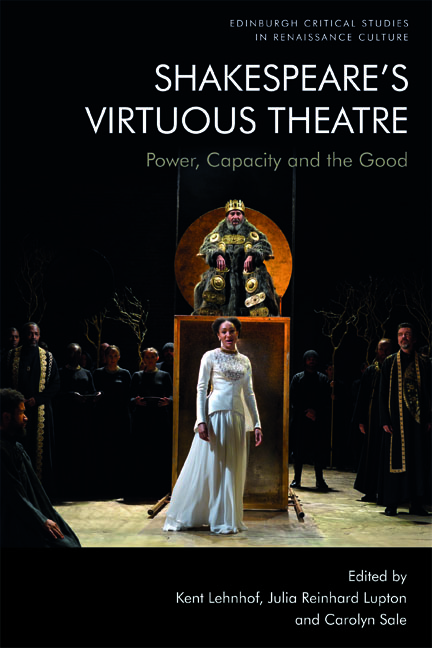
This collection of essays explores how the Shakespearean drama enacts ancient virtues and conceptualises new ones in complex fictional scenarios that test virtues for their continuing value. Contributors approach the virtues as a source of imaginative, affective and intellectual nourishment and consider how Shakespeare's art increases our capacity for new pursuits of the good. Examining Shakespeare's virtuous theatre in tragic, comic and romance modes and from ethical, theatrical and political perspectives, this volume establishes virtue as a framework for a socially, environmentally and spiritually renewed literary criticism. Contributors balance historical depth and philosophical insight with the art of close reading as they contemplate the dynamic field of virtue - embodied, responsive, energetic and dynamic - as it ebbs and flows across time, among multiple wisdom traditions, and in the entangled lives and troubled circumstances of Shakespeare's characters.