To save content items to your account,
please confirm that you agree to abide by our usage policies.
If this is the first time you use this feature, you will be asked to authorise Cambridge Core to connect with your account.
Find out more about saving content to .
To save content items to your Kindle, first ensure no-reply@cambridge.org
is added to your Approved Personal Document E-mail List under your Personal Document Settings
on the Manage Your Content and Devices page of your Amazon account. Then enter the ‘name’ part
of your Kindle email address below.
Find out more about saving to your Kindle.
Note you can select to save to either the @free.kindle.com or @kindle.com variations.
‘@free.kindle.com’ emails are free but can only be saved to your device when it is connected to wi-fi.
‘@kindle.com’ emails can be delivered even when you are not connected to wi-fi, but note that service fees apply.
It’s a tough world. Trees face a constant battle in competing for light, water and minerals with surrounding plants. As if that were not enough, they also have to fend off the attention of living things that view trees as good to eat and places to live. Insects chew away on all parts of a tree and are quite capable of completely defoliating it. Larger leaf-eating animals (which are usually on the ground since a belly full of compost heap is a heavy thing to carry around; leaf-eating monkeys are an exception) chew away at the lower parts of the tree, although giraffes can reach up around 5.5 m. Whole armies of animals that can climb and fly will feed on the more nutritious flowers, fruits and the sugar-filled inner bark (see Chapter 3). The grey squirrel, introduced to Britain from N America in the 1880s, is a prime example. This rodent does extensive damage to hardwoods by stripping bark in spring to get at the sweet sap. It seems that dense stands of self-sown hardwoods have little sap and are largely immune (which may be why it does not cause problems in its native home) but well-tended planted trees have thin bark and high sap content and are mercilessly attacked. So big is the problem that ash, lime and wild cherry may become more common in Britain because of their relatively low palatability to squirrels at the expense of palatable beech and sycamore.
The growth of trees leads to greater changes in size than in any other organism: for example, the mass of a giant sequoia (Sequoiadendron giganteum) can increase by 12 orders of magnitude from seed to mature tree (that’s a billion, billion times bigger, equivalent to an average seed of 0.005 grams becoming a tree of 5000 tonnes, which is the right order of magnitude; see below). Not surprisingly, common questions to ask are ‘how quickly will my tree grow?’ and ‘how big will my tree eventually get?’. In this chapter we will look at these and related questions, and the reasons behind the answers.
Speed of growth
Height
You have probably seen films where the hero in the Orient is strapped over a bed of growing bamboo as a means of torture and eventual death, speared by the hard growing shoots. The reason this works is the extraordinarily fast growth of over half a metre per day. While tropical vines and lianas can grow almost as fast, trees proper can’t equal this rate but can nevertheless be impressively quick, especially when young. A number of tropical species can add 8–9 m to their height in a year. A New World relative of the elm, Trema micrantha, has been seen to grow 30 m in 8 years (an average of 3.75 m per year) and a eucalypt (Eucalyptus deglypta) in New Guinea reached 10.6 m in just 15 months. The Guinness Book of Records has in the past quoted the air-speed record for a tree as a specimen of Albizia falcata (now called Paraserianthes falcataria) planted in Malaysia which grew 10.74 m (35 ft 3 in) in 13 months! As you would expect, there is a lot of variation among species. Trees that invade gaps in tropical forests, and need to grow quickly to win the race to the top, grow faster (an average of 1.5–4.0 m in height per year) than later species that can afford to slowly plod upwards through the shade at 0.5–1.2 m per year.
A lot has happened in the tree world since this book was first written. Some previously unanswered questions can now be addressed, and some things we thought we knew have proved to be wrong or not the whole story. These have been put right. Our understanding of trees has also made huge leaps in areas such as the role of genetics and genetic engineering, effects of climate change, hydraulic engineering (including the bitter debate over how water gets up a tree), factors limiting tree height and why trees have colourful leaves in the autumn. New material has been added on all these and in many other areas where new discoveries have been made. This ranges from the surreal (did you know that cosmic radiation and the ocean tides appear to affect tree growth?) to the practical (why have artificial wine bottle corks proliferated?). Many of the problems faced by trees are caused by us humans, so there is also a new chapter on our interactions with trees looking at just why they are good for us and therefore worth preserving. I hope you have as much fun reading this as I had writing it.
Following comments on the first edition, the number of references at the end of each chapter has been increased to help those who want to dig deeper. To keep the text flowing, however, I’ve only included reference to these in the text where it is not clear which source is being used. Also following reader feedback, more scientific names of trees have been included with the common names, which I hope you won’t find too intrusive.
A common view of tree roots is that they plunge deep into the ground producing almost a mirror image of the canopy. Yet in reality a tree usually looks more like a wine glass with the roots forming a wide but shallow base (Figure 4.1). Most trees fail to root deeply because it is physically difficult and unnecessary. The two main functions of roots are to take up water and minerals, and to hold the tree up. In normal situations, water is most abundant near the soil surface (from rain), and this is also where the bulk of dead matter accumulates and decomposes releasing minerals (nitrogen, potassium, etc.). It should not be surprising, therefore, to find that the majority of tree roots are near the soil surface. The flat ‘root plate’ also serves very well for holding up the tree; deep roots are not needed (see Chapter 9).
Roots have other functions as well. They store food for later use (see Chapter 3) and they play an important role in determining the size of the tree. Roots normally account for 20–30% of a tree’s mass (although it varies from as little as 15% in some rainforest trees up to 50% in arid climates). However, if the trunk is ignored (which forms 40–60% of the total mass), the canopy and the roots come out at roughly the same mass. This helps put into perspective the relative value of the roots and the leaves to each other. Too few roots and the canopy suffers from lack of water. Too few leaves and the roots get insufficient food. There has to be a balance. The roots ‘control’ the canopy partly through water supply but also by the production of hormones. If you doubt this control, think of fruit trees that are kept small by being grafted onto dwarfing root stock.
In Chapter 5 we followed the processes of reproduction through to the arrival of the seed on the ground. Here we will look at germination and early survival of the seedling, and ways of producing new trees without resorting to seed.
The seed
Seeds remind me of spaceships: they contain everything they need to colonise new worlds given favourable conditions and water once they arrive. The outside is covered by the seed coat (the testa), designed to protect the contents. At the centre of the seed is the embryo, consisting of little more than a miniature root (the radicle) and shoot (the plumule). The rest of the seed is taken up with the food supply to keep the embryo alive before it germinates and to sustain early growth before photosynthesis takes over. This food is stored usually in the cotyledons (the seed leaves, part of the plumule), although some store it outside the cotyledons in the endosperm (which can be thought of as a short-lived half-brother of the embryo; all flowering plants have endosperm but in most it is used up quickly). In ash (Fraxinus excelsior), for example (Figure 8.1), the cotyledons are small, surrounded by endosperm, but in oak (Quercus spp.) the cotyledons are bloated and fill the seed with no remaining sign of the endosperm. The best example of endosperm is in the coconut (Cocos nucifera): part liquid (the milk) and part solid (the flesh). Wherever the food is stored, it is usually in the form of starch but oils are not uncommon especially in small wind-dispersed seeds. Oils contain more calories in a given mass and volume and so allow the seeds to travel light (having said that, large seeds can also contain oil: think of walnut oil for cooking and cocoa fat in chocolate). There is a price to pay: seeds with fats cost more to produce and are fairly short-lived (they go rancid).
What makes a tree different from other plants is the trunk (or bole) and branches making up the woody skeleton. The main job of this tough, long-lasting skeleton is to display the leaves up high above other lesser plants in the battle for light. As well as support, though, the trunk and branches have two other important jobs: getting water from the roots to the leaves and moving food around the tree to keep all parts, including the roots, alive. But is the trunk just a large connecting drainpipe that keeps the two ends of the trees apart? In many senses ‘yes’ but its structure allows it to do many other things that no mere drainpipe could do.
Starting from the outside is the outer bark, a waterproof layer, over the inner bark or phloem (Figure 3.1). The phloem is made up of living tissue that transports the sugary sap from the leaves to the rest of the tree. Inside the bark is the cambium which, as will be shown, is responsible for the tree getting fatter. Inside this again is the wood proper or xylem. Although seemingly ‘solid wood’ it is the part of the tree responsible for carrying water from the roots to the rest of the tree. The water moves upwards through dead empty cells. But wood is not entirely dead. Running from the centre of the tree are rays of living tissue (made up of thin-walled ‘parenchyma’ cells) which reach out into the bark (and in some trees there are lines of these living cells running up through the wood as well). As will be seen later these living cells are involved with movement and storage of food and the creation of heartwood, the dense central core of wood that (reputedly) supports the tree as it becomes larger. At the very centre of the tree, some trees, but not all, have a core of pith (the strengthening tissue when the shoot was very young and soft).
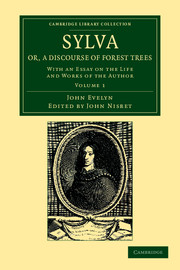
John Evelyn (1620–1706), intellectual, diarist, gardener and founder member of the Royal Society, is best known for his Diary, the great journal of his life and times, encompassing a momentous period in British history. A lifelong collector of books, like his contemporary Pepys, Evelyn amassed over 4,000 items in his library. This work, originally published in 1664, was the first English-language treatise on forestry. Intended for the gentry, it aimed to encourage tree-planting after the ravages of the Civil War and to ensure a supply of timber for Britain's fast-developing navy. The first work sponsored officially by the Royal Society, it was an offshoot of Evelyn's unpublished manuscript Elysium Britannicum, a compendium of gardens and gardening. This is the 1908 two-volume reprint of the fourth edition, published in the year of Evelyn's death. Volume 1 describes different species of tree, deciduous and evergreen, and includes an introductory biography of Evelyn by John Nisbet (1858–1914).
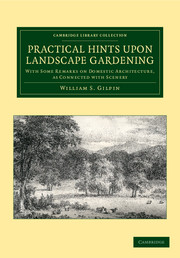
William Sawrey Gilpin (1761/2–1843), landscape painter and illustrator, later became a landscape gardener and writer. He set himself up as a drawing master in Paddington Green and also illustrated picturesque travel-writing. Between 1804 and 1806 he was the first president of the Society of Painters in Water Colours, and then the third drawing master at the Royal Military College in Marlow. After being discharged from this post, Gilpin became a successful landscape gardener and advisor to the nobility. His approach to landscape gardening was influenced by painting and Sir Uvedale Price's Essay on the Picturesque (1794). Gilpin's Hints, published in 1832, advocates that landscapes should be improved by the 'taste' of a painter's eye, and artificial buildings united with their surroundings. Like his landscape practice, this book was highly regarded by Gilpin's contemporaries for its emphasis on the picturesque, especially when landscape gardening centred upon the introduction of exotic plants.
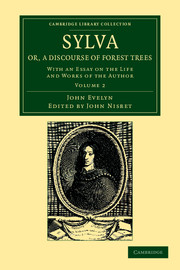
John Evelyn (1620–1706), intellectual, diarist, gardener and founder member of the Royal Society, is best known for his Diary, the great journal of his life and times, encompassing a momentous period in British history. A lifelong collector of books, like his contemporary Pepys, Evelyn amassed over 4,000 items in his library. This work, originally published in 1664, was the first English-language treatise on forestry. Intended for the gentry, it aimed to encourage tree-planting after the ravages of the Civil War and to ensure a supply of timber for Britain's fast-developing navy. The first work sponsored officially by the Royal Society, it was an offshoot of Evelyn's unpublished manuscript Elysium Britannicum, a compendium of gardens and gardening. This is the 1908 two-volume reprint of the fourth edition, published in the year of Evelyn's death. Volume 2 covers practical aspects of forestry and the use of trees in landscaping.