To save content items to your account,
please confirm that you agree to abide by our usage policies.
If this is the first time you use this feature, you will be asked to authorise Cambridge Core to connect with your account.
Find out more about saving content to .
To save content items to your Kindle, first ensure no-reply@cambridge.org
is added to your Approved Personal Document E-mail List under your Personal Document Settings
on the Manage Your Content and Devices page of your Amazon account. Then enter the ‘name’ part
of your Kindle email address below.
Find out more about saving to your Kindle.
Note you can select to save to either the @free.kindle.com or @kindle.com variations.
‘@free.kindle.com’ emails are free but can only be saved to your device when it is connected to wi-fi.
‘@kindle.com’ emails can be delivered even when you are not connected to wi-fi, but note that service fees apply.
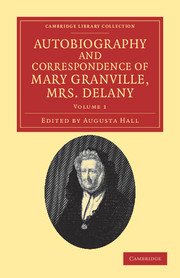
Mary Delany (née Granville, 1700–88) is best known for her cut-paper illustrations of plants - she completed nearly 1,000 of these detailed botanical pictures. Widowed after an unhappy first marriage, she lived in London, attended court, and was a favourite of George III and Queen Charlotte. After being widowed for a second time, and at the age of 74, she began her plant illustrations: failing eyesight caused her to abandon the work in 1784. Delany knew many of the leading cultural figures of the eighteenth century, including Handel and Swift. An enthusiastic correspondent, she wrote and received hundreds of letters, which were edited by her great-great-niece, Lady Llanover (1802–96). Published in 1861–2, they tell the life story of this remarkable woman, while also providing a fascinating glimpse into the world of Georgian England. Volume 1 begins with an unfinished autobiography and continues with correspondence from 1717 to 1737.
This world-famous work was begun by Sir William Jackson Hooker (1785–1865) in 1837, and the ten volumes reissued here were produced under his authorship until 1854, at which point his son, Joseph Dalton Hooker (1817–1911) continued the work of publication. Hooker's own herbarium, or collection of preserved plant specimens, was so extensive that at one point he stored it in one house and lived in another; it was left to the nation on his death. Each volume contains 100 line drawings of plants, and each is accompanied by a full Latin description, with notes in English on habitat and significant features. The order of the plants in each volume is not systematic, but two 'indexes' at the beginning provide plant lists, in alphabetical order and 'arranged according to the natural orders'.
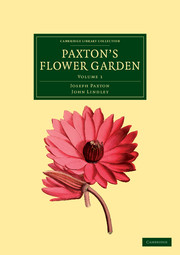
Best remembered today for his technically innovative design for the Crystal Palace of 1851, Joseph Paxton (1803–65) was head gardener to the Duke of Devonshire at Chatsworth by the age of twenty-three, and remained involved in gardening throughout his life. Tapping in to the burgeoning interest in gardening amongst the Victorians, in 1841 he founded the periodical The Gardener's Chronicle with the botanist John Lindley (1799–1865), with whom he had worked on a Government report on Kew Gardens. Paxton's Flower Garden appeared between 1850 and 1853, following a series of plant-collecting expeditions. Only three of the planned ten volumes were published, but with hand-coloured plates (which can be viewed online alongside this reissue) and over 500 woodcuts, the work is lavish. Volume 1 includes colour plates of orchids, Lindley's speciality, along with a pitcher plant and Moutan peony, both still unusual and exotic at the time of publication.
This world-famous work was begun by Sir William Jackson Hooker (1785–1865) in 1837, and the ten volumes reissued here were produced under his authorship until 1854, at which point his son, Joseph Dalton Hooker (1817–1911) continued the work of publication. Hooker's own herbarium, or collection of preserved plant specimens, was so extensive that at one point he stored it in one house and lived in another; it was left to the nation on his death. Each volume contains 100 line drawings of plants, and each is accompanied by a full Latin description, with notes in English on habitat and significant features. The order of the plants in each volume is not systematic, but two 'indexes' at the beginning provide plant lists, in alphabetical order and 'arranged according to the natural orders'.
George Bentham (1800–84) was one of Britain's most influential botanists, whose own collection of plant specimens numbered more than 100,000. Although he donated his herbarium to the Royal Botanic Gardens, Kew in 1854, he continued to make significant contributions to the field, including this exhaustive, seven-volume work detailing the plant life of Australia, which was published from 1863 to 1878. It was part of a series of works commissioned by the British government to document the flora in its colonies. Using the extensive numbers of specimens at Kew - and with the help of Ferdinand Mueller (1825–96), a German botanist in Australia - Bentham was able to compile descriptions of more than 8,000 species of Australian plants, making these volumes the first completed compendium of the flora of any large continental area. Volume 1, published in 1863, introduces the project and describes 39 orders of the dicotyledon class of flora.
This world-famous work was begun by Sir William Jackson Hooker (1785–1865) in 1837, and the ten volumes reissued here were produced under his authorship until 1854, at which point his son, Joseph Dalton Hooker (1817–1911) continued the work of publication. Hooker's own herbarium, or collection of preserved plant specimens, was so extensive that at one point he stored it in one house and lived in another; it was left to the nation on his death. Each volume contains 100 line drawings of plants, and each is accompanied by a full Latin description, with notes in English on habitat and significant features. The order of the plants in each volume is not systematic, but two 'indexes' at the beginning provide plant lists, in alphabetical order and 'arranged according to the natural orders'.
George Bentham (1800–84) was one of Britain's most influential botanists, whose own collection of plant specimens numbered more than 100,000. Although he donated his herbarium to the Royal Botanic Gardens, Kew in 1854, he continued to make significant contributions to the field, including this exhaustive, seven-volume work detailing the plant life of Australia, which was published from 1863 to 1878. It was part of a series of works commissioned by the British government to document the flora in its colonies. Using the extensive numbers of specimens at Kew - and with the help of Ferdinand Mueller (1825–96), a German botanist in Australia - Bentham was able to compile descriptions of more than 8,000 species of Australian plants, making these volumes the first completed compendium of the flora of any large continental area. Volume 5, published in 1870, gives the details of 14 orders of monopetalae and monochlamydeae dicotyledon flora.
This world-famous work was begun by Sir William Jackson Hooker (1785–1865) in 1837, and the ten volumes reissued here were produced under his authorship until 1854, at which point his son, Joseph Dalton Hooker (1817–1911) continued the work of publication. Hooker's own herbarium, or collection of preserved plant specimens, was so extensive that at one point he stored it in one house and lived in another; it was left to the nation on his death. Each volume contains 100 line drawings of plants, and each is accompanied by a full Latin description, with notes in English on habitat and significant features. The order of the plants in each volume is not systematic, but two 'indexes' at the beginning provide plant lists, in alphabetical order and 'arranged according to the natural orders'.
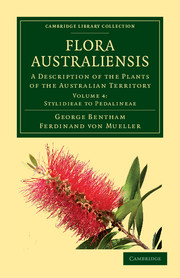
George Bentham (1800–84) was one of Britain's most influential botanists, whose own collection of plant specimens numbered more than 100,000. Although he donated his herbarium to the Royal Botanic Gardens, Kew in 1854, he continued to make significant contributions to the field, including this exhaustive, seven-volume work detailing the plant life of Australia, which was published from 1863 to 1878. It was part of a series of works commissioned by the British government to document the flora in its colonies. Using the extensive numbers of specimens at Kew - and with the help of Ferdinand Mueller (1825–96), a German botanist in Australia - Bentham was able to compile descriptions of more than 8,000 species of Australian plants, making these volumes the first completed compendium of the flora of any large continental area. Volume 4, published in 1869, describes 26 orders of dicotyledon flora in the subclass monopetalae.
This world-famous work was begun by Sir William Jackson Hooker (1785–1865) in 1837, and the ten volumes reissued here were produced under his authorship until 1854, at which point his son, Joseph Dalton Hooker (1817–1911) continued the work of publication. Hooker's own herbarium, or collection of preserved plant specimens, was so extensive that at one point he stored it in one house and lived in another; it was left to the nation on his death. Each volume contains 100 line drawings of plants, and each is accompanied by a full Latin description, with notes in English on habitat and significant features. The order of the plants in each volume is not systematic, but two 'indexes' at the beginning provide plant lists, in alphabetical order and 'arranged according to the natural orders'.
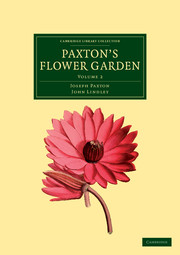
Best remembered today for his technically innovative design for the Crystal Palace of 1851, Joseph Paxton (1803–65) was head gardener to the Duke of Devonshire at Chatsworth by the age of twenty-three, and remained involved in gardening throughout his life. Tapping in to the burgeoning interest in gardening amongst the Victorians, in 1841 he founded the periodical The Gardener's Chronicle with the botanist John Lindley (1799–1865), with whom he had worked on a Government report on Kew Gardens. Paxton's Flower Garden appeared between 1850 and 1853, following a series of plant-collecting expeditions. Only three of the planned ten volumes were published, but with hand-coloured plates (which can be viewed online alongside this reissue) and over 500 woodcuts, the work is lavish. Further colour plates of orchids are to be found in Volume 2, clearly a reflection of Lindley's interest, but also of the wider fascination for these flowers.
George Bentham (1800–84) was one of Britain's most influential botanists, whose own collection of plant specimens numbered more than 100,000. Although he donated his herbarium to the Royal Botanic Gardens, Kew in 1854, he continued to make significant contributions to the field, including this exhaustive, seven-volume work detailing the plant life of Australia, which was published from 1863 to 1878. It was part of a series of works commissioned by the British government to document the flora in its colonies. Using the extensive numbers of specimens at Kew - and with the help of Ferdinand Mueller (1825–96), a German botanist in Australia - Bentham was able to compile descriptions of more than 8,000 species of Australian plants, making these volumes the first completed compendium of the flora of any large continental area. Volume 7, published in 1878, concludes with descriptions of flora in the classes of monocotyledon and cryptogamae.
George Bentham (1800–84) was one of Britain's most influential botanists, whose own collection of plant specimens numbered more than 100,000. Although he donated his herbarium to the Royal Botanic Gardens, Kew in 1854, he continued to make significant contributions to the field, including this exhaustive, seven-volume work detailing the plant life of Australia, which was published from 1863 to 1878. It was part of a series of works commissioned by the British government to document the flora in its colonies. Using the extensive numbers of specimens at Kew - and with the help of Ferdinand Mueller (1825–96), a German botanist in Australia - Bentham was able to compile descriptions of more than 8,000 species of Australian plants, making these volumes the first completed compendium of the flora of any large continental area. Volume 2, published in 1864, gives descriptions of seven orders of the dicotyledon class of flowering plant.
This world-famous work was begun by Sir William Jackson Hooker (1785–1865) in 1837, and the ten volumes reissued here were produced under his authorship until 1854, at which point his son, Joseph Dalton Hooker (1817–1911) continued the work of publication. Hooker's own herbarium, or collection of preserved plant specimens, was so extensive that at one point he stored it in one house and lived in another; it was left to the nation on his death. Each volume contains 100 line drawings of plants, and each is accompanied by a full Latin description, with notes in English on habitat and significant features. The order of the plants in each volume is not systematic, but two 'indexes' at the beginning provide plant lists, in alphabetical order and 'arranged according to the natural orders'.
James Shirley Hibberd (1825–90) was a journalist and writer on gardening, whose popular works had great influence on middle-class taste. Although not a trained horticulturalist, his many books were based on practical experience. He developed a succession of gardens in North London, concentrating on particular types of plants, and his books reflected this work, with this book of 1864 and The Fern Garden (1869) being particularly successful. He also wrote on garden design, flower arrangement, garden furniture and architecture, and his Rustic Adornments of 1856 (reissued in this series, together with The Fern Garden), is an interesting document of social history. He edited the magazine Floral World until 1875 and later The Gardener's Magazine, and was even consulted by the government about potato blight. His engaging and very personal style made him a popular forerunner of modern celebrity gardeners, and set a fashion for highly decorative and ornamental gardens.
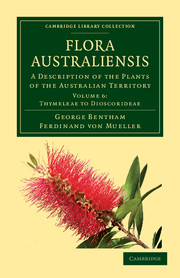
George Bentham (1800–84) was one of Britain's most influential botanists, whose own collection of plant specimens numbered more than 100,000. Although he donated his herbarium to the Royal Botanic Gardens, Kew in 1854, he continued to make significant contributions to the field, including this exhaustive, seven-volume work detailing the plant life of Australia, which was published from 1863 to 1878. It was part of a series of works commissioned by the British government to document the flora in its colonies. Using the extensive numbers of specimens at Kew - and with the help of Ferdinand Mueller (1825–96), a German botanist in Australia - Bentham was able to compile descriptions of more than 8,000 species of Australian plants, making these volumes the first completed compendium of the flora of any large continental area. Volume 6, published in 1873, describes 20 orders of flora in the classes dicotyledon and monocotyledon.
English botanist George Bentham (1800–84) is most famous as the author of the popular Handbook of the British Flora (1858), which ran into many editions. A distinguished scientist, Bentham was elected a Fellow of the Royal Society in 1862, and served as President of the Linnean Society of London for thirteen years (1861–74). Originally published in 1826, this catalogue of plants from the Pyrénées region of France is Bentham's second work. Inspired by French botanist de Candolle (1778–1841) as well as by the analytical methods of his uncle, the famous philosopher Jeremy Bentham, this book is a systematic overview of the plants found between Figueras, in the north of Spain, and Bordeaux, Narbonne and Montpellier in France. The book opens with the story of Bentham's 1825 three-month trip through the Pyrenees region, with botanist G. A. Walker Arnott (1799–1868), on which the Catalogue is based.
John Lindley (1799–1865) was an English botanist and a leading authority on orchids. He attended Norwich Grammar School but was unable to afford university. Lindley's passion for botany helped him into the position of assistant in the herbarium of the naturalist and explorer Sir Joseph Banks. He soon established himself as a botanist of considerable talent, and was elected to the Linnean Society of London at the age of twenty-one. In 1822 he became assistant secretary to the Horticultural Society, and was elected Fellow of the Royal Society in 1828. He was Professor of Botany at University College, London, from 1829 to 1860. Published in 1838, Flora Medica is a systematic reference work written to help medical students understand the botanical characteristics and therapeutic properties of important medicinal plants from around the world. The book includes an appendix of indigenous names of Asiatic species, and a full index.
This world-famous work was begun by Sir William Jackson Hooker (1785–1865) in 1837, and the ten volumes reissued here were produced under his authorship until 1854, at which point his son, Joseph Dalton Hooker (1817–1911) continued the work of publication. Hooker's own herbarium, or collection of preserved plant specimens, was so extensive that at one point he stored it in one house and lived in another; it was left to the nation on his death. Each volume contains 100 line drawings of plants, and each is accompanied by a full Latin description, with notes in English on habitat and significant features. The order of the plants in each volume is not systematic, but two 'indexes' at the beginning provide plant lists, in alphabetical order and 'arranged according to the natural orders'.