Refine search
Actions for selected content:
961 results in Property Law
Part III - Protagonists of property: beyond individual and state
-
- Book:
- The Construction of Property
- Published online:
- 05 June 2013
- Print publication:
- 20 June 2013, pp 151-240
-
- Chapter
- Export citation
Acknowledgments
-
- Book:
- The Construction of Property
- Published online:
- 05 June 2013
- Print publication:
- 20 June 2013, pp vi-viii
-
- Chapter
- Export citation
Bibliography
-
- Book:
- The Construction of Property
- Published online:
- 05 June 2013
- Print publication:
- 20 June 2013, pp 317-338
-
- Chapter
- Export citation
2 - Rules and standards: an institutional analysis of property
- from Part I - Structural and institutional foundations
-
- Book:
- The Construction of Property
- Published online:
- 05 June 2013
- Print publication:
- 20 June 2013, pp 59-94
-
- Chapter
- Export citation
The Construction of Property: Norms, Institutions, Challenges - Title page
-
-
- Book:
- The Construction of Property
- Published online:
- 05 June 2013
- Print publication:
- 20 June 2013, pp iii-iii
-
- Chapter
- Export citation
1 - Property as a legal construct
- from Part I - Structural and institutional foundations
-
- Book:
- The Construction of Property
- Published online:
- 05 June 2013
- Print publication:
- 20 June 2013, pp 13-58
-
- Chapter
- Export citation
Part II - The spectrum of property regimes
-
- Book:
- The Construction of Property
- Published online:
- 05 June 2013
- Print publication:
- 20 June 2013, pp 95-150
-
- Chapter
- Export citation
3 - Private-common-public: the promise of property hybrids
- from Part II - The spectrum of property regimes
-
- Book:
- The Construction of Property
- Published online:
- 05 June 2013
- Print publication:
- 20 June 2013, pp 97-150
-
- Chapter
- Export citation
6 - Eminent domain, incorporated
- from Part III - Protagonists of property: beyond individual and state
-
- Book:
- The Construction of Property
- Published online:
- 05 June 2013
- Print publication:
- 20 June 2013, pp 214-240
-
- Chapter
- Export citation
The Construction of Property - Half title page
-
- Book:
- The Construction of Property
- Published online:
- 05 June 2013
- Print publication:
- 20 June 2013, pp i-ii
-
- Chapter
- Export citation
Part IV - The global challenges of property
-
- Book:
- The Construction of Property
- Published online:
- 05 June 2013
- Print publication:
- 20 June 2013, pp 241-316
-
- Chapter
- Export citation
4 - How property can create, maintain, or destroy community
- from Part III - Protagonists of property: beyond individual and state
-
- Book:
- The Construction of Property
- Published online:
- 05 June 2013
- Print publication:
- 20 June 2013, pp 153-178
-
- Chapter
- Export citation
Part I - Structural and institutional foundations
-
- Book:
- The Construction of Property
- Published online:
- 05 June 2013
- Print publication:
- 20 June 2013, pp 11-94
-
- Chapter
- Export citation
Contents
-
- Book:
- The Construction of Property
- Published online:
- 05 June 2013
- Print publication:
- 20 June 2013, pp v-v
-
- Chapter
- Export citation
8 - BITs and pieces of property
- from Part IV - The global challenges of property
-
- Book:
- The Construction of Property
- Published online:
- 05 June 2013
- Print publication:
- 20 June 2013, pp 274-316
-
- Chapter
- Export citation
5 - The corporation as a property microcosm
- from Part III - Protagonists of property: beyond individual and state
-
- Book:
- The Construction of Property
- Published online:
- 05 June 2013
- Print publication:
- 20 June 2013, pp 179-213
-
- Chapter
- Export citation
7 - Can land law go global?
- from Part IV - The global challenges of property
-
- Book:
- The Construction of Property
- Published online:
- 05 June 2013
- Print publication:
- 20 June 2013, pp 243-273
-
- Chapter
- Export citation
Copyright page
-
- Book:
- The Construction of Property
- Published online:
- 05 June 2013
- Print publication:
- 20 June 2013, pp iv-iv
-
- Chapter
- Export citation
Index
-
- Book:
- The Construction of Property
- Published online:
- 05 June 2013
- Print publication:
- 20 June 2013, pp 339-351
-
- Chapter
- Export citation
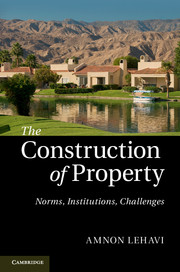
The Construction of Property
- Norms, Institutions, Challenges
-
- Published online:
- 05 June 2013
- Print publication:
- 20 June 2013
