To save content items to your account,
please confirm that you agree to abide by our usage policies.
If this is the first time you use this feature, you will be asked to authorise Cambridge Core to connect with your account.
Find out more about saving content to .
To save content items to your Kindle, first ensure no-reply@cambridge.org
is added to your Approved Personal Document E-mail List under your Personal Document Settings
on the Manage Your Content and Devices page of your Amazon account. Then enter the ‘name’ part
of your Kindle email address below.
Find out more about saving to your Kindle.
Note you can select to save to either the @free.kindle.com or @kindle.com variations.
‘@free.kindle.com’ emails are free but can only be saved to your device when it is connected to wi-fi.
‘@kindle.com’ emails can be delivered even when you are not connected to wi-fi, but note that service fees apply.
Accounts of property tend to define it as a right to exclude and treat use-privileges as incidental by-products of that right. In contrast, this paper treats recognition of use-privileges as prior and then asks what sorts of rights might be justified in their support. I defend this approach against arguments made by Douglas & Ben McFarlane. As the concept of “use” depends upon that of “thing,” I also attempt to shore up the reliance on “things” as central to the concept of property, arguing for a concept of “thing” that encompasses any discrete and intelligible nexus of human activity with respect to which human purposes may come into conflict; this renders intellectual property rights straightforwardly intelligible as usufructary interests in things. I also respond to Essert’s argument that property should jettison any reliance on things and simply view property rights as aimed at excluding others from classes of activity. Here my contention is that the identification of some discrete “thing” as an object of property provides a necessary focal point for the concepts of use and interest that are both functionally and normatively essential to property as a human institution.
In this chapter I suggest a straightforward justification for the original acquisition of property, based on a principle of respect for choice, and I ask why theorists of property in the broadly liberal tradition do not endorse this justification. I identify two main theoretical obstacles to the choice-based account. I proceed to show how theorists could avoid each of those obstacles by modifying their understanding of the nature of acts of acquisition and of extant property rights.
Contrary to portrayals of traditional Confucian thought as downplaying or opposing property, this chapter argues that two significant thinkers in the Chinese Confucian tradition – Huang Zongxi (1619-1692) and Wang Fuzhi (1610-1695) – radically challenged traditional views about the origins of property ownership in traditional China, denying that the emperor automatically owned all the empire’s land. Both thinkers also assigned property and property rights a significant role in their political theories, arguing that property could help limit despotic rule. This chapter discusses and compares Huang’s and Wang’s theories of property, and it argues that Wang’s theory of property can be described as Lockean in nature in that both Wang’s and Locke’s theory of property are built on a natural law foundation and both stress the importance of labor in the legitimate acquisition of property. This chapter also shows that Wang’s theory of property is more complete than Huang’s in that it explicitly addresses questions concerning the origins of property and the justification of property rights, whereas Huang’s theory only explicitly covers the latter. More broadly, this chapter is a work in comparative property theory, showing that Lockean property principles and ideas are not unique to the Western tradition.
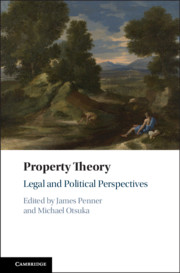
Property, or property rights, remains one of the most central elements in moral, legal, and political thought. It figures centrally in the work of figures as various as Grotius, Locke, Hume, Smith, Hegel and Kant. This collection of essays brings fresh perspective on property theory, from both legal and political theoretical perspectives, and is essential reading for anyone interested in the nature of property. Edited by two of the world's leading theorists of property, James Penner and Michael Otsuka, this volume brings together essays which consider, amongst other topics, property and public law, the importance of legal forms in property theory, whether use or exclusion are most essential to our understanding of property, distributive justice, Lockean and Grotian theories, the common ownership of the Earth, and Confucian ideas of property.
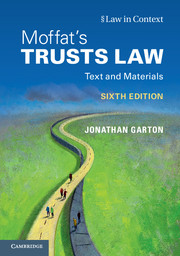
This latest edition of Moffat's Trusts Law has been fully revised and updated to cover recent statutory developments and explores the impact of a wealth of new cases including the Supreme Court decisions in Pitt v. Holt (2013), FHR European Ventures v. Cedar Capital Partners (2014) and Williams v. Central Bank of Nigeria (2014). It has been restructured to incorporate a new chapter on the internationalisation of the trust which provides an understanding of the new directions being taken in the areas of trust law and equitable remedies. Supplementary material includes an online chapter on occupational pension schemes. With suggestions for further reading guiding the student to contemporary debates, this leading textbook retains its hallmark combination of a contextualized approach and a commercial focus, and remains the serious student's textbook of choice.
The Boundaries of Australian Property Law offers a unique perspective on real property law in Australia. As the overwhelming majority of land interests in Australia now fall under the Torrens title system, this book's particular focus on the development and operation of the Torrens system in Australia is both timely and welcome. Addressing the prescribed Priestly 11 requirements for a property law subject in Australia, this informative and academically rigorous book includes carefully selected statutory material and case law from all Australian jurisdictions, as well as the United Kingdom. The general law system is also discussed and referred to where necessary, to give context and depth to the analysis of real property law. Written by prominent real property law academics from law schools around Australia, and edited by Hossein Esmaeili and Brendan Grigg, this text is a modern and much-needed addition to real property law literature.
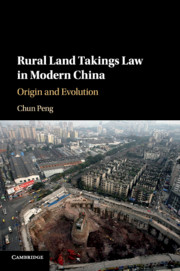
One of the most pressing issues in contemporary China is the massive rural land takings that have taken place at a scale unprecedented in human history. Expropriation of land has dispossessed and displaced millions for several decades, despite the protection of property rights in the Chinese constitution. Combining meticulous doctrinal analysis with in-depth historical investigation, Chun Peng tracks the origin and evolution of China's rural land takings law over the twentieth century and demonstrates an enduring tradition of land takings for state-led social transformation, under which the takings law is designed to be power-confirming. With changed socio-political circumstances and a new rights-respecting constitutional agenda, a rebalance of the law is now underway, but only within existing parameters. Peng provides a piercing analysis of how land has been used by the largest developing country in the world to develop itself, at what costs and where the future might be.