To save content items to your account,
please confirm that you agree to abide by our usage policies.
If this is the first time you use this feature, you will be asked to authorise Cambridge Core to connect with your account.
Find out more about saving content to .
To save content items to your Kindle, first ensure no-reply@cambridge.org
is added to your Approved Personal Document E-mail List under your Personal Document Settings
on the Manage Your Content and Devices page of your Amazon account. Then enter the ‘name’ part
of your Kindle email address below.
Find out more about saving to your Kindle.
Note you can select to save to either the @free.kindle.com or @kindle.com variations.
‘@free.kindle.com’ emails are free but can only be saved to your device when it is connected to wi-fi.
‘@kindle.com’ emails can be delivered even when you are not connected to wi-fi, but note that service fees apply.
(1) Frustration is a narrow doctrine; it is not enough that a contract becomes unexpectedly difficult or more expensive to perform on one or both sides; the courts will not relieve a party from a merely onerous turn of events. English judges possess no general power to absolve contracting parties from their obligations on the ground of hardship arising after formation. Aggravating circumstances, even a commercial crisis for the relevant party, will not constitute frustration unless Lord Radcliffe's test in Davis Contractors Ltd v. Fareham Urban District Council (1956) (cited at 16.02) can be satisfied.
(2) The modern frustration doctrine concerns three situations: (a) supervening illegality, that is, performance of the contract becomes illegal because of a legal change subsequent to the contract's formation; (b) other instances of impossibility; or (c) severe obstruction of contractual performance (‘frustration of the venture’; sometimes referred to as ‘frustration of the purpose’ by some modern commentators), although this third category is very seldom successfully pleaded.
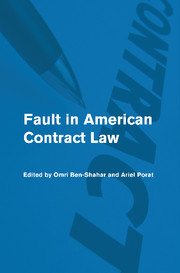
Representing an unprecedented joint effort from top scholars in the field, this volume collects original contributions to examine the fundamental role of 'fault' in contract law. Is it immoral to breach a contract? Should a breaching party be punished more harshly for willful breach? Does it matter if the victim of breach engaged in contributory fault? Is there room for a calculus of fault within the 'efficient breach' framework? For generations, contract liability has been viewed as a no-fault regime, in sharp contrast to tort liability. Is this dichotomy real? Is it justified? How do the American and European traditions compare? In exploring these and related issues, the essays in this volume bring together a variety of outlooks, including economic, psychological, philosophical, and comparative approaches to law.
Although the role of fault in contract law has traditionally received little theoretical or doctrinal attention, it is central to commonsense moral theories of contract. Most people believe that breaking a promise is wrong, and that breach of contract is a form of promise breaking. Parties' moral intuitions may affect their willingness to breach when it is otherwise efficient to do so, their ability to reach settlement once a contract has been breached, their predictions about legal rules of contract, and their post hoc assessments of appropriate damages. This chapter reviews experimental research on the effects of moral norms on contracting. Behavioral studies show that many people believe that breach of contract is a moral harm irrespective of actual losses suffered by the promisee. It is argued in the chapter that moral norms often act as default rules in legal decision making about contracts when a contingency is unspecified in the contract.
Although the role of fault in contract law has traditionally received little theoretical or doctrinal attention, it is central to commonsense moral theories of contract. Most people believe that breaking a promise is wrong, and that breach of contract is a form of promise breaking. In fact, evolutionary psychologists have identified the rule of honoring contracts as one of only three universal moral norms.
Behavioral research has begun to address the role of moral intuition in legal decision making. This chapter reviews experimental research on the effects of moral norms on contracting.
The remedy of expectancy damages in contract law is conventionally described as strict liability for breach. Parties sometimes stipulate damages in advance, and may agree that the damages they stipulate shall be the exclusive remedy for breach. This chapter advances two claims. First, that the familiar expectation remedy is correctly understood to involve elements of fault. There is litigation over the question of fault with respect to the mitigation of damages. Stipulation, on the other hand, makes contract liability stricter because it takes the mitigation question away from courts. Second, while law is generally described as being suspicious of, or even hostile to, stipulation, in fact, law encourages stipulation. It does this by sometimes declining to award expectancy damages, often in the very situations where stipulation seems sensible, and also by providing expectancy damages where the award of stipulated damages is regarded as a penalty. These two claims illuminate cases on such diverse matters as residential leases, construction contracts, product warranties, service contracts with liability waivers, and no-show customers and their service providers.
Introduction
The remedy of expectancy damages plays a central role in the conventional statement of American contract law. Specific performance is a smaller but well-recognized feature, and it is prominent in some subsets of contract law, such as those concerned with unique goods and land transfers. Both rules are usefully described as providing strict liability, though occasional academic campaigns draw attention to the ways in which fault permeates contract law.
It is often asserted that contract law is based on strict liability, not fault. This assertion is incorrect. As this chapter demonstrates, fault is a basic building block of contract law, and pervades the field. Contract law discriminates between two types of fault: the violation of strong moral norms, such as the prohibition of deception, and the violation of somewhat weaker norms, such as the requirement of due care. Where both types of fault are relevant, one party's violation of a strong moral norm will normally override the other party's violation of a weaker moral norm. Fault is pervasive in contract law because it should be. If moral obligation and fault were removed from contract law, the contracting system would be much less efficient. The efficiency of the contracting system rests on a tripod whose legs are legal remedies, reputational effects, and the internalization of social norms – in particular, the moral norm of promise keeping. All three legs are necessary to ensure the reliability, and therefore the efficiency, of the contracting system.
Introduction
The Second Restatement of Contracts states that “[c]ontract liability is strict liability. It is an accepted maxim that pacta sunt servanda, contracts are to be kept. The obligor is therefore liable in damages for breach of contract even if he is without fault.” Similarly, Farnsworth's treatise states that “contract law is, in its essential design, a law of strict liability, and the accompanying system of remedies operates without regard to fault.”
Willful breach doctrine should be a major embarrassment to contract law. If the default remedy for breach is expectation damages designed to put the injured promisee in the position in which she would have been had the contract been performed, then the promisor's behavior – the reason for the breach – looks to be irrelevant in assessing damages. And yet the cases are full of references to “willful” breaches, which seem often to be treated more harshly than ordinary ones based on the promisor's bad/willful conduct. This chapter's explanation is that willful breaches are best understood as those that should be prevented or deterred because the parties have implicitly agreed that the promisor would not breach in those circumstances. When willfulness, so understood, is present, courts rightly award remedies that serve to deprive the promisor of any incentive to breach and to assure the promisee of getting her full expectation.
Willful breach is an embarrassment to contract law. The standard remedy for breach of contract is expectation damages, which are designed to put the injured promisee in the position in which she would have been had the contract been performed. Yet courts often award greater remedies when they find “willful breach,” even though the willfulness of a breach can have little to do with the promisee's expectation interest, which is measured with reference to the harm suffered by the injured promisee, and that is the same whatever motivated the promisor's breach.
The formative period in the history of contract and tort may be characterized by the cleavage of contract and tort around the concept of fault: tort modernized by moving from strict liability to a regime of “no liability without fault,” while contract moved toward strict liability. Nineteenth-century scholars of private law offered explanations for the opposition, reasoning that alternative ideas about fault account for the different character of state involvement in enforcing private law rights: Tort law governs liabilities imposed by law on nonconsenting members of society (and thus, it should limit itself to fault-based conduct), while contract law governs bargained-for duties and liabilities of parties who exercise freedom of contract (and thus, liability voluntarily undertaken need not consider fault). It is argued in this chapter, that these theories are problematic, especially because they cannot offer a complete account of contract or tort. Tort retains too much strict liability to be thought of as a regime of no liability without fault, and contract has too many fault-based rules to be conceived of through strict liability. While these justifications for the distinction between contract and tort were questioned in ensuing generations, they still structure much of the debate over the current boundary between contract and tort.
Introduction
Despite a number of notable exceptions, the concept of fault has not been central to contemporary contracts scholarship. I would like to suggest that this is no simple oversight.
This chapter begins with a comparative law survey showing that not all legal systems opt exclusively for fault liability or strict liability in contract law, but often adopt a more nuanced approach. This approach includes intermediate solutions such as reversing the burden of proof, using a market (“objective”) standard of care, distinguishing between different types of contracts, and providing a “second chance” for breaching parties. Taking this starting point seriously and arguing that it is highly unlikely that all legal systems err, this chapter argues that the core question is how and when each liability regime should prevail or how and when the regimes should be combined. When asking how best to combine the regimes, the simple answer is that market expectation, and specifically the ability to compare offers, should be the core criterion.
Introduction
When Ernst Rabel came to the United States, some seventy-five years ago, he brought with him his conception of comparative law as a discovery device for all countries, and sought to develop this international discussion into more concrete results, namely, into a unification of sales law as the core of contract law. Moreover, when Rabel later wrote his treatise on (comparative) sales law – which became highly influential for the Hague Uniform Sales Law of 1964 and subsequently the Vienna Convention on the International Sale of Goods of 1980 (CISG) – one of the central questions where his new surroundings heavily influenced him was fault.
The basic rule of liability in tort law is fault. The basic rule of liability in contract law is no fault. This is perhaps one of the most striking divides within private law, the most important difference between the law of voluntary and the law of nonvoluntary obligations. It is this fault line (speaking equivocally) that this book explores. Is it a real divide – two opposite branches of liability within private law – or is it merely a rhetorical myth? How can it be justified?
For law-and-economics scholars, this fault/no-fault divide between contract and tort is all the more puzzling. In law and economics, legal rules are understood as incentives, evaluated within a framework in which parties take actions to prevent different types of loss. Tortfeasors can take measures to avoid accidents; contracting parties can take measures to avoid loss from breach. The context of the loss can diverge between contract and tort – accidents to strangers versus harm to a known breached-against party – but the underlying framework of incentives is similar, if not identical. Robert Cooter famously described this underlying framework as a unified “model of precaution,” and Richard Craswell showed how to think of the breach-or-perform decision as a problem of precaution, mirroring the framework of tort law. Thus, to those who take the idea of a unified model seriously, a significant puzzle looms large: If these two branches of law share the same underlying framework, why do they follow different liability regimes?
Holmes famously proposed a “no-fault” theory of contract law: A contract is an option to perform or pay, and a “breach” is therefore not a wrongful act but merely triggers the duty to pay liquidated or other damages. This chapter elaborates the Holmesian theory, arguing that fault terminology in contract law, such as “good faith,” should be given pragmatic economic interpretations, rather than be conceived of in moral terms. It further argues that contract doctrines should normally be alterable only on the basis of empirical investigations.
My thesis is that concepts of fault or blame, at least when understood in moral terms rather than translated into economic or other practical terms, are not useful addenda to the doctrines of contract law. I have borrowed this thesis from Holmes, who in The Common Law (and later in The Path of the Law) drew a sharp distinction between tort and contract law, so far as issues of fault or blameworthiness are concerned. In the case of an accident giving rise to a tort suit, he thought the loss should lie where it fell, that is, on the victim, unless the injurer was at fault, that is, negligent, and the victim faultless, that is, not contributorily negligent. He thus disapproved, in general, of strict tort liability. But a complication in his analysis arose from his belief in “objective” standards of liability; negligence was the failure of the average person to take proper care, even if the defendant was below average in his ability to do so.