To save content items to your account,
please confirm that you agree to abide by our usage policies.
If this is the first time you use this feature, you will be asked to authorise Cambridge Core to connect with your account.
Find out more about saving content to .
To save content items to your Kindle, first ensure no-reply@cambridge.org
is added to your Approved Personal Document E-mail List under your Personal Document Settings
on the Manage Your Content and Devices page of your Amazon account. Then enter the ‘name’ part
of your Kindle email address below.
Find out more about saving to your Kindle.
Note you can select to save to either the @free.kindle.com or @kindle.com variations.
‘@free.kindle.com’ emails are free but can only be saved to your device when it is connected to wi-fi.
‘@kindle.com’ emails can be delivered even when you are not connected to wi-fi, but note that service fees apply.
Changes in social structure often lead to mobility and migration. Urbanisation is one important outcome of mobility and migration. Mobility, migration and urbanisation lead to dialect contact, that is, between speakers of mutually intelligible varieties. This chapter first introduces general concepts such as diffusion and supralocalisation, and then moves on to discuss sociolinguistic models developed for the analysis of dialect contact, including the theories of koineisation and new-dialect formation, based on principles such as accommodation and salience. Case studies are taken from medieval Spain, Early Modern New Mexico and twentieth-century Norway. The chapter also addresses the role of new speakers in contact situations, based on an example from sixteenth-century Tuscany, and ends with a short discussion of sociolinguistic typology.
Different texts have different characteristics. In this chapter, we first explore the concepts of register, genre and style, which are, in the tradition of Biber, linked to communicative functions and situational characteristics. The co-occurrence of register features and dimensions are introduced as the linguistic indicators of communicative functions. A particularly useful approach to register centres around keyness, which we demonstrate with historical Portuguese data. We then introduce discourse traditions as a historical-linguistic concept closely related to genre and register. We use French literary examples to explain stylistic differences and the link with the Labovian distinction between indicators, markers and stereotypes. This leads to a discussion of indexicality and indexical fields more generally, for which we draw on ancient Greek plays. The chapter continues the discussion of the literary representation of language variation on the basis of English texts comprising dialect, and explains the important concept of enregisterment.
This chapter discusses standardisation as a major factor in sociolinguistic history. After a brief dicussion of basic concepts such as diglossia, Ausbau, Abstand and diaglossia, we introduce the Haugen model, including the key concepts of selection, codification, elaboration and acceptance. We go on to argue that the later introduced concept of implementation is crucial in analyses of the interaction of norms and language use in the language community. Focusing on this interaction, and based on case studies from English and Dutch, three scenarios are distinguished: prescriptive influence, prescriptive delay and concurrent prescriptivism. The chapter ends by situating the interaction of norms and usage into the wider framework of the total linguistic fact as developed by Silverstein.
In this chapter, we focus on multilingualism and language contact, moving away from the strong focus on monolingualism characteristic of many traditional approaches to language history, and discussing various onsets, scenarios and outcomes of language contact. We introduce the concepts of borrowing and imposition as central constructs to understand contact-induced change in language, illustrating and critically examining these ideas in three case studies: the development of loanwords in Canadian French, Germanic substrate effects in the formation of American Englishes and mixed-language business writing in medieval Britain after the Norman Conquest. Building on these cases, we discuss which elements of the language can be transferred and explore possible pathways of social diffusion of borrowings, as well touching upon various traits and examples of code switching and similar multilingual practices in historical texts. Finally, we evaluate the constructs of pidgin and creole languages, discussing to what extent they can be seen as different in structural terms, or whether their distinctiveness arises primarily from the sociohistorical circumstances from which they arose.
Historical Sociolinguistics is the study of the relationship between language and society in its historical dimension. This is the first textbook to introduce this vibrant field, based on examples and case studies taken from a variety of languages. Chapters begin with clear explanations of core concepts, which are then applied to historical contexts from different languages, such as English, French, Hindi and Mandarin. The volume uses several pedagogical methods, allowing readers to gain a deeper understanding of the theory and of examples. A list of key terms is provided, covering the main theoretical and methodological issues discussed. The book also includes a range of exercises and short further reading sections for students. It is ideal for students of sociolinguistics and historical linguistics, as well as providing a basic introduction to historical sociolinguistics for anyone with an interest in linguistics or social history.
Speech act theory has been foundational in establishing pragmatics as an independent field of inquiry; yet, recent pragmatic research appears to have drifted away from the theoretical investigation of speech acts. This Element explores the reasons why this is so, focusing on the difference of perspective that emerges when the scope of the discipline is viewed through a narrow versus a broad lens. Following an overview of the initial exposition of speech act theory by Austin, it tracks its evolution, through subsequent Searlean and Gricean elaborations, to the currently received view. This view is then found to have diverged substantially from Austin's original vision, largely due to its alignment with the narrow conception of pragmatics. Against this backdrop, it is suggested that embracing the broad take on the discipline can allow for a reintegration of Austin's vision into the way we theorise about speech acts.
Small linguistic tricks can have big footprints. This book examines how India's current Hindu nationalist government uses language as a weapon against its Muslim citizens. Each chapter provides a discursive history of matters that have been a source of conflict between Hindus and Muslims in India, highlighting the potent relationship between language and politics. The book explores four issues, Ramajanmbhoomi temple, Muslim Personal Law as it pertains to Indian Muslim women, Kashmir and revocation of Article 370, and Citizenship (Amendment) Act/National Registry of Citizens, whose histories in courts and legislative bodies are written in linguistic trickery. Offering novel ways of understanding why the Hindu right has claimed victories on these legislative and judicial matters that impact the lives of minority citizens, it is essential reading for key insights for academic researchers and students in sociolinguistics, as well as South Asia studies, gender studies and Indian politics and culture.
This Element analyses the sociolinguistic navigation of cultural and ideological influence among queer male-identified individuals in Chengdu and Taipei. By analysing how queer and ethnically Chinese-identified individuals navigate ideological influences, it investigates some of the complexities of culture and identity and their dependence on semiotics and situated communication. Thus, the social affordances and constraints relevant to specific individuals in these contexts are described not only in terms of influences like 'Chinese culture' or 'Western ideology', but also in terms of the ongoing communicative processes through which they orient themselves to diverse structural influences. As such, this Element engages with the diversity typically subsumed into common identity categories. In turn, through its qualified deconstructionist approach to identity, it sheds novel light on the ideological complexity that tends to underlie queer individuals' performance of 'who they are', in Sinophone contexts and elsewhere.
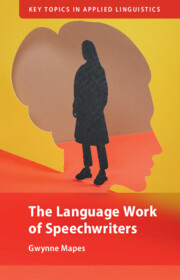
The work of speechwriters is prominent in political discourse, yet the writers themselves remain in the shadows of the powerful, public figures they work for. This book throws the spotlight on these invisible wordsmiths, illuminating not only what they do, but also why it matters. Based on ethnographic research in the US American speechwriting community, it investigates the ways in which speechwriters talk about their professional practices, and also the material procedures which guide the production of their deliverables. Relying on a robust collection of various genres of discursive data, Mapes focuses on the primary rhetorical strategies which characterize speechwriters' discourse, neatly exposing how they are beholden to a linguistic marketplace entrenched in ideological and socioeconomic struggle. Providing fascinating insights into an understudied and relatively misunderstood profession, this book is essential reading for academic researchers and students in applied linguistics, discourse studies, linguistic and cultural anthropology, and sociolinguistics.
This Element explores the gendered dimensions of the ways language used to describe, define, and diagnose pregnancy loss impacts experiences of receiving and delivering healthcare in a UK context. It situates experiences of pregnancy loss language against the backdrop of gender role expectations, ideological tensions around reproductive choice, and medical misogyny; asking how language both reflects and influences contemporary gender norms and understandings of maternal responsibility. To do this, the Element analyses 10 focus group transcripts from metalinguistic discussions with 42 lived experience and healthcare professional participants, and 202 written metalinguistic contributions from the same cohorts. It demonstrates the gendered social and symbolic meanings of diagnostic terminology such as miscarriage, incompetent cervix, and termination or abortion in the context of a wanted pregnancy, as well as clinical discourses, on the experience of pregnancy loss and subsequent recovery and wellbeing. This title is also available as Open Access on Cambridge Core.
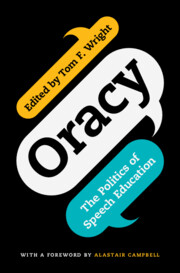
Oracy – or 'speaking and listening skills' – has become one of the most prominent ideas in modern education. But where has this idea come from? Should oracy education be seen as positive, or does it hold unintended consequences? How can problems over definitions, teaching and assessment ever be overcome? This timely book brings together prominent practitioners and researchers to explore the often overlooked implications of speaking and listening education. It features essays from teachers, school leaders, political advisers and charity heads, and from leading thinkers across the fields of linguistics, political science, history, Classics and anthropology. Together, they consider the benefits and risks of oracy education, place it in global context, and offer practical guidance for those trying to implement it on the ground. By demystifying one of the most important yet contentious ideas in modern education, this book offers a vital roadmap for how schools can make oracy work for all.