To save content items to your account,
please confirm that you agree to abide by our usage policies.
If this is the first time you use this feature, you will be asked to authorise Cambridge Core to connect with your account.
Find out more about saving content to .
To save content items to your Kindle, first ensure no-reply@cambridge.org
is added to your Approved Personal Document E-mail List under your Personal Document Settings
on the Manage Your Content and Devices page of your Amazon account. Then enter the ‘name’ part
of your Kindle email address below.
Find out more about saving to your Kindle.
Note you can select to save to either the @free.kindle.com or @kindle.com variations.
‘@free.kindle.com’ emails are free but can only be saved to your device when it is connected to wi-fi.
‘@kindle.com’ emails can be delivered even when you are not connected to wi-fi, but note that service fees apply.
We look at the comparative properties of modal verbs in English, Romance and Slavic, and investigate whether modal verbs with their typical clustering property share something with auxiliaries. One main asset is that modals verbs in German (and Dutch, but not in English) can be used as full lexical verbs. Another main asset of German and Dutch modal verbs is their contingency upon aspect and Aktionsart embeddings. In this respect. Slavic , with its strong propensity to grammatical aspect, provides confirming evidence as complex aspectual properties often give rise to modal interpretations reflecting modal verbs of German.
Fear of generalizing about people is often prompted by legitimate concerns that implicit racial, gender, and other social biases and stereotypes may lead to problematic generalizations and action. There is a pronounced tendency to (over)generalize stereotype-confirming and negative actions by people one assigns to an outgroup, a social group to which one does not belong. We cannot dispense with generalizing but we can consider how and when we generalize. (White) Americans often profess to be colorblind and are certainly often color-mute, reluctant to speak of racial matters even in the interest of reducing persisting racial inequality. Explicit talk about quantities – some, 500, and the like – depends on who or what is included in the category being counted, the domain in the particular context, but ‘marked’ members of categories are often erased in this process, not counted. Bringing them back in is the point of “Black Lives Matter,” a point often (deliberately) overlooked. Implicit generalizations or generics don’t answer the question of "how many" but assign properties at the level of kinds. They are used to talk about both statistical and social norms (e.g., “Boys don’t cry”).
Labels – names – are at the heart of social identities. Identity categories like race, ethnicity, nationality, and even gender do not have sharp boundaries given by biology or history or cultural affiliations. Social identity groups are less like biological species than like sports teams or their fans, largely created and sustained by labeling and other linguistic and social processes. They are not unreal, but they are always changing. Identities can be created by labeling from above that obliterates the identity distinctions drawn by those labeled (e.g., Indians in the Americas) and helps disempower them. Identities can be created by strategic labeling to create alliances to help improve the positions of those so labeled (.e.g., Asian Americans). Labeling with a noun (e.g., a vegan or vegans) suggests that those labeled are a kind, sharing not just the properties that prompted attaching a label but a cluster of other relatively stable properties as well. In contrast, describing by using some kind of verb phrase (eats only plant-based food) carries fewer suggestions about persistence of that property or about other properties that those to whom the description applies might have.
This book is aimed at a general audience. Its aim is to engage readers in thinking critically about the words in their world and about the linguistic practices in which they participate. Linguistic practices are ways of doing things with words, and they are tied to particular communities, some face-to-face and small (a classroom) and others vast and ‘imagined’ (a nation). The politicization of social identities has gone hand in hand with politicization of language, and this book tries to provide insight into those connections. Social power can confer linguistic privilege but the disempowered can find words enormously useful for resisting. It is hard to talk about contentious language without raising immediate emotional responses, visceral reactions to proposed reforms or resistance to them. The book aims not to promote particular ways of speaking but to get readers thinking about their own linguistic experiences in new ways.
What "goes without saying," what’s expected (statistically or normatively), is often unmarked linguistically. What is special, distinctive, in some way seen as unusual, gets marked. For social kinds, this often involves adding modifiers or affixes to names of distinctive subkinds within an overarching social category – hyphenated Americans, for example. This can lead to the erasure of those distinctive subkinds in talk of the overarching category. So, for example, ‘hyphenated’ Americans can be ignored in some talk of Americans. It can also lead to erasure of distinctiveness among those not included in the marked subkinds so that, e.g., whiteness or maleness can be elided with being American or being human. Dominant social groups often have no distinctive labels since they become ‘normal’ exemplars of the larger social group. Subordinated groups can push back by labeling the larger default category and trying to get its members to label themselves, to acknowledge, e.g., that being cisgender brings with it a range of experiences and privileges not all share.
What words mean depends on contexts: the speaker(s), the audience, the interests at stake, relevant history. Many saw shifting Cornell Plantations to Botanic Gardens as excessively PC, but there were multiple reasons for abandoning plantations. Just considering proposals to abandon words like felon, convict, and parolee opened some minds to new possibilities for people now or formerly incarcerated. Considering the recently minted label Latinx has prompted not only appreciation of new gender options but also new futures in which racialization becomes less socially constricting. Especially in the age of the internet, language is as often encountered in graphic form as in speech. Features such as capitalization take on substantial and sometimes problematic social significance. Like particular words, typographic conventions can ‘dog-whistle’ hatred, becoming less effective when those targeted can engage in counter-speech. Counter-speech isn’t easy. Presidential tweets telling US-born congresswomen to “go back” to the countries of their (recent) ancestors did, however, get telling responses from American Indians and others. We need to acknowledge that there are no quick linguistic fixes to social ills and that those resisting reforms we might endorse need not be acting out of ill will but out of discomfort with the disruption of well-ingrained linguistic habits.
A shout of “Come here, boy” treats its target as both male and inferior. An adult man brought into a linguistic exchange by that direct address (vocative) is thereby shoved beneath the shouter, positioned below them. ‘Racial etiquette’ once made boy a common address from white people to black men, who were expected/required to return deferential or respectful forms of address like sir or ma’am. Work on European languages with grammatically singular and plural second-person pronouns that now function mainly to position those being addressed (called T/V, as in French tu and vous) has explored two distinct axes of social position influencing address, power and solidarity. Power is nonreciprocal, solidarity goes in both directions. English now has only grammatically plural you as a direct address pronoun, but it has other address resources people use to position one another: given and family names, endearments, mock insults, professional titles, kinship terms, and more. Nicknaming asserts power, which may be affectionate (e.g., a fond parent’s pet name for their child) or coercive. Addressing is part of a larger system of linguistic (im)politeness involved in interactions. Large data studies found police (no matter what their own racial identity) speaking more politely to white than to black motorists during traffic stops.
What words mean, Lewis Carroll’s Humpty Dumpty suggests, depends only on individuals’ asserting their authority to give them a particular meaning, but Alice and others question this claimed semantic authority. Dictionaries are often thought of as semantically authoritative, but most aim to describe actual usage, not to endorse ‘proper’ meanings. For words like tree names, semantic authority plausibly lies with those who know about trees. But even in sciences, semantic authority is disputable, as shown by debates over defining planet. Sometimes courts adjudicate conflicts over meanings, as illustrated by shifts in marriage and related words. Even then divergent interests can allow continuing disputes. Guidelines for ‘inclusive language’ sought to direct people to use words in certain ways. Their effective authority was tied to the issuing group’s status: government agencies, e.g, could better wield semantic authority than small interest groups. Policing others’ usage sometimes happens and is called ‘political correctness’ (PC); mocking others’ usage often accompanies charges of being PC. Claims of trans women that they themselves know best whether they are women are sometimes derided. But such first-person semantic authority gains its force from existence of communities recognizing the legitimacy of such gender claims. Ultimately, semantic authority resides in communities.
Words can and do change. Social reform often goes hand in hand with linguistic reform. Introducing words like sexism and sexual harassment has allowed feminist thinkers and activists to uncover patterns of attitudes, behavior, and institutions that supported men’s control of women and made men into default people. Black women, realizing that identities intertwine, have introduced intersectionality and words like womanism and misogynoir to develop their insights. But it’s not just new words. Evolving insights into racial injustice have led many to rethink words like racism, but conflict over racial matters persists and often emerges in disputes over interpreting racism. Changing attitudes towards women and LGBTQ people have affected what courts and ordinary people take rape to mean. Recognition of gender nonbinarism and of gender instability has meant that he and shecan no longer be assumed sufficient for third-person reference to individual people. Some rejecting gender binaries as well as transgender people have begun announcing their own preferences for how others should refer to them pronominally, with singular they, a nonbinary option, among the possible PGPs (preferred gender pronouns). Users of ASL (American Sign Language) also sometimes ‘reform’ signs, rejecting suggestions that these changes are mere euphemisms.
“Sticks and stones can break my bones but words can never hurt me.” Words do, however, sometimes hurt. Speech that promotes condoning or actually practicing physical violence is not just unpleasant but dangerous. An orchestrated war of words preceded the Rwandan genocidal slaughter. Hutu political leaders actively promoted using forms meaning ‘snake’ and ‘cockroach’ in talking of Tutsi neighbors, which made slaughtering those neighbors more readily acceptable to ordinary Hutu. The N-word in contemporary America is often used in diverse objectionable and sometimes dangerous ways. At the same time, there are affiliative uses within some black communities. And mentioning the word in order to criticize racist linguistic practices should be supported, not punished as continues to happen. Native Americans continue to protest being turned into mascots for sports teams; they resist suggestions that team names ‘honor' them. Semantic derogation of women continues, but some have tried to embrace derisive terms like slut, efforts that are unwelcome to some self-identified feminists. Even what many have heralded as successful reclamation of the term queer for non-heterosexuals, purging it of its negative flavor, does not work for all. Words harm by making public and more ‘acceptable’ the social hostility and potential violence of those using (not ‘mentioning’) them.
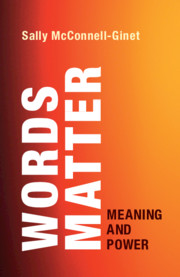
History and current affairs show that words matter - and change - because they are woven into our social and political lives. Words are weapons wielded by the powerful; they are also powerful tools for social resistance and for reimagining and reconfiguring social relations. Illustrated with topical examples, from racial slurs and sexual insults to preferred gender pronouns, from ethnic/racial group labels to presidential tweets, this book examines the social contexts which imbue words with potency. Exploring the role of language in three broad categories - establishing social identities, navigating social landscapes, and debating social and linguistic change - Sally McConnell-Ginet invites readers to examine critically their own ideas about language and its complicated connections to social conflict and transformation. Concrete and timely examples vividly illustrate the feedback loop between words and the world, shedding light on how and why words can matter.
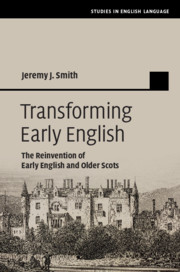
Transforming Early English shows how historical pragmatics can offer a powerful explanatory framework for the changes medieval English and Older Scots texts undergo, as they are transmitted over time and space. The book argues that formal features such as spelling, script and font, and punctuation - often neglected in critical engagement with past texts - relate closely to dynamic, shifting socio-cultural processes, imperatives and functions. This theme is illustrated through numerous case-studies in textual recuperation, ranging from the reinvention of Old English poetry and prose in the later medieval and early modern periods, to the eighteenth-century 'vernacular revival' of literature in Older Scots.