To save content items to your account,
please confirm that you agree to abide by our usage policies.
If this is the first time you use this feature, you will be asked to authorise Cambridge Core to connect with your account.
Find out more about saving content to .
To save content items to your Kindle, first ensure no-reply@cambridge.org
is added to your Approved Personal Document E-mail List under your Personal Document Settings
on the Manage Your Content and Devices page of your Amazon account. Then enter the ‘name’ part
of your Kindle email address below.
Find out more about saving to your Kindle.
Note you can select to save to either the @free.kindle.com or @kindle.com variations.
‘@free.kindle.com’ emails are free but can only be saved to your device when it is connected to wi-fi.
‘@kindle.com’ emails can be delivered even when you are not connected to wi-fi, but note that service fees apply.
In this chapter we explore the interrelated phenomena of conventionalization and conventions. We argue that the essence of convention is to facilitate meaning making in interaction, while conventionalization refers to the process through which conventions come into existence. We investigate the pragmatic complexity surrounding convention and conventionalization by arguing that (1) conventionalization is a matter of degree; (2) conventions and conventionalization are particularly prominent in intercultural interactions; and (3) language and socialisation are highly relevant to conventionalization. We also investigate facets of language use with complex implications for convention and practice, and we provide various interactional examples to illustrate these facets.
Commercial service encounters are broadly defined as everyday interactions in which some kind of commodity, be it goods, information or both, is exchanged between a service provider (e.g. clerk, vendor) and a service seeker (e.g. customer). Previous work has focused primarily on transactional and interpersonal aspects of service encounters, including issues of politeness and intracultural variation in face-to-face, telephone and online contexts. In this chapter, we examine current issues in service encounter discourse. After presenting some key concepts and predominant contexts of service encounters, we provide a critical review of theoretical models used to examine service encounter interaction, explain the distinction between interpersonal and transactional talk and describe some aspects of sociopragmatic variation in service encounter contexts. We end the chapter with a discussion of methodological issues and future directions.
Building on Grice’s seminal work on ‘speaker meaning’, this chapter explores three different approaches to meaning in communication in light of how they view the relationship between ‘speaker meanings’ and ‘speaker commitments’: (1) inferential accounts of intentional meaning (stemming from Relevance Theory), (2) normative commitment-based approaches to communication and (3) interactional achievement accounts. It examines how these different perspectives yield different results regarding the meanings that speakers are committed to, held committed to by others or held normatively committed to in virtue of conventions of language use. Finally, it demonstrates how the concept of ‘reflexive accountability’ from talk-in-interaction provides the link in the sociopragmatic toolkit between questions about meaning recovery and the questions of why and how speakers choose to formulate their utterances in different ways for different purposes.
Social actions are recipient-designed actions that occur in the context of interaction sequences. This chapter focuses on sources and practices for the formation and ascription of social actions. While linguists stress the relevance of linguistic social action formats, conversation analysts highlight the relevance of the sequentialposition of an action, and sociolinguists point to the influence of social identities for action-formation and -ascription. The combination of these three approaches helps us to solve the analytic problem of indirectness, which, however, only rarely becomes a problem for the participants in an interaction themselves. Social properties which recurrently apply when using verbal and bodily resources of action-formation, i.e. the social actions themselves, inferred meanings, projected next actions, the participation framework, the activity type, speaker’s stance, participants’ identities, etc. lead to stable pragmatic connotations of those forms, i.e. action-meanings, which become idiomatic and part of our common-sense competence. Still, social actions are multi-layered and can be ambiguous at times. Therefore, their meaning can be open for negotiation. Intersubjectivity of action ascription is ultimately secured neither by conventions nor by speaker’s intentions, but is accomplished by their treatment in subsequent discourse
Historical sociopragmatics studies the social dimension of language use from a historical perspective. Like historical pragmatics in general, it must rely on written data (except for the very recent past), which poses some specific analytical challenges. In this contribution, we show how approaches to these challenges have developed in recent years. The research focus in historical sociopragmatics has followed the trend in sociopragmatics, where the earlier focus on a mapping between specific linguistic forms and specific pragmatic functions is increasingly extended to a wider consideration of the discursive nature of pragmatic entities whose function only emerges in the interaction between conversational partners. We illustrate such a discursive approach with an analysis of a sequence of letters from the Breadalbane Collection, 1548--83, in which leading members of a Scottish Highland clan negotiate their relationships, their respective roles and the wider impact of events that led to growing tensions between them.
This chapter aims to give an overview of the interdisciplinary linguistic research on conversational humour, depicting it as a vital sociopragmatic phenomenon in human interaction. First, we address the key concepts and theoretical approaches found in this field. Second, we focus on a wide spectrum of discourse domains in which those different types of humour are typically deployed. Furthermore, this chapter provides an overview of sociocultural variables in the research on conversational humour, such as intercultural (involving interlocutors from different cultural backgrounds) and cross-cultural (comparing social practices in different cultures) aspects. Our fourth goal is to present the sociopragmatic functions, both discursive and interpersonal, of humour in human interaction. Finally, a number of case studies are offered throughout the chapter in order to illustrate how language users engage in and refer to humorous practices in different interactional settings.
The early days of sociolinguistic research were dominated by theories of language variation as correlations between linguistic variables and sociolinguistic factors including age, gender, class, and ethnicity, among others. Years later, Milroy and Milroy questioned these categories’ explanatory power, proposing Social Network Theory as superior for the study of social groups and relational networks. The basic unit of analysis was thus transferred from social structures to individual and sociocultural identification. Subsequently, linguists studying identity in groups have resorted to a newer concept, that of Community of Practice (Lave & Wenger 1991; Eckert & McConnell-Ginet 1992; 1999). This shift in focus opened the door to sociopragmatic analysis via the observation of interactions and the strategies by which interactants self-identified. In this chapter we overview the progression of these approaches, concentrating on the present-day view that social groups necessarily entail concepts of identity (personal, social and relational).In so doing, we explore current theories and research in sociopragmatics regarding the connection between social groupings, identity and relational networks.
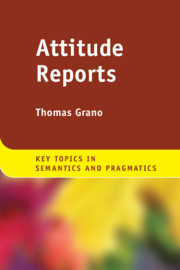
Propositional attitude reports are sentences built around clause-embedding psychological verbs, like Kim believes that it's raining or Kim wants it to rain. These interact in many intricate ways with a wide variety of semantically relevant grammatical phenomena, and represent one of the most important topics at the interface of linguistics and philosophy, as their study provides insight into foundational questions about meaning. This book provides a bird's-eye overview of the grammar of propositional attitude reports, synthesizing the key facts, theories, and open problems in their analysis. Couched in the theoretical framework of generative grammar and compositional truth-conditional semantics, it places emphasis on points of intersection between propositional attitude reports and other important topics in semantic and syntactic theory. With discussion points, suggestions for further reading and a useful guide to symbols and conventions, it will be welcomed by students and researchers wishing to explore this fertile area of study.
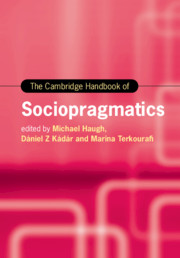
Sociopragmatics is a rapidly growing field and this is the first ever handbook dedicated to this exciting area of study. Bringing together an international team of leading editors and contributors, it provides a comprehensive, cutting-edge overview of the key concepts, topics, settings and methodologies involved in sociopragmatic research. The chapters are organised in a systematic fashion, and span a wide range of theoretical research on how language communicates multiple meanings in context, how it influences our daily interactions and relationships with others, and how it helps construct our social worlds. Providing insight into a fascinating array of phenomena and novel research directions, the Handbook is not only relevant to experts of pragmatics but to any reader with an interest in language and its use in different contexts, including researchers in sociology, anthropology and communication, and students of applied linguistics and related areas, as well as professional practitioners in communication research.
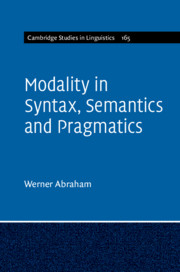
What do we mean when we say things like 'If only we knew what he was up to!' Clearly this is more than just a message, or a question to our addressee. We are expressing simultaneously that we don't know, and also that we wish to know. Several modes of encoding contribute to such modalities of expression: word order, subordinating subjunctions, sentences that are subordinated but nevertheless occur autonomously, and attitudinal discourse adverbs which, far beyond lexical adverbials of modality, allow the speaker and the listener to presuppose full agreement, partial agreement under presupposed conditions, or negotiation of common ground. This state of the art survey proposes a new model of modality, drawing on data from a variety of Germanic and Slavic languages to find out what is cross-linguistically universal about modality, and to argue that it is a constitutive part of human cognition.
Chapter 12 is the first of two that deal with reactive politeness in intercultural contexts: the issues associated with handling relations when an offence has been perceived or when a disagreement/conflict has occurred or is emerging. The chapter focuses on situations in which one or both parties want to restore relations and considers how cultural factors may influence the process. Normally (although not exclusively), apologies are used to (try to) restore smooth relations. Unfortunately, there has been very little research into apologies from an evaluation perspective, neither prior to an apology (i.e. assessments relating to the behaviour that triggers the potential need for an apology) nor subsequent to an apology (i.e. whether the apology is accepted and smooth relations are restored). The chapter explores the potential impact of culture on the restoration process from three angles: culture and reactive assessments of an offence; culture and the performance of an apology; culture and the effectiveness of the apology.
Much work in both politeness theory and the intercultural field focuses on problematic interactions (situations where there has been some kind of offence or disagreement) and/or on ways of preventing or avoiding such problems, where the aim is to maintain smooth interpersonal relations. However, another important angle on relating is ways of proactively building and enhancing relations, and this is the focus of this chapter. It considers ways in which relationships of various kinds (personal friendships, workplace colleagues, international business partners) can be initiated and fostered, and the impact that cultural factors can have on these processes. Chapter 15 notes that there are few developmental models that identify or explain these processes, and that there is a corresponding minimal amount of empirical research into the developmental process, especially for intercultural relations. The chapter suggests, therefore, that this is a valuable area for further research. The chapter has four main sections: developmental conceptual frameworks; initiating intercultural relations; fostering and enhancing intercultural relations; conceptual reflections.
Chapter 8 explores the second major component of the evaluation warrant: the socio-moral order that underpins judgements and complements the other major component – interpersonal sensitivities. The chapter starts by considering theorising on morality and the moral order, since recent work in politeness theory has focused particularly on this. First, it discusses pragmatic theorising on the moral order before turning to work in moral psychology and describe two well-known moral frameworks in psychology. The chapter then explores possible links between face, values and moral foundations/motives from an interdisciplinary perspective, in an attempt to gain a deeper understanding of their interconnections. Finally, the chapter argues for the inclusion of a social order that is primarily convention-based (i.e. relates more to descriptive norms and ‘social oughts’) and proposes that there is a continuum between the social and moral warrants to participants’ judgments. The chapter labels this the socio-moral order. As with concepts discussed in previous chapters, the issue of universality and cultural variability is central. There are three main sections to the chapter: morality and the moral order; moral foundations, values and face; social transgressions and morality.
This chapter is the second of two on ‘reactive politeness’; in other words, on the ways that interlocutors react and respond to something that has happened previously. It starts by considering the pros and cons of disagreement and conflict, and argues that, contrary to much public opinion, disagreement and conflict can be positive if handled well. Chapter 13 reports linguistic findings on conflict management strategies and provides an extensive analysis of a conflict in which culture plays a role. The chapter examines the different ways in which culture can affect disagreement and conflict, and notes the impact of the following: cultural membership/identity, different assessments/expectations associated with the communicative activity in which the disagreement takes place, and different assessments/expectations associated with the nature of the participant relations. In relation to cultural membership/identity, the chapter introduces faultline theory, explaining the impact that ‘identity faultlines’ can have on group or team relations. There are six main sections to the chapter: pros and cons of disagreement; conflict management orientations and strategies; dynamics of disagreement; cultural membership and disagreement; cultural orientation and tactics; culture, context and disagreement.
This chapter moves to the next main step in the book's politeness evaluation model: whether the behaviour in the focal event is expected or not and whether or not the evaluation process is triggered. It explores the concept of norms and the expectations that they give rise to. The chapter argues that breaches in norms and expectations trigger the evaluation process and that there can be cultural differences in the norms and expectations that people hold, as well as in the strictness with which they are upheld. In addition, it is argued that participants’ normalcy thresholds can vary according to the characteristics of other interlocutors, including ingroup/outgroup membership, biculturality/multiculturality and the influence of affective factors. The chapter has four main sections: descriptive and injunctive (prescriptive/proscriptive) norms, expectations and expectancy violation theory, prescriptive/proscriptive norms and etiquette, normalcy zone and threshold.
This chapter explores the final step in the evaluation process: the judgement itself. When the evaluation process is triggered through a noticeable breach of expectations, interactants draw on the various facets of their evaluation warrant (as explained in Chapters 7 and 8) and make a judgement. Chapter 9 focuses on this verdict stage of the process and explores the various elements associated with this. It points out that emotions are often intimately linked with the whole process of evaluation and argues that judgement of behaviour and judgement of the agent need to be distinguished. Often the two are imperceptibly merged, with ‘rude behaviour’ turning into a judgement of ‘rude individual’. Drawing on a theory of blame, the chapter unpacks the various elements that influence people’s judgement of the agent. It also acknowledges that the judgement process is affected by the dynamics of behavioural interaction, including issues such as mindfulness. Finally, the chapter argues that reflecting on the whole evaluation process, including the different perspectives that people may have on what happened and different reasons for it, can be extremely valuable for enhancing intercultural awareness and promoting positive intercultural relations.