To save content items to your account,
please confirm that you agree to abide by our usage policies.
If this is the first time you use this feature, you will be asked to authorise Cambridge Core to connect with your account.
Find out more about saving content to .
To save content items to your Kindle, first ensure no-reply@cambridge.org
is added to your Approved Personal Document E-mail List under your Personal Document Settings
on the Manage Your Content and Devices page of your Amazon account. Then enter the ‘name’ part
of your Kindle email address below.
Find out more about saving to your Kindle.
Note you can select to save to either the @free.kindle.com or @kindle.com variations.
‘@free.kindle.com’ emails are free but can only be saved to your device when it is connected to wi-fi.
‘@kindle.com’ emails can be delivered even when you are not connected to wi-fi, but note that service fees apply.
The de dicto/de re ambiguity concerns the multiplicity of readings that many attitude reports give rise to depending on whether an expression in the complement clause is interpreted as part of the content of the attitude (de dicto reading) or as an attitude-external means of referring to or quantifying over some aspect of the content of the attitude (de re). For example, Beatrix wants to marry a plumber can report either that Beatrix wants her eventual spouse to have a particular occupation (de dicto) or that there is a particular plumber that Beatrix wants to marry (de re). We discuss the classic scope solution to this ambiguity, as well as theproblems for that approach that have inspired adjustments (world pronouns, split intensionality). We outline the implications of these adjustments for the grammar of attitude reports and of intensionality more generally. We then discuss a more serious problem (“double vision”) first noticed by W. V .O. Quine that has inspired a very different approach to de re readings, involving concept generators. We close by stepping back and asking: Should one approach ultimately be subsumed under the other, or are both needed in a comprehensive theory?
A central theoretical tension for the semantics of proper names and attitude reports, known as Frege’s puzzle, goes as follows. On the one hand, a simple and attractive theory holds that the sole semantic function of a proper name is to contribute a referent, leading to the prediction that co-referential proper names like Superman and Clark Kent are semantically equivalent.On the other hand, intuition tells us that it could be true to say that Lois Lane believes that Superman is strong while at the same time seemingly false to say that Lois Lane believes that Clark Kent is strong. We survey the three most popular approaches to reconciling this tension: complicating the semantics of proper names (non-rigid designation), complicating the semantics of attitude reports (hidden indexicals), and complicating the pragmatics of attitude reports. We also discuss the related issues of Kripke’s puzzle, as well as Saul’s puzzle concerning substitution of co-referential proper names in simple sentences.
Traditional grammar and current theoretical approaches towards modelling grammatical knowledge ignore language in interaction: that is, words such as huh, eh, yup or yessssss. This groundbreaking book addresses this gap by providing the first in-depth overview of approaches towards interactional language across different frameworks and linguistic sub-disciplines. Based on the insights that emerge, a formal framework is developed to discover and compare language in interaction across different languages: the interactional spine hypothesis. Two case-studies are presented: confirmationals (such as eh and huh) and response markers (such as yes and no), both of which show evidence for systematic grammatical knowledge. Assuming that language in interaction is regulated by grammatical knowledge sheds new light on old questions concerning the relation between language and thought and the relation between language and communication. It is essential reading for anyone interested in the relation between language, cognition and social interaction.
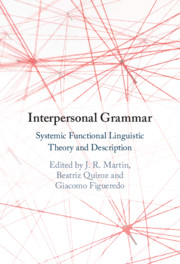
This pioneering volume lays out a set of methodological principles to guide the description of interpersonal grammar in different languages. It compares interpersonal systems and structures across a range of world languages, showing how discourse, interpersonal relationships between the speakers, and the purpose of their communication, all play a role in shaping the grammatical structures used in interaction. Following an introduction setting out these principles, each chapter focuses on a particular language - Khorchin Mongolian, Mandarin, Tagalog, Pitjantjatjara, Spanish, Brazilian Portuguese, British Sign Language and Scottish Gaelic – and explores mood, polarity, tagging, vocation, assessment and comment systems. The book provides a model for functional grammatical description that can be used to inform work on system and structure across languages as a foundation for functional language typology.
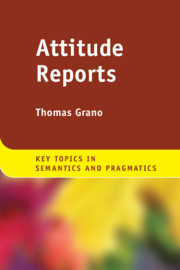
Propositional attitude reports are sentences built around clause-embedding psychological verbs, like Kim believes that it's raining or Kim wants it to rain. These interact in many intricate ways with a wide variety of semantically relevant grammatical phenomena, and represent one of the most important topics at the interface of linguistics and philosophy, as their study provides insight into foundational questions about meaning. This book provides a bird's-eye overview of the grammar of propositional attitude reports, synthesizing the key facts, theories, and open problems in their analysis. Couched in the theoretical framework of generative grammar and compositional truth-conditional semantics, it places emphasis on points of intersection between propositional attitude reports and other important topics in semantic and syntactic theory. With discussion points, suggestions for further reading and a useful guide to symbols and conventions, it will be welcomed by students and researchers wishing to explore this fertile area of study.
This chapter outlines the present-day distribution of languages and language families used across mainland Southeast Asia, drawing on current historical/comparative linguistic research. Overviews are given of what is known in the historical/comparative linguistics of the Austroasiatic, Tai-Kadai, Chamic, Moklenic, Hmong-Mien, and Tibeto-Burman language families, along with surveys of the area's sign languages, classical languages, and writing systems.
This chapter gives an introductory overview of the strategies used in mainland Southeast Asian languages for making verbal predications in the core of clauses. There is an overview of verbal marking including patterns of negation, aspect, and modality. An important feature of the area’s languages is the heavy reliance on serial verb constructions (or multi-verb constructions) for packaging information in clauses and sentences. The chapter surveys various sub-categories of multi-verb construction, including depictive/adverbial constructions and complementation strategies. The chapter closes with a section on valency-changing strategies, including syntactic causatives, reflexives, and reciprocals.
This chapter gives an introductory overview of the patterns of reference and nominal syntax in the languages of mainland Southeast Asia. The chapter begins with the principles by which head nouns are modified, for example by adjectives or relative clauses, or in possessive constructions. Many languages of the area have systems of nominal classification, especially numeral classifiers and class terms. Personal pronoun systems range from extremely simple, such as in certain varieties of Chinese, to extremely complex, such as in the systems of Thai, Burmese, or Cambodian, whose systems of pronouns show elaborate distinctions in social-hierarchical structure and politeness. Demonstrative systems of the area span the range of complexity, ranging from two-term systems to systems with eight or more distinctions.