To save content items to your account,
please confirm that you agree to abide by our usage policies.
If this is the first time you use this feature, you will be asked to authorise Cambridge Core to connect with your account.
Find out more about saving content to .
To save content items to your Kindle, first ensure no-reply@cambridge.org
is added to your Approved Personal Document E-mail List under your Personal Document Settings
on the Manage Your Content and Devices page of your Amazon account. Then enter the ‘name’ part
of your Kindle email address below.
Find out more about saving to your Kindle.
Note you can select to save to either the @free.kindle.com or @kindle.com variations.
‘@free.kindle.com’ emails are free but can only be saved to your device when it is connected to wi-fi.
‘@kindle.com’ emails can be delivered even when you are not connected to wi-fi, but note that service fees apply.
This chapter clarifies that the treatment and reliability of orthographic variables as linguistic variables has already been tested with the application of both macroscopic and microscopic approaches to digitalized historical materials. Patterns of variation and change in past periods of a given language have been evidenced through the observation of its users’ sociolinguistic behavior in social interaction. The recent prolific research output in historical sociolinguistics reflects the growth of interest in style and register within the field. The role of new genres and text types (e.g. travel accounts, court records, recipes, diaries, and letters) is thus also being highlighted as materials worth studying for both interspeaker and intraspeaker variation. The chapter explores the indexical potential of orthographic variation in style, register, genre and text types. The extralinguistic factors conditioning the use of different spelling forms in cases of variability are usually based on production, geographical location, sociodemographics (sex, age, rank), social networks, text type (and genre), style, register and medium (handwritten vs. printed). In earlier periods, when correspondence and other ego-documents were probably the most frequent means of written communication and without the existence of a well-established and fixed standard variety, orthographic variation constituted a source of social meaning.
This chapter explains that linguistic uniformity is rarely characteristic of nation-states. In Europe, official national languages brought powerful and ongoing consequences for ‘minority’ languages and their speakers. Nineteenth-century nation- and empire-building affected regional speakers of national languages, such as Flemish or Austrian German, or Afrikaans among other postcolonial varieties of European languages. Imposing European languages in settler nations has irrevocably endangered or eliminated Indigenous languages and cultures. The debates about European orthographic authorities surveyed in this chapter expose conflicting cultural allegiances and pedagogical needs. Vernaculars inherited diverse writing practices from different scholarly discourse communities, whether government chanceries or literary scriptoria or national language academies. Representative conflicts include tensions between scholarly traditions and simplified spellings for mass state education. Existing traditions can be difficult to displace, especially in democracies. Educators’ engagement with the state reminds us that pedagogy is often a matter of politics. Journalists can support or undermine proposed norms, whether using or reporting them. Successful reforms sometimes reflect intersections of low literacy and/or authoritarian states. Many debates that raged in the nineteenth century have continued into modern times. With the rise of social media, individuals can not only internalize but also influence and drive discourses of group identity.
This chapter provides a short introduction to historical orthography, discussing purposes, ambitions and boundaries within the subfield. It also outlines chapter contents.
This chapter introduces readers to the concept of spelling standardization, offering an overview of the ways in which spelling standardization occurred, the agents behind the modern-like developments in historical spelling, and the chronology of the process of development in historical English. The chapter departs from the idea that historical spelling represents one of the most complex facets of linguistic standardization, and one where disagreements exist about its overall process of development. The contribution moves on to discuss the idea that standardization in English spelling was, for some scholars, an intralinguistic, spontaneous process of self-organization, and for others a multiparty affair that involved authors, readers, the printing press and linguistic commentators of the time. The final section summarizes findings from recent work that focuses on large-scale developments over the sixteenth and the seventeenth century, and overviews the role and relevance of theoreticians, schoolmasters, authors and readers in Early Modern English spelling.
This chapter focuses on the terminology and typology relevant to the study of early writing systems from a linguistic perspective. It first introduces writing as a linguistic notation system that arose in the context of numerical and iconographic notation systems, and the study of writing systems as a growing subdiscipline of linguistics. Next, it presents the typology of written signs, including the basic divide between logograms and phonograms. It also describes how writing arose independently in three or four places in the world, resulting in writing systems that were heavily logographic, encoding morphemes, which have both phonological and semantic values. Abstraction along the phonological and semantic dimensions led to phonography and semantic determinatives. The author briefly characterizes each of the pristine systems and considers the typology of phonographic writing more closely, following the traditional division into syllabaries and alphabets. This chapter defends the established definition of syllabary and offers some criticism of the Daniels’ abjad-abugida-alphabet typology of segmental scripts. The chapter presents some early historical examples of phonographic scripts and considers implications of script typology on sign inventory size as well as the evolution of script types, and whether there is directionality in script evolution.
This chapter discusses the ongoing enterprise of developing typologies of writing systems, which strives to propose a coherent framework for classifying the world’s diverse writing systems. Because different theoretical assumptions about the core entities under analysis can yield divergent proposals, it is valuable to continually assess the conceptual and terminology contrasts that both shape and communicate typology proposals. Therefore, this chapter examines the underlying conceptualizations, the diverse, and often inconsistent, terminology, and the main limitations of existing typologies of writing systems, to further elucidate the materialization of written language both diachronically and synchronically. The substantial third section illustrates how the majority of typology proposals classify writing systems primarily in terms of a core set of representational principles, or mapping relationships, assumed to exist between the linguistic units and graphemes of a language. After commenting on the elusive trinity of key terms (writing system, script and orthography), this section outlines some of the most influential, controversial and promising typology proposals and reflects on the various conceptual and terminological distinctions propounded to capture the principles of representational mapping. The last section of the chapter briefly considers the merits of exploring complementary or alternative approaches to writing system typologies.
This chapter gives an overview of different approaches to data collection. Three methods of comparative variable studies are presented in detail and illustrated with examples from the early history of printing: intratextual, intertextual and cross-textual variable analyses. Intratextual variable analysis investigates the frequency and range of spelling variants in a single text copy and is particularly useful for the detection of possible internal factors that trigger the choice of a variant. The intertextual analytical method compares the results of two or more intratextual investigations, for example with respect to different external determinants such as time and place. The third method, cross-textual variable analysis, compares the spelling variants of different versions of the same text, and is concerned with alterations from one version to the other in order to detect a pattern of deliberate changes. The advantages and disadvantages of the three methods are considered in the chapter, and their inherent theoretical premises are discussed. The author shows that data collection and interpretation are closely intertwined, and also that the chosen approach prestructures the data and leads to preferences for specific interpretations.
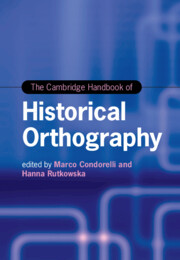
The study of orthography (spelling and writing systems), and its development over the history of language, is central to many areas of linguistic enquiry, offering insight into syntactic and morphological structures, phonology, typology, historical linguistics, literacy and reading, and the social and cultural context of language use. With contributions from a global team of scholars, this Handbook provides the first comprehensive overview of this rapidly developing field, tracing the development of historical orthography, with special emphasis on the last and present centuries. Chapters are split into five key thematic areas, with a focus throughout on the interplay between theory and practice. It also explores the methods used in studying historical orthography, and the principles involved in the development of a spelling system. Providing a critical assessment of the state of the art in the field, it is essential reading for anyone with an interest in writing systems and historical linguistics.
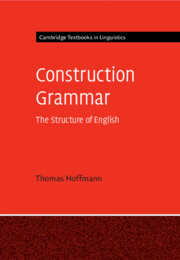
What do speakers of a language have to know, and what can they 'figure out' on the basis of that knowledge, in order for them to use their language successfully? This is the question at the heart of Construction Grammar, an approach to the study of language that views all dimensions of language as equal contributors to shaping linguistic expressions. The trademark characteristic of Construction Grammar is the insight that language is a repertoire of more or less complex patterns – constructions – that integrate form and meaning. This textbook shows how a Construction Grammar approach can be used to analyse the English language, offering explanations for language acquisition, variation and change. It covers all levels of syntactic description, from word-formation and inflectional morphology to phrasal and clausal phenomena and information-structure constructions. Each chapter includes exercises and further readings, making it an accessible introduction for undergraduate students of linguistics and English language.
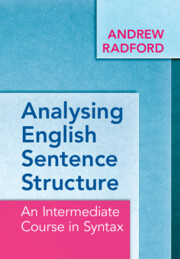
Andrew Radford has acquired an unrivalled reputation over the past forty years for writing syntax textbooks in which difficult concepts are clearly explained without excessive use of technical jargon. Analysing English Sentence Structure continues in this tradition, offering a well-structured intermediate course in English syntax and contemporary syntactic theory. Chapters are split into core modules, each focusing on a specific topic, and the reader is supported throughout with learning aids such as summaries, lists of key hypotheses and principles, extensive references, exercises with handy hints, and a glossary of terminology. Both teachers and instructors will benefit from the book's free online resources, which comprise an open-access Students' Answerbook, and a password-protected Teachers' Answerbook, each containing comprehensive answers to exercises, with detailed tree diagrams. The book and accompanying resources are designed to serve both as a coursebook for use in class, and as a self-study resource for use at home.