To save content items to your account,
please confirm that you agree to abide by our usage policies.
If this is the first time you use this feature, you will be asked to authorise Cambridge Core to connect with your account.
Find out more about saving content to .
To save content items to your Kindle, first ensure no-reply@cambridge.org
is added to your Approved Personal Document E-mail List under your Personal Document Settings
on the Manage Your Content and Devices page of your Amazon account. Then enter the ‘name’ part
of your Kindle email address below.
Find out more about saving to your Kindle.
Note you can select to save to either the @free.kindle.com or @kindle.com variations.
‘@free.kindle.com’ emails are free but can only be saved to your device when it is connected to wi-fi.
‘@kindle.com’ emails can be delivered even when you are not connected to wi-fi, but note that service fees apply.
This chapter introduces the operation Remove. The starting point is the question of how to account for conflicting structure assignments in syntax. After excluding the standard means of syntactic movement for certain cases, several predecessors and alternatives of Remove are discussed (among them tree pruning, S-bar deletion, and exfoliation). In addition, the concept of coanalysis is critically evaluated. The core of the chapter is devoted to introducing Remove as an elementary operation that is the complete mirror image of Merge in that it triggers structure removal rather than structure building, and that it obeys exactly the same restrictions (with respect to triggers, strict cyclicity, etc.). On this basis, the different effects that Remove has for removal of phrases versus removal of heads are illustrated. Some general consequences are discussed next, concerning short life cycle effects, incompatibilities with other constraints (in particular, this holds for the Projection Principle), and semantic interpretation.
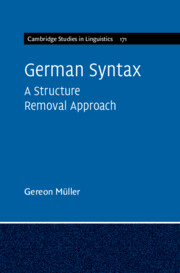
Exploring the major syntactic phenomena of German, this book provides a state-of-the-art account of German syntax, as well as an outline of the key aspects of Chomsky's Minimalist Program. It is one of the first comprehensive studies of the entire syntactic component of a natural language within the Minimalist Program, covering core issues including clause structure, binding, case, agreement, control, and movement. It introduces a phase-based theory of syntax that establishes Remove, an operation that removes syntactic structure, as a mirror image of Merge, which builds syntactic structure. This unified approach resolves many cases of conflicting structure assignments in syntax, as they occur with passivization, restructuring, long-distance passivization, complex prefields, bridge verbs, applicatives, null objects, pseudo-noun incorporation, nominal concord, and ellipsis. It will pave the way for similar research into other languages and is essential reading for anyone interested in the syntax of German, syntactic theory, or the Minimalist Program.
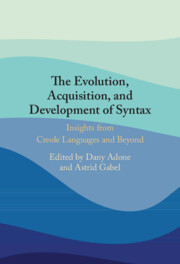
Bringing together an interdisciplinary team of scholars, this book explores three interconnected aspects of syntax - its origins and evolution, its acquisition by children, and its role in languages' ongoing development and change. These three distinct areas were linked through Bickerton's most provocative work 'Language Bioprogram Hypothesis' (LBH). This book highlights the discussions on syntax that have emerged over the years as a result of the LBH model. Each chapter include a discussion of Bickerton's work, and a special focus is placed on Creole languages, which provide unique case studies for the study of the evolution, acquisition and development of languages. The book also discusses the relevance of LBH for other natural languages, including sign languages. Shedding light on the relevance of syntax in language, it is essential reading for researchers and students in a wide range of linguistic disciplines.
This chapter presents the current state of research in multimodal Construction Grammar with a focus on co-speech gestures. We trace the origins of the idea that constructions may have to be (re-)conceptualized as multimodal form–meaning pairs, deriving from the inherently multimodal nature of language use and the usage-based model, which attributes to language use a primordial role in language acquisition. The issue of whether constructions are actually multimodal is contested. We present two current positions in the field. The first one argues that a construction should only count as multimodal if gestures are mandatory parts of that construction. Other, more meaning-centered, approaches rely less on obligatoriness and frequency of gestural (co-)occurrences and either depart from a recurrent gesture to explore the verbal constructions it combines with or focus on a given meaning, for example, negation, and explore its multimodal conceptualization in discourse. The chapter concludes with a plea for more case studies and for the need to develop large-scale annotated corpora and apply statistical methods beyond measuring mere frequency of co-occurrence.
De Lisser and Durrleman’s second chapter explores the syntax of missing subjects in the acquisition of creole languages by children. They focus on two Creoles – Jamaican, a non-null subject language, and Morisyen, a language which allows null subjects in certain contexts. The results of both cross-sectional and longitudinal analyses reveal striking similarities in the L1 acquisition of subjects in both Jamaican and Morisyen. Both languages start out with a grammar displaying predominantly target-inconsistent missing subjects, which later shifts to a grammar involving an overwhelming number of overt subjects. This development of subjects in the grammar of Creole-speaking children can be accounted for by the modified version of the Truncation approach in terms of the Spell-out mechanism (De Lisser et al., 2016). The initial structure reflects Universal Grammar, a system providing the option of truncation, and which gives rise to subject drop.
Adone’s chapter focuses on home signs, bringing to light the acquisition process against a background of ‘normless’ language environment (Bakker, this volume) and in the absence of exposure to a ‘conventional language model’ (Adone 2005). She thus discusses what absence of exposure means when looking at children home signers. In comparison to previous work, Adone shows that the absence of a conventional language model does not mean complete absence of input. She argues that children ‘scan’ their environment for input and use every bit of language-related information as input. Adone further argues that the verb chains in child home signers’ initial grammars develop into adult-like serial verb constructions. This development can be interpreted as evidence for the view that children exploit input to the best of their ability to ‘create language’.
Baptista and Sedlacek’s chapter takes Bickerton’s view that admixture is one of the chief characteristics of Creole languages (Bickerton 2008) as a starting point. The objective of their chapter is to bring to light the tight connections between the congruent forms observed across Creole languages (Faraclas et al. 2014; Faraclas 2012; Baptista 2006, 2009, 2020) which have been argued to result from speakers’ perception of similarities between the languages in contact and Weinreich’s notion of interlingual identification. A close review of interlingual identification (as it was laid out in Weinreich 1953) and how the concept has been applied and experimentally tested in situations of both bilingualism (Flege 1991) and multilingualism (Kresić and Gulan 2012) attest to how speakers use their native language as the mold through which they shape differently their interpretation of the same linguistic element in another language. As a result, the chapter argues that interlingual identification is ground zero for language mixing and language change.
De Lisser and Durleman’s first chapter focuses on Bickerton’s hypotheses about language acquisition. Whether articulated in terms of the Language Bioprogram or in terms of default parameter settings of Universal Grammar (1981, 1984, 1999, 2014, 2016), the hypotheses predict that prototypical Creole features will emerge in early stages of child productions. This view thus leads them to expect target-inconsistent utterances during the acquisition of non-Creole languages where such features are not present, and target-consistent utterances in the acquisition of Creole languages. The investigation tests the second of these predictions for negation via an eighteen-month longitudinal study of the spontaneous production of six Jamaican-speaking children between the ages of 18 and 23 months at the start of the research. The findings reveal an absence of target-inconsistent options for the expression of negation, suggesting that children acquiring Jamaican are knowledgeable of the rules governing negation from their earliest negative utterances, be they sentential, constituent or anaphoric. Taken together, these findings suggest that the acquisition of negation in Jamaican follows Bickerton’s predictions, which are also in line with the more general claim that Negative Concord (NC) is a default choice explored in early stages of child grammar regardless of the target (Moscatti 2020; Thornton 2020).
It follows from the usage-based view of language adopted in most strands of Construction Grammar that the constructicons of speakers of what is considered to be one and the same language will differ along social, or ‘lectal’, lines. This chapter explains the inherent theoretical importance of lectal variation for Construction Grammar and surveys existing construction-based work on synchronic language variation. Four major research strands are discussed: (i) studies aimed at the analysis of the form and/or meaning poles of constructions from specific lects; (ii) comparisons of the properties of a given construction or a set of related constructions across different lects; (iii) quantitative studies of grammatical alternations which include lectal variables in their research design; and (iv) studies of social variables involved in the propagation of constructional changes through communities of speakers. The chapter also identifies a number of challenges and open questions.
In this chapter, a central tenet of Construction Grammar is explored: the idea that linguistic knowledge on all levels (e.g., lexicon, morphosyntax, pragmatics) is related in a network fashion, with the building blocks of language (i.e., constructions) forming different types of connections (i.e., links). In general, we discuss the ingredients of constructional networks with our main focus on construction-external links (vertical and horizontal). Another aim of the chapter is to embed constructional networks into a larger domain-general theory of networks but also to demarcate constructional modeling from other network models in linguistics, like Connectionism or models of sociolinguistic propagation. We also glance at how diachronic network change is currently being conceptualized and end by a discussion of open issues.
Over the last four decades, Construction Grammar has developed into a rich, robust conceptual framework for analyzing language in its entirety, based on the crucial assumption that language by its nature is a complex and ever-adapting and adaptable system designed for communication. The starting point was Charles J. Fillmore’s vision for an approach that would allow us to analyze grammatical organization of (any) language in such a way that we could answer the broad question of what it means to know one’s language and to use its grammatical resources with native-like fluency by individual speakers within a given language community. Put differently, this framing aims for generalizations that will naturally include systematic observations about meaning and conditions of language use as integral parts of grammatical descriptions.
Ever since its conception in the 1980s, the scope of what is understood by ‘construction grammar’ has evolved to a point where the constructional enterprise has become a full branch of linguistics in its own right. It can therefore be a daunting challenge for newcomers to come to grips with different research directions that have been pursued under a constructional banner, and even seasoned construction grammarians are at risk of misunderstanding each other. The goal of this chapter is therefore to offer a comparative guide for navigating the constructional landscape and to show that the existence of different constructional flavors is a healthy and necessary response to the problem of analyzing complex linguistic structures, provided that the community maintains a consensus about its core concepts.