To save content items to your account,
please confirm that you agree to abide by our usage policies.
If this is the first time you use this feature, you will be asked to authorise Cambridge Core to connect with your account.
Find out more about saving content to .
To save content items to your Kindle, first ensure no-reply@cambridge.org
is added to your Approved Personal Document E-mail List under your Personal Document Settings
on the Manage Your Content and Devices page of your Amazon account. Then enter the ‘name’ part
of your Kindle email address below.
Find out more about saving to your Kindle.
Note you can select to save to either the @free.kindle.com or @kindle.com variations.
‘@free.kindle.com’ emails are free but can only be saved to your device when it is connected to wi-fi.
‘@kindle.com’ emails can be delivered even when you are not connected to wi-fi, but note that service fees apply.
How do children acquire African American English? How do they develop the specific language patterns of their communities? Drawing on spontaneous speech samples and data from structured elicitation tasks, this book explains the developmental trends in the children's language. It examines topics such as the development of tense/aspect marking, negation and question formation, and addresses the link between intonational patterns and meaning. Lisa Green shows the impact that community input has on children's development of variation in the production of certain constructions such as possessive -s, third person singular verbal -s, and forms of copula and auxiliary be. She discusses the implications that the linguistic description has for practical applications, such as developing instructional materials for children in the early stages of their education.
Based on a corpus of Texan oral narratives collected by the author over the past fifteen years, this study presents an analysis of the literary qualities or orally performed verbal art, focusing on the significance of its social context. Although the tales included are all from Texas, they are representative of oral storytelling traditions in other parts of the United States, including tall tales, hunting stories, local character anecdotes, accounts of practical jokes, and so on. They are also highly entertaining in their own right. Professor Bauman's main emphasis is on the act of storytelling, not just the text. His central analytical concern is to demonstrate the interrelationships that exist between the events recounted in the narratives (narrated events), the narrative texts, and the situations in which the narratives are told (narrative events). He identifies these interrelationships by combining a close formal analysis of the texts with an ethnographic examination of the way in which their telling is accomplished, paying particular attention to the links between form and function. He also illuminates other more general concerns in the study of oral narrative, such as stability and variation in the oral text, the problem of genre, and the rhetorical efficacy of literary forms. As an important contribution to the theoretical and practical literary analysis of orally performed narratives, the book will appeal to students and teachers of folklore, sociolinguistics and linguistic anthropology, and literary theory.
In this book Gillian Brown draws on a wide range of examples of discourse analysis to explore the ways in which speakers and listeners use language collaboratively to talk about what they can see in front of them and about a series of events. She examines the conditions under which communication is successful, and the conditions under which it sometimes fails. The focus of her attention is upon the listener's role, as the listener tries to make sense of what the speaker says in a highly constrained context; her cognitive/pragmatic approach to discourse analysis both complements and challenges the sociological/anthropological perspectives on the subject which currently predominate. Gillian Brown is co-author of the well-known textbook Discourse Analysis (Cambridge University Press, 1983).
This book describes the most important kinds of texts in English and introduces the methodological techniques used to analyse them. Three analytical approaches are introduced and compared, describing a wide range of texts from the perspectives of register, genre and style. The primary focus of the book is on the analysis of registers. Part 1 introduces an analytical framework for studying registers, genre conventions, and styles. Part 2 provides detailed descriptions of particular text varieties in English, including spoken interpersonal varieties (conversation, university office hours, service encounters), written varieties (newspapers, academic prose, fiction), and emerging electronic varieties (e-mail, internet forums, text messages). Finally, Part 3 introduces advanced analytical approaches using corpora, and discusses theoretical concerns, such as the place of register studies in linguistics, and practical applications of register analysis. Each chapter ends with three types of activities: reflection and review activities, analysis activities, and larger project ideas.
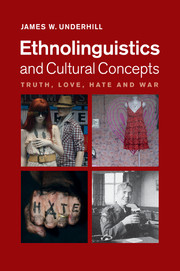
'Ethnolinguistics' is the study of how language relates to culture and ethnicity. This book offers an original approach to ethnolinguistics, discussing how abstract concepts such as truth, love, hate and war are expressed across cultures and ethnicities. James W. Underhill seeks to situate these key cultural concepts within four languages (English, French, Czech and German). Not only do these concepts differ from language to language, but they go on changing over time. The book explores issues such as how far meaning is politically and culturally influenced, how far language shapes the thought of ethnic groups and how far their thought shapes language, and the role of individuals in the consolidation of cultural concepts. It offers a clear and thought-provoking account of how concepts are understood and will be welcomed by those working in the fields of sociolinguistics, linguistic anthropology, discourse analysis, semantics and pragmatics.
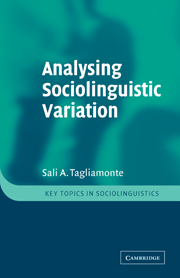
The study of how language varies in social context, and how it can be analyzed and accounted for, are the key goals of sociolinguistics. Until now, however, the actual tools and methods have been largely passed on through 'word of mouth', rather than being formally documented. This is the first comprehensive 'how to' guide to the formal analysis of sociolinguistic variation. It shows step-by-step how the analysis is carried out, leading the reader through every stage of a research project from start to finish. Topics covered include fieldwork, data organization and management, analysis and interpretation, presenting research results, and writing up a paper. Practical and informal, the book contains all the information needed to conduct a fully-fledged sociolinguistic investigation, and includes exercises, checklists, references and insider tips. It is set to become an essential resource for students, researchers and fieldworkers embarking on research projects in sociolinguistics.