To save content items to your account,
please confirm that you agree to abide by our usage policies.
If this is the first time you use this feature, you will be asked to authorise Cambridge Core to connect with your account.
Find out more about saving content to .
To save content items to your Kindle, first ensure no-reply@cambridge.org
is added to your Approved Personal Document E-mail List under your Personal Document Settings
on the Manage Your Content and Devices page of your Amazon account. Then enter the ‘name’ part
of your Kindle email address below.
Find out more about saving to your Kindle.
Note you can select to save to either the @free.kindle.com or @kindle.com variations.
‘@free.kindle.com’ emails are free but can only be saved to your device when it is connected to wi-fi.
‘@kindle.com’ emails can be delivered even when you are not connected to wi-fi, but note that service fees apply.
Making Sense addressed three meaning functions – reference, agency, and structure – in terms roughly parallel to Halliday’s three “metafunctions,” ideational, interpersonal, and textual. This companion volume “adds sense” by exploring two additional functions that we call context and interest. It sets out to create a framework with which to account for meaning that crosses the disciplinary paradigms of semiotics, linguistics (mainly pragmatics), the sociology of action, cultural and media studies, philosophy (ontology) and computer science (ontology again, or data structures). In this way, the book aims to provide a shared framework by means of which a range of practitioners will be able to work together, in education, communications, media, architecture, the arts, design, computing, and more. These disciplines and their related work practices have their own distinctive but mostly separate frameworks for understanding their respective domains of action. But all deal in their daily practices with meanings in their profound multimodality.
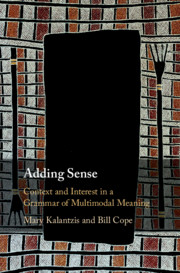
In recent years, with the rise of new media, the phenomenon of 'multimodality' (communication via a number of modes simultaneously) has become central to our everyday interaction. This has given rise to a new kind of literacy that is rapidly gaining ground as an area of research. A companion to Making Sense, which explored the functions of reference, agency and structure in meaning, Adding Sense extends this analysis with two more surrounding functions. It addresses the ways in which 'context' and 'interest' add necessary sense to immediate objects of meaning, proposing a 'transpositional grammar' to account for movement across these different forms of meaning. Adding Sense weaves its way through philosophy, semiotics, social theory and the history of ideas. Its examples cross a range of social contexts, from the meaning universes of the First Peoples, to the new forms of meaning that have emerged in the era of digitally-mediated communication.
Chapter 9 looks beyond CODA in two ways. On the one hand, CODA is only one among many established ways to examine human thought; linguistic analysis can be easily and fruitfully combined with other methods. The first half of this chapter addresses triangulation with performance and other observable data as well as subtler measures such as reaction times and eye movements, and also includes brief discussions of cognitive modelling and corpus linguistic methods. On the other hand, CODA is rarely used purely for its own sake; more often than not, linguistic analysis is part of a wider goal. Results can be used for a multitude of applications and purposes, including implementation in automatic systems that support human everyday needs. Therefore, the second half of Chapter 9 concludes the book with a discussion of practical applications for the methodology in academia and beyond, in applied and interdisciplinary fields such as architecture and artificial intelligence, and also looks at how CODA results can be made more accessible using suitable visualisation tools. The final section provides a brief wrap–up of the book's main messages.
Chapter 8 provides a detailed account of practical steps and advice for doing CODA. While avoiding reintroducing well-known methods of discourse analysis , it highlights important principles and shares practice–based insights that have accumulated over many years of doing CODA. Starting with considerations as to the purpose of individual CODA studies, it discusses relevant procedures step by step, including experimental design aspects, data collection, transcription and data preparation, and practical steps of data analysis such as segmentation, content analysis, tool support, and operationalisation of analysis categories. The final sections of this chapter consider issues pertaining to qualitative and quantitative analysis methods. The practical guidance using only simple and highly accessible tools provided in this chapter will be well received particularly by graduate students (or early-career researchers) with little access to complex technologies or hands–on practical support in their own universities. More experienced researchers will understand the principles quickly and be able to adapt them for their own purposes, using whichever technology they may have access to.
Chapter 4 is the first of four chapters that each explore conceptual aspects that are of potential interest to researchers when using language to access cognition, across a broad range of subject areas. These conceptual aspects can therefore be regarded as prominent analysis perspectives. This chapter starts by discussing two central phenomena related to cognitive orientation: attention and perspective. Both of these are systematically reflected in language use, albeit in different ways: attention underlies our choice of what we say, whereas perspective addresses how we say it. What we say will reflect what we attend to; aspects that we barely think about will rarely be reflected in our descriptions. As we formulate what we’re attending to, we can use our own point of view or adopt a different one, such as our interaction partner’s standpoint. While we don𣀙t often say explicitly which perspective we’re using, our language will reflect the underlying viewpoint in systematic ways.
Chapter 1 has three goals. First, it provides motivation and history for the methodology by reviewing seminal insights and current debates about the relationship between language and thought, outlining how most research in this field concerns the structure of language rather than its use. Second, it outlines the scope for using CODA by identifying crucial and typical areas of application, with specific focus on mental representations and cognitive processes. Third, it highlights the scope and limits of language analysis of this kind, along with a discussion of reliability and generalisability of insights gained by using CODA. Altogether, the chapter provides in-depth insights into the foundational insights the method builds on, what it is intended for, why and where it is useful, and how it relates to other approaches to cognition.
Chapter 7 addresses the formulation of thought from two perspectives. On the one hand, whenever we put thoughts into words, we do this for a specific purpose – typically for the benefit of an interaction partner. The first half of Chapter 7 discusses communication and dialogic interaction, where thoughts are formulated for an addressee; this affects how words are chosen, what kind of background knowledge is presumed, what style of language is adopted, etc.; also, speakers adapt to each other in the course of a dialogue. Further, dialogues follow specific structures that can be systematically accounted for. The second half of this chapter addresses the idea of cognitive strategies, which are the main target of think–aloud protocol analysis in traditional problem-solving studies. These are not intended to be primarily formulated for an addressee but instead represent the structure of cognitive processes in temporal sequence. While content analysis is the first (and often the only) crucial step for researchers in this general field, the chapter explores what kinds of insights CODA adds with its focus on linguistic features. This concludes the set of chapters addressing analysis perspectives.
This chapter gently sets the stage for the book, using accessible language and intuitive examples. It outlines the key insights in the book in simple terms, provides motivation for the issues addressed in subsequent chapters, and introduces relevant facts from everyday experience as well as academic background. Straightforward insights help to motivate and encourage the reader to consider using Cognitive Discourse Analysis in their own research, independent of previous experience in linguistic analysis. The short chapter ends by listing the main content for each of the book’s chapters, thus providing a first detailed and intuitive overview of the book’s overall scope.
Concluding the set of general background chapters that introduce theoretical foundations, Chapter 3 summarises relevant insights from three fairly unrelated fields: cognitive linguistics, discourse analysis, and functional grammar. In cognitive linguistics, prominent insights include the relationship between words, concepts, and meanings, along with their structures in terms of semantics and syntax, general patterns concerning how language is used, and the fact that meanings are embedded in physical experience and transferred to more abstract domains (often referred to as metaphor). Discourse analysis is a generic label encompassing many ways of analysing actual language used in different contexts; this section looks at prominent methods adopted in well-known approaches such as Critical Discourse Analysis and Conversation Analysis, and then addresses a range of discourse-specific phenomena to illustrate pertinent insights in the field. Finally, Functional Grammar with its three levels of analysis (interpersonal, ideational, and textual) offers specific analysis perspectives and insights that are highly relevant and useful for understanding discourse in a cognitive context.