To save content items to your account,
please confirm that you agree to abide by our usage policies.
If this is the first time you use this feature, you will be asked to authorise Cambridge Core to connect with your account.
Find out more about saving content to .
To save content items to your Kindle, first ensure no-reply@cambridge.org
is added to your Approved Personal Document E-mail List under your Personal Document Settings
on the Manage Your Content and Devices page of your Amazon account. Then enter the ‘name’ part
of your Kindle email address below.
Find out more about saving to your Kindle.
Note you can select to save to either the @free.kindle.com or @kindle.com variations.
‘@free.kindle.com’ emails are free but can only be saved to your device when it is connected to wi-fi.
‘@kindle.com’ emails can be delivered even when you are not connected to wi-fi, but note that service fees apply.
Pétain’s successful handling of the French Army after the mutinies following Nivelle’s failed offensive (see Chapter 5) has obscured Pétain’s other significant achievements in improving its organisation. If his appointment did not arouse great enthusiasm amongst his colleagues – ‘the most acceptable’ of the possibilities, wrote Guillaumat – yet he had the necessary qualities to restore the French Army. Pétain’s strength was his sense of order and organisation, and he imposed his views about training, doctrine and materiel provision upon a reorganised GQG staff. It is important to note, in this respect, that Pétain was an infantry officer, hence likely to be more in tune with the pcdf, unlike his two predecessors, Joffre an engineer and Nivelle an artillery officer. (Joffre’s GQG in 1915, for example, had four artillery officers and three engineers in the senior positions.) Colonel Pétain began the war as a brigade commander, moving quickly through the various levels of command, from division to corps to army and army group. Although he had spent time as a lecturer in the Ecole Supérieure de Guerre, his experience was of active command in the field, rather than as a staff officer. He believed that training was important, as well as liaison between infantry and artillery and between aviation and artillery, and he imposed that belief on the French Army.
Just as Foch’s general offensive was about to begin on the Western Front, events in Macedonia gave even greater reason for hope in a quicker than anticipated end to the war. The Allied armies in Macedonia numbered over half a million at the beginning of 1918, but by 14 September their strength had been increased by the arrival of Greek divisions. Greece had joined the war on 2 July 1917 after the removal of King Constantine, and a large French military mission, headed by General Braquet, the military attaché in Athens, had helped to put the Greek Army onto a war footing. Sarrail’s replacement as Allied CinC in Salonika, General Guillaumat, had been recalled to Paris as a precaution, because he was the only possible successor to either Foch or Pétain, should the aftermath of the German May 1918 offensive on the Chemin des Dames demand sackings, as had happened in 1917 after the French offensive there. General Franchet d’Espèrey, former commander of the Northern Army Group, replaced Guillaumat in Salonika. Franchet d’Espèrey had 670,000 men under his orders in twenty-eight divisions: four British (some of the earlier strength had been transferred to the Middle East), nine Greek, one Italian, six Serbian and the French cavalry brigade plus eight French infantry divisions commanded by General Henrys. As well as constituting the largest contingent, the French Army had also armed the Greek and Serbian contingents. The British official history of the Macedonian campaign praises the French for their work, which ‘cannot be too highly estimated’. After the Serbian and Romanian armies, the Greek ‘was the third East European Army of which France had undertaken the re-organization in the course of the war, in every case with striking success’.
In 1915 the French Army carried out a series of bloody and repetitive attacks from their own trenches against those of the entrenched enemy opposite. Attempts were made by various means to break the stalemate. These were technological (the development of new weapons) and doctrinal (the development of better tactics both in attack and in defence). Politics and diplomacy were invoked also. The politicians had returned to Paris from Bordeaux, and they attempted to impose closer control over what the army’s high command was doing, thereby preventing the worst (to political eyes) military errors; diplomacy consisted essentially of bribing new members into joining the alliance. So the struggle to improve the conditions under which the war was being conducted by all, from the poilu in the trenches to the premier and President of the Republic, dominated the search for victory. Yet the principle on which that search for victory rested remained the offensive.
Although the winter 1914/15 had shut down most fighting, already reduced in scale for lack of munitions, Joffre was determined that the fighting should not stop altogether. There were internal domestic reasons for his decision, as well as external ones. Domestically, the government’s return to the capital meant that the CinC and his staff faced parliamentary criticism over the costs to France of 1914’s events, costs that were both human in the huge numbers of killed and wounded, and material in the destruction of towns and the loss of manufacturing capacity, especially the mineral resources in north-eastern France where the loss of the iron-ore deposits in the Briey basin gave Germany a crucial advantage. The new war minister, Alexandre Millerand, provided Joffre with a counterweight to criticism, since he supported Joffre and the GQG wholeheartedly. Besides, the French Army could not simply sit idly by while the enemy took French citizens as hostages or helped themselves to French coal and iron-ore deposits and machine-tools.
In August 1914 Joffre’s stated intention was to take the offensive once all his armies had assembled. Despite some claims to the contrary, the French Army’s ‘doctrine of the offensive’ did not imply a belief that sufficient offensive spirit could carry a soldier in his red trousers and armed with a bayonet into the enemy’s lines, where he could pluck a laurel wreath from an enemy gun. Unfortunately, however, too many insufficiently trained men, led by unfit or incompetent commanders, attempted to mount infantry charges, unsupported by artillery and lacking intelligence about the enemy’s whereabouts and strength. Yet, fortunately, enough sense of the offensive survived the slaughter of the Battles of the Frontiers to enable the French to retreat far enough to turn around and halt the invasion on the Marne, much to German surprise. In 1915 the French Army began to think about methods, and how to break out from the static trenches and through the enemy’s front line. The thinking was mainly top-down at first, but gradually ideas began to percolate upwards as well, and by the end of 1915 GQG was soliciting detailed after-action reports in order to learn lessons. The aim remained breakthrough, but this proved elusive as the belligerents matched ever greater volumes of shell. The two Western Front battles of 1916 showed that, even when the front lines were breached, the depth of the defensive positions meant strategic failure. One answer was the ‘scientific method’, in which lengths and depths of front were assessed and the numbers of shells necessary to shatter defences were calculated, but this method was no more successful on the Somme than the enemy offensive had been at Verdun. There the Germans had concentrated an immense weight of artillery against a limited objective, but the French defenders managed to hold on. Nivelle’s successful counter-stroke at Verdun in October 1916 gave him the top job in 1917, but then his attempt to duplicate his tactical success on a strategic scale failed utterly, achieving neither surprise, nor speed, nor overwhelming superiority of firepower. His failure led men to cry ‘halt’.
On the evening of 24 July 1914, the French war minister, Colonel Adolphe Messimy, summoned the commander-in-chief designate of the French Army, General Joseph Joffre. Messimy told him that, following the assassination in Sarajevo, Germany supported Austria-Hungary’s firm stance against Serbia in the matter. That support would represent direct opposition to Russia’s support for Serbia; hence France’s military agreements with Russia might come into play. Joffre recorded in his memoirs that he replied to Messimy: ‘Well, monsieur le ministre, if we have to make war we will do so.’ It must be presumed, therefore, that Joffre believed that France could emerge victorious. This book examines the French Army, which Joffre was to use to defeat Germany, in order to evaluate how well it performed. It begins with the reforms following the disastrous Franco-Prussian war, when France was defeated and humiliated, examines the battles between 1914 and 1918, and explains how France did indeed emerge victorious to sit at the victors’ table in 1919 for the signatures on the Treaty of Versailles.
The prelude to the First World War took place in North Africa. In 1911, at the height of the second Moroccan crisis, when the German gunboat Panther anchored off Agadir in order to protect the rights of German merchants in the North African country where French economic interests were growing, Europe feared a general war. France’s then premier, Joseph Caillaux, asked Joffre what France’s chances of victory were if such a war resulted from the crisis. He reminded Joffre that Napoleon Bonaparte had stated that a general should have at least a 70 per cent chance of victory before embarking on a battle, and Joffre replied that France did not possess such a margin. Caillaux ended the Moroccan crisis diplomatically, therefore, ceding a portion of the French Cameroons to Germany in return for German recognition of France’s protectorate in Morocco. War had been averted for three years.
The general chosen to replace Joffre is the only man with a Western Front battle named after him. Joffre had preferred Robert Nivelle to the cautious and demanding Pétain of May 1916 at Verdun, and he recommended Nivelle to Briand. Since Briand was expecting Joffre still to play a role as the government’s ‘technical advisor’, it seemed prudent that Joffre and the new CinC should be able to work together. Furthermore, Poincaré much preferred the Joffre–Nivelle strategy of seeking the decisive battle in 1917, with the aim of capturing strategic German territory, over anything the other candidate, Pétain, might propose. Briand knew that Pétain would not work willingly with Joffre; moreover, Pétain favoured small, local actions with limited aims. Briand wanted a ‘new spirit’ in his rejigged cabinet and favoured Nivelle as being more likely to infuse the high command in similar manner. Besides, Pétain was not acceptable politically. He had insulted Poincaré by saying ‘we are neither commanded nor governed’, and suggested that the head of state should act as a dictator to get things moving. When Poincaré exclaimed, ‘but what about the Constitution?’, Pétain replied ‘bugger the Constitution’. Yet his dislike of Pétain’s politics was probably a less important factor in Poincaré’s eyes than his wish for Nivelle’s more aggressive attitude. See Figure 11.
The anticipated blow fell on 21 March when Ludendorff threw down his last card in his gamble to win the war before the British could transport, and the French train and equip, enough American troops in France to trump the numerical advantage that the Germans currently possessed. Following the armistice with Russia, forty-four German divisions had transferred to the Western Front. Although these now contained fewer men than an Allied division, some of them had been specially trained in the tactics that had won decisive victories at Riga and Caporetto. At least 188 German divisions faced 163 Allied infantry divisions in France: 58 British, 99 French, and 6 American. In addition the Allies had 12 Belgian divisions, the French and British divisions in Italy and the cavalry divisions. Of the 6 US divisions, however, 2 were still disembarking and none of the others was ready to fight. The French had armed the Americans: by 15 March the total supplied amounted to 156 batteries of 75s, 35 batteries of short 155s and 5 groups of the modern extra heavies, plus 2,894 machine guns and 12,864 automatic rifles.
Two offensives against the British front
The last intelligence before the Germans attacked reported 108 enemy divisions on the front, with 74 in reserve, whose whereabouts were known in about two-thirds of cases. The only enemy activity that the French had noted was two trench raids (coups de main) around Reims and Verdun; otherwise 20 March had been ‘a calm day overall’. Pétain believed that the German offensive was about to begin, as did General Cox, the new head of intelligence at GHQ. Pétain’s head of intelligence, Colonel Cointet, agreed with Cox on the two most likely areas of attack: the rivers Scarpe and Oise, and also in Champagne. They disagreed, however, on the relative weight of the attacks, Cox judging that the French sector would see the main action, because the political situation in France was less stable. Cointet believed, on the other hand, that the British would bear the brunt of the attack. Whichever assessment was correct, there was no joint planning to resist the enemy offensive. The only Franco-British arrangement concerned the use of reserves for support in case of emergency, and this had only been made because Haig and Pétain wished to avoid dealing with the SWC and supplying divisions for a general reserve.
The opening battles: from the frontiers to the river Marne
On the evening of 2 August, Joffre warned the commanders of the covering forces that he did not intend to launch a general offensive until all his forces were assembled. He moved Fourth Army forward from its planned location to between Fifth and Third after learning that Germany had violated Luxembourg’s neutrality, and he repeated the warning that troops were not to breach the 10-kilometre line behind the frontiers unless to repel any enemy incursion. There was to be no provocation; it must be Germany who declared war on France. This Germany did on 3 August. The German charge that French aircraft had bombed Nürnberg was false propaganda. Britain declared war on Germany on 4 August after the German violation of Luxembourg and Belgium swung both public opinion and the uncertain Cabinet members in favour of intervention. They had caused considerable anguish to France’s ambassador in London, Paul Cambon, as they deliberated.
The Grand Quartier Général (French headquarters in the field, GQG) would operate in Vitry-le-François in the Marne département from 5 August. The fifty or so GQG officers were supervised by the major général (Joffre’s chief of staff) General Emile Belin. They manned three bureaux: the first, led by Colonel Poindron, dealt with personnel and the transport and supply of materiel; the second handled intelligence under Colonel Dupont; the third, led by Colonel Pont, dealt with operations. In addition, a ‘Direction de l’Arrière’, the equivalent of ‘lines of communication’, operated the Direction des étapes et des services under General Laffon de Ladébat. The second and third bureaux received their directions from the first sub-chief of staff, General Henri Berthelot; the first and the Direction de l’Arrière came under the direction of the second sub-chief, General Deprez (soon replaced, in mid-August 1914, by Colonel Maurice Pellé, former military attaché in Berlin). The missi dominici of Operations acted as liaison officers with the army commanders, reporting back to Joffre for good or for ill on the armies in the field. Their influence became feared and detested in equal measure. Colonel Pénelon and Major Herbillon acted as liaison officers with the President of the Republic and the government.
More than eight million French citizens were mobilised during the fifty-two months of the First World War, and the principal battleground in Europe was Northern France, which was devastated as a result. In round figures, of those 8.4 million French soldiers, 1.4 million (including colonials and foreign volunteers) were killed or disappeared during the conflict. A further nine million wounded, gassed or ill men passed through the medical service, some of these, of course, figuring three or four times. Almost two million pensions were being paid to war-wounded veterans in December 1921, of whom 42,000 were blind in one or both eyes and 43,600 had lost either an arm or a leg. These figures exceed comparable statistics for the principal allies on the Western Front, although Russian figures are no doubt higher.
The French Army was fighting to defend home and country, unlike the British and Americans, who occasionally exasperated their ‘hosts’ by seeming to be prepared to fight to the last Frenchman. It is difficult to imagine the British Army fighting in England with the home counties occupied by the enemy, but enemy occupation is what drove not only those eight million Frenchmen to accept their duty to serve, but also their parents, wives and sisters to work in war factories. Yet, too often, the enormous effort of the French Army of 1914–18 is seen through the prism of 1940, all the more so because its Commander-in-Chief in 1917–18 was Philippe Pétain (who did not sign the 1918 armistice, but is counted responsible for that of 1940). Those volumes of the British official history dealing with 1918 reveal this tendency very clearly, and some American writing on the war reflects a similar tendency to imagine that effete Europeans required an infusion of transatlantic vigour to finish the war.
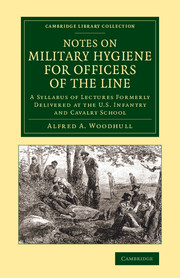
For those engaged in military conflict at the end of the nineteenth century, infection and disease were still as formidable enemies as the guns of an opposing army. Yet advances in sanitary science and understanding continued to help officers keep their troops in optimal fighting condition. After serving as an assistant surgeon for the Union Army during the American Civil War, Alfred Alexander Woodhull (1837–1921) began to publish on the topics of hygiene and sanitation, and how they related to military effectiveness. Arguably his most important publication, the present work was based on lectures he delivered at the US Infantry and Cavalry School. It covers such varied topics as the selection of men, uniform design, and the management of waste. First published in 1890, it was recommended as a textbook by the surgeon general of the time. Reissued here is the revised third edition, which appeared in 1904.
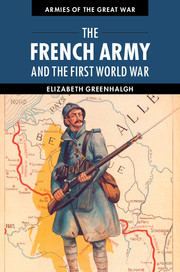
This is a comprehensive new history of the French army's critical contribution to the Great War. Ranging across all fronts, Elizabeth Greenhalgh examines the French army's achievements and failures and sets these in the context of the difficulties of coalition warfare and the relative strengths and weaknesses of the enemy forces it faced. Drawing from new archival sources, she reveals the challenges of dealing with and replenishing a mass conscript army in the face of slaughter on an unprecedented scale, and shows how, through trials and defeats, French generals and their troops learned to adapt and develop techniques which eventually led to victory. In a unique account of the largest Allied army on the Western Front, she revises our understanding not only of wartime strategy and combat, but also of other crucial aspects of France's war, from mutinies and mail censorship to medical services, railways and weapons development.
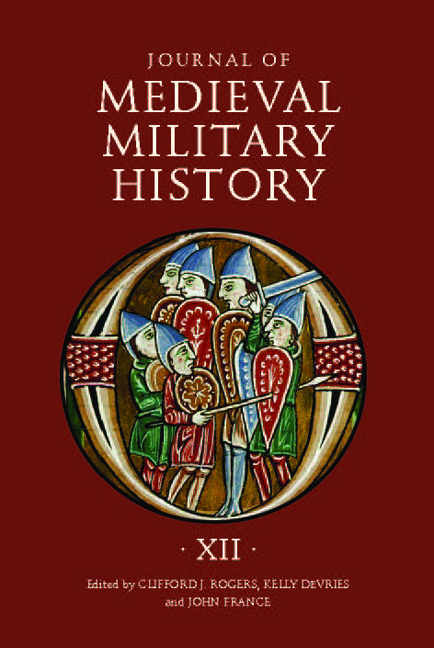
The latest collection of the most up-to-date research on matters of medieval military history contains a remarkable geographical range, extending from Spain and Britain to the southern steppe lands, by way of Scandinavia, Byzantium, and the Crusader States. At one end of the timescale is a study of population in the later Roman Empire and at the other the Hundred Years War, touching on every century in between. Topics include the hardware of war, the social origins of soldiers, considerations of individual battles, and words for weapons in Old Norse literature. Contributors: Bernard S. Bachrach, Gary Baker, Michael Ehrlich, Nicholas A. Gribit, Nicolaos S. Kanellopoulos,Mollie M. Madden, Kenneth J. McMullen, Craig M. Nakashian, Mamuka Tsurtsumia, Andrew L.J. Villalon.