To save content items to your account,
please confirm that you agree to abide by our usage policies.
If this is the first time you use this feature, you will be asked to authorise Cambridge Core to connect with your account.
Find out more about saving content to .
To save content items to your Kindle, first ensure no-reply@cambridge.org
is added to your Approved Personal Document E-mail List under your Personal Document Settings
on the Manage Your Content and Devices page of your Amazon account. Then enter the ‘name’ part
of your Kindle email address below.
Find out more about saving to your Kindle.
Note you can select to save to either the @free.kindle.com or @kindle.com variations.
‘@free.kindle.com’ emails are free but can only be saved to your device when it is connected to wi-fi.
‘@kindle.com’ emails can be delivered even when you are not connected to wi-fi, but note that service fees apply.
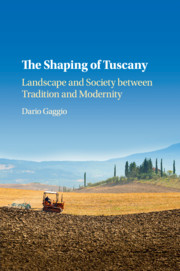
To its many tourists and visitors, the Tuscan landscape evokes a sense of timelessness and harmony. Yet, the upheavals of the twentieth century profoundly reshaped rural Tuscany. Uncovering the experiences of ordinary people, Professor Gaggio traces the history of Tuscany to show how the region's modern conflicts and aspirations have contributed to forging its modern-day beauty. He demonstrates how the rise of Fascism was particularly violent in rural Tuscany, and how struggles between Communist sharecroppers and their landlords raged long after the end of the dictatorship. The flight from the farms in the 1950s and 1960s disorientated many Tuscans, prompting ambitious development projects, and in more recent decades the emergence of the heritage industry has raised the spectre of commodification. This book tells the story of how many Tuscans themselves have become tourists in their own land – forced to adapt to rapid change and reinvent their landscape in the process.
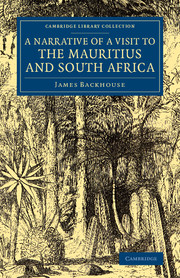
James Backhouse (1794–1869) came from a family of accomplished naturalists and horticulturalists. As a Quaker, he spent several years in Australia engaged in missionary and humanitarian work, after which he returned to England via Mauritius and South Africa. The present work, first published in 1844, is adapted from his journals of that journey, providing a rich and personal account. It contains vivid descriptions of the people he encountered, particularly the indigenous communities and those involved in the slave trade, which he found revolting and unchristian. Backhouse's horticultural interests are evident in the detailed botanical observations he made, the value of which led to a genus of shrub being named after him: Backhousia. This work contains illustrations based on original sketches made by Backhouse during the trip, and appendices which include letters and texts relating to the mission, as well as a map of South Africa.
This 1875 manual presents a detailed scientific picture of Greenland and its Arctic environment. Edited by the geologist Thomas Rupert Jones (1819–1911), it was prepared for the British Arctic Expedition of the same year in order to inform and instruct the explorers. The work presents previously ascertained information, ranging from astronomical data, including observations of the northern lights, through to material on plant and animal life. Sir George Nares (1831–1915), the expedition's leader, had hoped the North Pole could be reached. Though this proved impossible, a team of his men set a record for the furthest northern latitude attained at the time. Underpinning the expedition's gathering of important scientific and geographical results, this manual clarifies for modern readers the specific objectives of late Victorian polar research. Nares' official 1876 report and his 1878 two-volume account of the journey are also reissued in the Cambridge Library Collection.
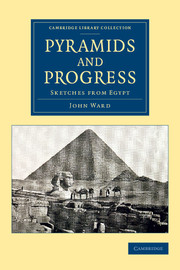
This highly illustrated 1900 work on Egypt old and new by John Ward (1832–1912) seeks to guide the visitor to the ancient sites while also remarking on the radical changes to the economy and the development of the modern state since the intervention of the British government in 1883 and the appointment of Lord Cromer as consul-general and effective ruler. This blending of ancient and modern can be seen in discussions of Port Said ('not an Egyptian town at all') alongside the abandoned and silted-up delta ports of the Egyptians, Ptolemies and Ottomans. Thebes is discussed both as a city of the living and a city of the dead, and Ward notes approvingly the flattening of the ancient town of Assouan (Aswan), to form the foundations for new public buildings, on the orders of Lord Kitchener. Ward's subsequent book, Our Sudan (1905), is also reissued in this series.
Published together in 1846 for a British readership, these reports of two westward expeditions shed light on the challenges of exploration in nineteenth-century North America. Led by the army officer and future presidential candidate John Charles Frémont (1813–90), who became known as 'the Pathfinder', the first expedition ranged west of the Missouri River, while the second pushed beyond the Rocky Mountains, north to Fort Vancouver and then south into Mexican-held California. Frémont's detailed accounts are accessible to the non-specialist: this edition omits 'only the portions which are altogether astronomical, scientific, and philosophical, and, therefore, not adapted for general utility'. When originally published separately in 1843 and 1845, the narratives enthused a great many Americans, encouraging them to migrate west by providing stirring inspiration, valuable maps and practical information. Frémont's words and deeds remain of interest in the debate surrounding the 'manifest destiny' of the United States.
A staunch supporter of exploration, Sir John Barrow (1764–1848) backed expeditions to Africa, Australia, the Arctic and the Antarctic during his forty-year tenure as Second Secretary to the Admiralty. In his early career, he served as an aide to the diplomat Lord Macartney, joining him on his 1792–4 embassy to China, and during his later governorship of the Cape of Good Hope. Barrow was a prolific author, setting new standards of detail and accuracy for travel writing. In this 1806 account, he recounts the embassy's journey to Cochinchina (now Vietnam) via Brazil and Java. In one of the first illustrated accounts of the country in English, Barrow applies his boundless curiosity and elegant style to history, politics, local customs, and the flora and fauna. His autobiography and several other volumes of his travel writing are also reissued in the Cambridge Library Collection.
William Marshall (1745–1818), from farming stock, became a farmer and then estate manager and land agent after several years spent conducting business in the West Indies. A pioneer of scientific methods of farming, he published widely on best practice, and was also known for his geographical surveys of agriculture. This two-volume 1789 work covers the county of Gloucestershire, but also includes dairy management in north Wiltshire and the orchards and fruit products of Herefordshire. A hands-on reporter, Marshall stayed in the vale of Gloucester to learn the art of cheese-making, and then spent a year in various locations studying local farming practice. Volume 1 describes the rural economy of the area, with the different activities suited to the different geographical locations and soil types, giving information on the types of land tenure, crops and animals, and providing a list of 'provincialisms' which offer fascinating insights into the Gloucestershire dialect.
Originally published in 1694, this record of recent voyages made by Sir John Narborough, Abel Tasman, John Wood and Friderich Martens includes Tasman's account of discovering Tasmania and New Zealand in 1642. Equally engaging, Narborough's journal records his voyage to the Straits of Magellan and his interest in the lands and peoples he encountered from 1669 to 1671. Here also are Wood's thoughts on his 1676 attempt to find a north-east passage to the East Indies, along with Martens' observations on Spitsbergen and whaling in northern waters in 1671. The extracts given here, translated where necessary, offer valuable insights into seventeenth-century navigation and exploration. A selection of illustrations, ranging from maps to depictions of exotic flora and fauna, accompany the text. A key reference for later navigators and for those interested in the history of maritime exploration, the book was also one of the oldest works in Darwin's library aboard the Beagle.
The Scottish doctor Henry Faulds (1843–1930) is best remembered for his role in the history of fingerprinting. His strong religious faith had first led him to missionary work in India and then, from 1874, in Japan. He worked there as a surgeon in the mission hospital at Tsukiji, near Tokyo, where he also established a medical school and a school for the blind. It was his discovery of the impressions of thumbprints on ancient Japanese pottery which led to his development of a fingerprinting system and his championing of it as a forensic tool. The present work, part-travelogue, part-journal, was first published in 1885. It remains an engaging account of Japanese life, customs, geography and natural history, interwoven with discussions of topics such as education, language, and the future of the country. There are characterful line drawings throughout. Faulds' Dactylography (1912) is also reissued in the Cambridge Library Collection.
During his five years in the 1730s as rector of St John's parish on the Caribbean island of Nevis, William Smith collected a number of remarkable seashells, which he presented to the Woodwardian Museum of Fossils at the University of Cambridge nine years after his return to England. When the incumbent Woodwardian Professor, Charles Mason, asked Smith for 'some account' of the Nevis shells, Smith wrote him a series of eleven undated letters, published as this book in 1745, containing observations on the island's flora and fauna, and details relating to the neighbouring islands. Mason and Smith became friends, and the content of the letters gradually diverged from pure recollection to larger digressions on subjects as varied as cryptography, diseases common to slaves, tarantulas, and the Great Wall of China. The result is an idiosyncratic snapshot of the mind of an educated and slightly eccentric cleric in eighteenth-century England.