To save content items to your account,
please confirm that you agree to abide by our usage policies.
If this is the first time you use this feature, you will be asked to authorise Cambridge Core to connect with your account.
Find out more about saving content to .
To save content items to your Kindle, first ensure no-reply@cambridge.org
is added to your Approved Personal Document E-mail List under your Personal Document Settings
on the Manage Your Content and Devices page of your Amazon account. Then enter the ‘name’ part
of your Kindle email address below.
Find out more about saving to your Kindle.
Note you can select to save to either the @free.kindle.com or @kindle.com variations.
‘@free.kindle.com’ emails are free but can only be saved to your device when it is connected to wi-fi.
‘@kindle.com’ emails can be delivered even when you are not connected to wi-fi, but note that service fees apply.
Caernarvonshire CL 3 (Aber) and CL 42 (Llanllechid).
These upland grazing commons, in the north-west corner of the Snowdonia National Park, cover a block of mountainous territory falling steeply from the summit of Carnedd Llewelyn (1,064m) down to the Ogwen valley and the narrow coastal strip to the east of Bangor. Divided by the watershed along the crest of the hills between Moel Wnion and Carnedd Gwenllian, their combined extent covers over 10,550 acres (4,270 ha), of which Llanllechid Mountain (CL 42) accounts for 6,126 acres (2,479 ha) and Aber Mountain (CL 3) 4,425 acres (1,790 ha). The mountain slopes are dominated by acid grassland, with areas of blanket peat and heather moorland, and rock and scree on the highest parts. The recent histories of the two commons are intertwined, as will be seen; the focus here is on Llanllechid Mountain, which Dudley Stamp described as ‘an almost unique example of a true common’, by which he seems to have meant an unmanaged common, exhibiting aspects of a Hardinesque ‘tragedy’.
Evidence of past human activity abounds on both commons (Figure 52). Legacies of prehistoric settlement are widespread in the remains of groups of huts and associated enclosures across the lower slopes, while reminders of resource exploitation in the historic period survive in disused stone quarries and trial levels from lead mining.2 Tangible evidence of the exercise of common rights is also abundant. Sheepfolds are numerous, especially on Llanllechid Mountain, most of them simple folds but several taking the form of strikingly complex, multicellular structures (Figure 51). These probably reflect the large number of small graziers putting sheep on the common, the flock of each commoner being sorted from a central gathering area into cells belonging to individual farms. It has been suggested that the folds date from the expansion of sheep-farming during the eighteenth century: several are recorded on maps of c.1810.
Peat-digging in turbary grounds on wet saddles high in the hills also left a legacy of manmade features, notably the ‘peat stools’ (ystolion mawn), platforms of large stones beside the turbary grounds, on which peat was stacked to dry.
The endurance of the British forces in India and the Indian seas and of the East India Company in the face of the French assault between 1778 and 1783 was decisive for British control of India, though only in retrospect. That control was further consolidated after 1783, by the developments during the next ten years, and by the defence, once again, of the British position in India in the succeeding decades of warfare; this included the extension of British control as far as the Indus River. The American War had technically ended with the mutual return of conquered lands between the Europeans, but, as after 1748 and after 1763 this did not mean much in India and the east; for a start it took two years for the terms to be implemented. Negapatam was not returned to the Dutch; this was the only territorial change.
The successful voyages of the Pitt to and from China through the Indonesian islands in 1759 had been followed by more British ships sailing the same way, and by the Dutch formal prohibition of this, which the British ships, all large and well-armed, could easily ignore. It also emerged that Dutch control of the islands was by no means either universally welcome to the islanders or very extensive, relying as it did on repeated terrorising voyages of destruction, designed to prevent the production of spices in those islands the Dutch did not control; the Dutch may have claimed control of the seas because they held the islands, but most of the archipelago was not under their actual rule.
With peace in 1763 there had been no political need for this new route, the Eastern Passage, to be followed, since the South China Sea route was then available and reasonably safe, but one or two ships did take it, so that when the Dutch joined in the American War at the end of 1780 it was a relatively familiar route to many of the Company's captains. Participation in this war also produced a British blockade against Dutch traffic through the Malacca Straits and the Sunda Straits, and an almost complete halt to Dutch exports from Java to Europe, for, even if the Dutch ships could get through the immediate blockades, they were very liable to be captured on the long voyage to Europe.
It took a little time for the Admiralty to react to the elimination of the French threat in the Indian Seas, but then the wider war was still on in Europe until 1814, with a final burst in mid-1815. With peace seemingly assured after the defeat and occupation of France, and with the conclusion of the peace settlement, the Treaty of Vienna, and no naval threat visible after the defeat of the United States’ ships at sea between 1812 and 1814, the naval establishment in the Indian Ocean could be relaxed.
The war with the United States had scarcely had any effect in eastern waters. The occasional American ship might penetrate past the Cape or into Indonesian waters, but only one incursion into these seas was seriously attempted, by three ships, President (44), Peacock (22), and Hornet (18), all frigates or smaller, out of New York. President was damaged coming out of New York harbour in a gale, and was quickly caught and captured. Peacock and Hornet left New York a week later, on 22 January 1815, also in a storm to avoid the blockading squadron. They separated, and Hornet met and defeated Penguin (18); Commodore Biddle in Hornet was told that the war was over, but continued firing. They sailed to pass the Cape, but encountered Cornwallis (74), which chased Hornet, while Peacock, a faster sailor, got away. Hornet only survived by throwing overboard its guns and stores, after which it could only go home. Peacock got as far as the Sunda Strait, where it encountered the Bombay Marine brigsloop Nautilus (14), which was defeated, even though Nautilus made it clear to Captain Warrington of Peacock that peace had been made six months before – which Warrington presumably also knew since he had met Hornet which had the news. But Peacock went on firing until Nautilus surrendered. (The ship was returned and compensation paid.) All in all, it was an inglorious end to the inglorious war for the United States’ Navy. For the British it was fortunate that they had secured Mauritius; in French hands, the island would have provided a useful base for the American raiders.
The British Pacific Fleet was at its most powerful, numerous, and potent at the point when it ceased to be required, a comment which can also be applied to the Royal Navy as a whole. In September 1945, as the Japanese were signing the surrender document, the fleet included nine aircraft carriers, six replenishment carriers, four battleships, eleven cruisers, an anti-aircraft ship, three fast minelayers, and seventy-one destroyers and smaller craft; in addition there were ninety ships in the two fleet trains, one train manned by Royal Navy personnel, the other, termed ‘auxiliary’, manned by civilians. There were also twenty shore establishments of various sorts, mainly in Australia. Then, in the next three years, the Pacific Fleet was reduced to two cruisers, nine destroyers and frigates, and sixteen other ships. In that same period, the commander- in-chief of the station lost control of the Indian Navy, and effectively relinquished any real influence over the Australian and New Zealand navies, which had grown in the war years to the status of independent organisations. There still remained a force of ships in the Indian Ocean, based at Suez, at Aden, in Kenya, and at Singapore, but it was reduced in strength similarly. There was just one British fleet once more east of Suez.
This reduction was accomplished in the midst of a long series of crises and difficulties following the end of the war, which culminated in a new war in Korea between 1950 and 1953. In the five years after the surrender of Japan most of the countries from China to Africa underwent political convulsions, which in the end destroyed the political basis for the navy's presence in eastern waters; it had always been an instrument of empire, and with the empire mostly gone, the fleet was not necessary.
The Pacific Fleet's first task was to rescue, collect, and despatch home the prisoners of war held by the Japanese. Many were debilitated, requiring careful feeding, clothing, and medical care. They came from all the original imperial lands, from the lands of the Allies, and the United States, and there were well over a hundred thousand of them.
The great circumnavigation voyage of Francis Drake between 1577 and 1580 took him across the Pacific to the Spice Islands, then across the Indian Ocean to South Africa, and north along the length of the Atlantic to triumph and a knighthood at Greenwich, with his one remaining ship ballasted and loaded with gold and spices. This was the first seaman-like view of the Pacific and Indian Oceans by an English captain. The first voyage of James Lancaster between 1591 and 1594 went in the opposite direction, south along the length of the Atlantic, round the Cape of Good Hope, into the Indian Ocean and across to Indonesia, returning much the same way. It produced no wealth, and came back with a small sickly crew in a ruined ship, though Lancaster did gain a knighthood eventually. Drake had lost four out of his original five ships one way and another; Lancaster's voyage started with three ships and ended with one. And yet, despite the contrast in their immediate fortunes, there was no follow-up to Drake's voyage, other than some looting expeditions which were less than successful, and Cavendish's circumnavigation, which was useful and profitable. Lancaster's voyage, on the other hand, was the origin of one of the most remarkable and successful commercial ventures in world history, for it led to the formation of the East India Company.
Drake had followed Magellan's route to Patagonia, then through the Strait which his predecessor had discovered, north along the Spanish South American Pacific coast, looting and burning towns, capturing ships, and filling his hold with stolen wealth. This part of the voyage was in relatively familiar territory by this time, as his activities showed. If he is to be credited with an exploratory voyage, it was only after Mexico that he found anything new. He careened his ship somewhere on the upper Californian coast, possibly near San Francisco Bay (which he missed), and from there struck out across the Pacific for the Spice Islands, which he located by an admirable feat of navigation. He started this Pacific crossing further north than the Spanish ships usually did, and sailed by the trade wind route, briefly calling at the Palau Islands, and then at Mindanao in the Philippines. He made no wholly new discoveries in that island-littered Ocean.
The Royal Navy had been able to restrict its presence in the Indian Ocean between 1793 and 1801 to a relatively few ships, even in a time of the greatest European war since the Thirty Years’ War, because it was able to prevent its enemies from sending a major naval force into that ocean. This power lay mainly in its control of the waters of Western Europe, that is, the North Sea and the English Channel, and so preventing access to the French Atlantic ports; from there it could also dominate the North Atlantic and the Mediterranean. As further insurance the approaches to the Indian Ocean had been seized – the Cape, the Red Sea, Penang in the Straits of Malacca, Botany Bay – which not only controlled the ‘entrances’ to the ocean, but prevented the entry of enemies by controlling the means of ships’ refreshment. They also acted as bases from which armed forces could sally. But the essential centre of the whole scheme was India, and its two major British naval bases, the cities of Bombay and Madras.
The peace of 1801–1803 ordered the restoration of some conquests, but, just as the restitution of Malta to the Knights Hospitaller was deliberately delayed until it became a major cause of the new war, so the restoration of Indian Ocean territories deliberately took a long time, and in some cases did not even happen. The Cape was not returned to the Dutch until late 1805; the Dutch also recovered Malacca and the Moluccas. The French were supposed to recover Mahe, Pondicherry, and Chandernagar, but failed to do so in time; even as they prepared to re-occupy these places, and some others in India, they were conscious that these places would be retaken by the British within days of a new war beginning. Their consolation was their continued possession of Mauritius. The Dutch also retained their Indonesian possessions.
The British had meanwhile begun applying the power of a more centralised government in India, but slowly and gradually. This was applied in patches only, but cumulatively, and especially during the rule of Governor-General Lord Mornington (later Marquess Wellesley: 1798–1805).
The last years of Charles II and the reign of James VII/II (1680–1688) saw varied pressures mounting on the Company. It had by 1680 existed for eighty years, but had suffered repeated buffetings during that time, including the near-death experience of constant governmental and parliamentary hostility in the 1640s and 1650s. This was due to its simultaneous relationships with the English royal (and republican) governments and the Mughal imperial government in India; the Company was in effect serving two masters. Both of these were extravagant spenders of tax money and the Company was wealthy, so it was inevitable that these relations would continue, and that the hostility of those who disliked those governments would also continue.
Then in the thirty years after 1680 the Company went through its most serious crisis since the time of the English Commonwealth, when it came, once again, within an inch of dissolution. It survived, once again, and came through into calmer waters after 1710 (as it had before 1680), but this was only because it outlasted its two masters, one of which (the Mughals) collapsed, while the other (the English) went through a revolution during which a better source of funds for the government to spend was devised than intermittently harassing the Company.
The Company had made enormous profits in the reign of Charles II, but by 1680 there were increasing doubts in England about the propriety of such an organisation having the right to wage wars, build forts, maintain an army and a navy, coin its own currency, and generally to act, as it was seen from England, as a sovereign state in the east. These doubts were, of course, voiced chiefly by those who felt excluded from its affairs and jealous of its profits, but there is no need to doubt their concerns. Accordingly, challenges grew to the Company's rights and duties, above all to its monopoly of eastern trade, and these disputes were fought by foul means and fair on both sides.
The Company was well supported by the last two Stuart kings to whom it ‘loaned’ substantial sums of money – £170,000 to Charles II during the course of his reign. This, of course, marked a substantial change from the sabotaging of the Company by their father in the 1630s.
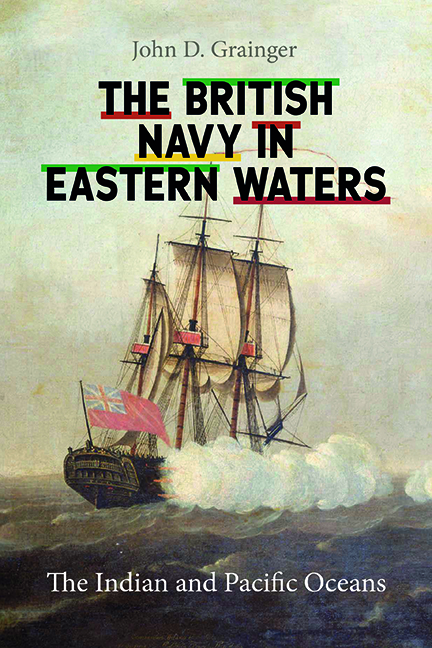
The subject of this book is the activities of the British Royal Navy in the Indian and the western Pacific Oceans, that is, in over half the world, from the Cape of Good Hope to China and Japan. Neither of these oceans and the lands they gave access to were known to European before the ‘Age of Discoveries’, though they were well enough known to many inhabitants of these regions, and certainly rumours and hints had reached Europeans of their existence. It was, of course, difficult for any European ships to penetrate into these oceans even in the century or so after the initial Portuguese explorations had reached them. This was in contrast to the accessibility of the contemporary revelation of the American continents, which seemed to be, by comparison, relatively easy to reach. It was clearly possible for English, French, and Dutch ships to get across the Atlantic and to interrupt Spanish activities in the Caribbean, and perhaps in West Africa and Brazil, but to reach the Pacific Ocean or the Indian Ocean required a voyage of years, far more courage and endurance, and a greater financial investment, than was involved in sailing to the east coast of America.
It was not at first known whether this could be done at all. Vasco da Gama, following Bartholomew Diaz and a long list of earlier Portuguese sailors, reached the Indian Ocean in 1498. The Portuguese had been moving slowly down the coast of Africa for a century before then, and had established a precarious control over the coast and its trade from Morocco southwards. They had even established a presence on the coast of eastern South America – Brazil – discovered in about 1500, and were gaining some control there. They did not wish any other Europeans to interfere with the profits they had been making in the Indian and Spice Island trades, any more than the Spaniards wanted others to interfere in the Caribbean. The two states had a treaty to that effect, ratified by the Pope, though no other country recognised it. Nonetheless this was the foundation of their empires. When other Europeans’ ships actually reached the Indian Ocean, they found that the main ports were already under Portuguese control – though there were always other ports which they could use.
The ships which sailed to eastern waters from European ports had a choice of several routes in the Indian Ocean, depending on their destinations and on the state of the monsoon. The monsoon blew from south to north from June to September, the Indian hot season, and in reverse from December to March, but the winds originate south of the equator, so in the south in the hot season they began by blowing south-east to north-west, and swing round to south-west to north-east after the equator. The cool season winds are less powerful, not being so much heated by the sun, and begin over land as dry (and cold) winds: they begin by blowing from north-east to south-west, but then shift round at the equator, and then meet the south-westerly trade winds there.
Ships heading for India, therefore, would be well advised to arrive off South Africa during the south-west monsoon, say in June, but not too early since this could be a time of violent weather. Company ships called at St Helena for fresh supplies; Dutch ships used the Cape, which was usually available in peacetime to others. From there the choice of routes from South Africa depended on the ship's destination. Ships heading for Bombay or Surat could use the Mozambique Channel, or possibly sail east of Madagascar, passing the islands of Bourbon and Mauritius. Ships heading for Madras or Calcutta found it best to sail due east along the line of 40 S from the Cape and swing north at about 80 E, and then sail due north; this would save them having to negotiate a passage round southern India and Ceylon. The Dutch had long used an even longer easterly track to reach their part of the East Indies, heading for one of the passages through the Indonesian islands, so much so that several of their ships collided with Australia, to their grief.
Returning to Europe was somewhat easier, since the north-east monsoon was less powerful, though there was an area of doldrums along the equator which might delay progress. There were variations on all these routes, including using the southern trade winds to sail north in the hot season.
As if to deny the victories of the Seven Years’ War, the British Admiralty recalled back to Britain all the Royal Navy ships in the Indian Ocean when the war was over. This did not happen all at once, but the big ships were recalled by 1764, leaving two frigates and one sloop in 1765; only one frigate was left the following year, and this was withdrawn in 1767. This was part of an extreme programme of cost reduction, aimed at reducing the National Debt, but it reduced the Royal Navy to little more than its frigates and smaller ships.
The maritime wing of the Company was thus once more only the Bombay Marine, without any support from larger ships of the Royal Navy. Its capture of Surat, and its participation in the events of the recent war had shown that the Marine was capable of activity on a small scale by itself, but its ships were still small and were not numerous. It was, in fact, capable of little more than local campaigns against coastal towns along the Indian west coast, unless it was supported by bigger ships. These might be forthcoming from the great trading ships, but not always. It was not long before the absence of the Royal Navy was felt, and requests for support were dispatched to London.
The Marine would rarely act aggressively. Instead it reacted to what was seen as a threat – its purpose, after all, was the defence of Bombay and the trading ships, and no more, though this did include overseeing the Company's establishments overseas. In other words, the driving forces of Indian history which were the greater events in the interior were not its, or Bombay’s, direct concern. Those conflicts were beginning to sort out the new political condition of the country after the Mughal Empire's disintegration; how far the Company should become involved was a question. For the Bombay Council this meant watching the actions of the Peshwa of the Marathas, based in the hills above Bombay at Pune, and the rise of the kingdom of Mysore. Both of these were neighbours to the Bombay Presidency's coastal factories and posts.
The ‘overland route’ across Egypt had become established as one in regular use since Muhammad Ali had made himself ruler of Egypt, and especially since the alternative route through Mesopotamia had proved to be too difficult, slower, and more expensive. The sea routes, to Alexandria and from Suez, were clear enough, with the Peninsular and Orient steamship line providing the Mediterranean route, and the Bombay Marine the Red Sea route (taken over later by the P. and O.). Since the 1830s the facilities along the route had also been steadily improved, but only in sections. The steamship sections had used bigger, faster, and more comfortable ships, but the land section of the route, from Alexandria to Suez, was developed in slow stages between 1819 and 1858. The first stage was the construction of the Mohammerah Canal, connecting Alexandria with the Nile at Atfeh. This allowed dhows to sail from Alexandria as far as Cairo, a service which improved in speed when steam was applied to the riverboats in the 1830s. Cairo having been reached, it was then necessary to cross the desert to Suez, the worst part of the whole journey. Camels and donkeys were the earliest (thoroughly uncomfortable) transports, but by the 1830s stage coaches and a series of inns had become available.
The improvements were a classic sequence of increasing use and demand leading to increasing speed and improved facilities, leading to increasing demand and use once more. What had taken several weeks and a large expense in 1819, in which only 200 or so passengers used the route, became a journey of only a few days by 1850, travelled by 5000, and one of increasing comfort as hotel accommodation at Alexandria and Cairo also improved in response to similar demand. Expense could have been reduced as well, except that many passengers were wealthy enough to afford the most expensive accommodation. The next to last stage of improvement was the construction of railways. Two lines were built, Alexandria to Cairo, finished in 1856, and Cairo to Suez, finished in 1858. The whole journey was now no more than three days, unless one waited for a time at Cairo to see the pyramids and enjoy a rest, and a regular timetable of steamers in both the Mediterranean and the Red Sea was now possible.