To save content items to your account,
please confirm that you agree to abide by our usage policies.
If this is the first time you use this feature, you will be asked to authorise Cambridge Core to connect with your account.
Find out more about saving content to .
To save content items to your Kindle, first ensure no-reply@cambridge.org
is added to your Approved Personal Document E-mail List under your Personal Document Settings
on the Manage Your Content and Devices page of your Amazon account. Then enter the ‘name’ part
of your Kindle email address below.
Find out more about saving to your Kindle.
Note you can select to save to either the @free.kindle.com or @kindle.com variations.
‘@free.kindle.com’ emails are free but can only be saved to your device when it is connected to wi-fi.
‘@kindle.com’ emails can be delivered even when you are not connected to wi-fi, but note that service fees apply.
Helping your children with their homework is a part of every parent's job description. It can be frustrating to watch your kid struggle with something as basic as elementary subtraction, but incredibly rewarding when they finally master borrowing ten under your tutelage.
Homework gets harder as students progress through grade levels and, like all parents, I (Steve) realized that the time would come when I would no longer be able to help my daughter Bonnie with her homework. But I didn't expect that moment would first arise in fifth grade U.S. history!
Bonnie's assignment was to match historical figures with descriptions of who they were and why they were important. Several names were well known to her from prior experience, such as Christopher Columbus (1451–1506) [20], George Washington (1732–1799) [6], and Abraham Lincoln (1809–1865) [5]. Others were new, but clearly worth learning about as she began her study of American history – people such as:
• Henry Ford (1863–1947) [148]: automobile industry pioneer.
• Robert Fulton (1765–1815) [954]: steamboat inventor.
• William Lloyd Garrison (1805–1879) [735]: abolitionist who fought against slavery.
• Alexander Hamilton (1755–1804) [45]: secretary of the Treasury who put the United States on a firm financial footing.
• Robert E. Lee (1807–1870) [76]: commander of the Confederate Army during the Civil War.
But Bonnie's homework also contained the names of several people who, frankly, I had never heard of before.
Our rankings of historical significance will be used to rationally assess the reputation of figures in the historical canon. But how can algorithms do this in a fair and sensible way? We start by reviewing how people approach ranking problems, to better understand the strengths and limitations of our computational methods.
Traditional Ranking Methodologies
The rankings most prominent in popular culture are produced in several ways. Perhaps most popular is the expert poll, used to create the Associated Press Top 25 College Football Rankings. Every week a set of experts (here coaches and sportswriters) independently rank the top teams. These ratings are combined using a point system, and the cream skimmed off after sorting teams by points yields the Top 25. Expert polls prove effective in clearly defined domains followed by many knowledgeable individuals. They tend to be fairly conservative, however, and are often based on second-hand judgments. Do we really believe that active college football coaches have enough time, or even a good enough cable television plan, to watch all their peers play?
Still, polls of professional historians might be used to rank historical figures. Indeed, historian polls ranking the greatness of U.S. presidents are conducted regularly as a sort of academic parlor game; an early example was the 1948 poll by Arthur M. Schlesinger (1888–1965) [27072] of Harvard University. These polls reflect interesting changes in historical reputation over time.
The battle between good and evil has been fought since the beginning of time. Which is the surer path to historical recognition? There seems to be conflicting evidence wherever you look:
• For every Jesus (7 B.C.–A.D. 30) [1], there is an Adolf Hitler (1889–1945) [7].
• For every charitable missionary like Mother Teresa (1910–1997) [820] lurks a gangster like Al Capone (1899–1947) [646].
• For every social worker like Jane Addams (1860–1935) [1256] exists an assassin like Lee Harvey Oswald (1939–1963) [1435].
• For every civil rights leader like Martin Luther King (1929–1968) [221], we find a serial killer like Jack the Ripper [166].
In this chapter, we will consider a range of figures from both ends of the morality scale, to open a discussion on which is the more enduring path to glory. Our conclusion is that true virtue is generally rewarded, but spectacular acts of infamy endure longer than similar acts of heroism.
The Killers
Hammurabi (1796–1750 B.C.) [899], the lawmaker, has been followed by three millennia of law breakers. But several criminals richly deserving of their punishment endure as cultural figures because of the imagination and magnitude of their crimes. In this section we will identify the most prominent outlaws, assassins, and other killers, to better understand the source of this fascination.
The previous chapter presented the popular history of American political leadership. Here we apply our analytical tools to study the reputations of the rest of the world's leaders. We are particularly interested in understanding the factors that shape our perceptions of other places, such as size, economics, and culture.
Knowing the who's who of a country is helpful to understand what's what. In the same way that speaking a trivial amount of the local language (“excuse me”) can pay big dividends, we have found that knowing the name of the current or iconic political leader opens doors to greater understanding. Asking immigrants or locals “What do you think of …?” is an excellent way to start a revealing conversation. We provide tables identifying the dominant political figure from essentially every country on earth. These can be seen as crib notes in cultural literacy; a chance to refresh our memories about the people who built or led nations.
Analyzing Political Leadership
In the course of our study, we have created a dataset of more than 3,000 modern national leaders from more than 150 different countries. But any meaningful attempt to identify the “most significant” leader of a nation faces several issues of definition and bias. We discuss some of these considerations here.
CULTURAL AND REGIONAL BIAS
Our analysis relies on datasets that inherently display linguistic and cultural biases. Both our Wikipedia analysis and book Ngrams data are based exclusively on English-language sources, and hence do not equally reflect the contributions of other languages and cultures.
We hope that some readers will be inspired by this book to perform further investigations into historical significance. We encourage you to visit our website at http://www.whoisbigger.com, where you can access our latest analysis for more than 800,000 different people. These rankings will be updated to reflect more recent editions of Wikipedia, including those of languages beyond English.
This website is still under active development, so you will have to visit to see exactly what information we present on each individual. But at the time of this writing, we include rosters of people with comparable significance, celebrity, and gravitas, to help you put their achievements into perspective.
We also provide an interface to rank individuals within hundreds of thousands of Wikipedia categories, so you can see how they stack up in comparison with their peers.
We also encourage the reader to check out the Google books Ngram viewer, which Google makes available at http://books. google.com/ngrams. Although we have developed our own Ngram visualizations, which we make available at http://www.whois bigger.com, the Google site has far more comprehensive data. This includes more general vocabularies, annotation by parts of speech, and even Ngrams in multiple languages. It is a fabulous resource to explore.
Birth/Death Calendars
In Section 7.2 of Chapter 7, we showed that life outcomes can be affected (at least to a minor extent) by the specifics of one's calendar birth date. It is natural to be curious about the historical figures which share your birth date: perhaps this kinship may reflect something of our own prospects for the future.
Most historical figures are accorded a one-way ride down the road from glory. Long-dead figures rarely regain prominence, except perhaps in response to external events, such as the release of a movie about their life. But the most dramatic swings in historical reputation we have encountered occur in the arts, reflecting long-term fluctuations in taste. Authors and their books can rise in response to fresh critical attention, and obscure painters may suddenly find their work back in style.
In this chapter, we will identify the most significant figures in literature and the fine arts. Along the way we will address certain larger-scale questions: In which media do contemporary artists have enough stature to compete with the classical masters? How well do best-seller lists and literary awards identify the significant voices of their times? Have modern architects usurped the role traditionally occupied by sculptors?
Literature
Ranking the world's greatest literary figures is a parlor game of comparable popularity to the ranking of presidents. It provides free rein to express the biases inherent in everyone's worldview. Which is better: classical or contemporary, domestic or international, or prose vs. verses?
The Literary 100 [Burt, 2000] is a representative ranking, which tries to identify “the most influential novelists, playwrights, and poets of all time.” Burt provides an alternate perspective to evaluate our “Literary 50” rankings, presented in Figure 13.1.
Quantitative analysts (“quants”) are finding new homes in the social and cultural domains. Finance? Hedge funds employing quantitative trading strategies now rule Wall Street, to the extent that more than 80 percent of all buy-sell decisions are made by algorithms, not people. Sports? The best selling book Moneyball detailed how successful major league teams now hire general managers who value statistical analysis above gut instinct – and get to be played by Brad Pitt in the movie version of the story. Politics? Prediction markets and the meta-analysis of polling data work so reliably that it hardly seems necessary to hold the actual election.
In this book, we bring quantitative analysis to bear on ranking and comparing historical reputations. Who's bigger: Washington or Lincoln? Hitler or Napoleon? Picasso or Michelangelo? Charles Dickens or Jane Austen? Did you realize that:
• Although Paul Revere (1735–1818) [627] and Betsy Ross (1752–1836) [2430] are well known to all American schoolchildren, they fell into complete obscurity for several generations after their contributions to the American Revolution. Their rediscoveries, completely independent of their actual achievements, tell us much about the capricious forces of history.
• Women remain significantly underrepresented in the historical record compared to men. We can prove that women have long required substantially greater achievement levels (analogous to about 4 IQ points in the mean) than men to get equally noted for posterity.
Here we provide greater technical detail concerning our historical significance ranking methods. We will discuss (1) exactly what data we used, (2) how the data was normalized, and (3) the statistical methodology we used to develop our rankings. Interested readers should begin with the high-level overview of our methods that we presented in Chapter 2.
Feature Set
We used the October 11, 2010 Wikipedia release (http://dumps.wikimedia.org/enwiki/20101011/) as the basis for our analysis. We extracted six input variables from this distribution and other available datasets:
• Page Rank (NPR and PPR) – Wikipedia is a hyperlinked document, defining a network with vertices corresponding to articles and directed edges (x, y), meaning that article x references article y. The well-established PageRank measure of network centrality [Brin and Page, 1998] computes a significance score based on the number and strength of the in-links to each node. We compute two forms of PageRank, based on two different graphs derived from Wikipedia. The first contains all Wikipedia pages, while the second consists only of the pages corresponding to people. Page annotations were determined using Freebase (http://www.freebase.com/), a collaborative knowledge database. We employed the Cloud9 map-reduce library (https://github.com/lintool/Cloud9) to compute Page-Rank.
• Page Hits (PH) – Web logging data reveal how often eachWikipedia page is viewed. More famous/significant entities should have their pages read more frequently. We analyzed six months of log data, collected immediately prior to the date of our Wikipedia release. In order to reduce the large monthly variance in readership owing to news events, we used the median monthly frequency as our measure of page hits.
For thousands of years, man has watched stories told through flickering images, be they in front of a campfire or displayed on a television. Performance modes and styles have changed, but the human need to entertain and be entertained has remained a constant of our species.
The performing arts are both the oldest forms of human expression and the greatest contemporary source of new cultural memes. Primitive man and the hippest club-goers both loved music and dance, although it is hard to tell whether they would appreciate each other's art.
In this chapter, we will review the most significant people in the performing arts. We start from the era before recorded media and continue through the present day. We will analyze trends in classical and popular music, for clues as to which of these cultural streams is likely to dominate historically. We do the same for broadcast and visual media, studying the history of film, radio, and television as a guide to the future of communications.
Before Recording Technology
Sunday preachers can be thought of as early America's most prominent class of performing artist. The rigors of the six-day workweek and the strictures of the Christian Sabbath left little time for secular entertainment, but spellbinding ministers drew large crowds for Sunday worship. In his autobiography [Franklin, 1818], Benjamin Franklin (1706–1790) [35] estimated that more than 30,000 people attended a sermon by George Whitefield (1714–1770) [1258] in Philadelphia.
I (Steve) recently turned the big 5-0, a lifetime long enough to measure up against historical time scales in a nontrivial way. The grand old game of baseball's American League was founded in 1901, exactly 60 years and two days prior to my own founding. We have shared almost half of its history together. I recall the United States Bicentennial in 1976, amazed that our country was really 200 years old. Now I have personally witnessed more than 20 percent of American history since the Declaration of Independence. The Jewish calendar marks this year as 5774, meaning that my life will soon cover 1 percent of the span since the world's biblical creation. Young readers may smirk, but if you are lucky someday this will happen to you.
Time is the basic organization of history, measured across many scales: the calendar year, the human life span, and the historical age. But the flow of time seems deceptively slow moving, and most of it occurred off of our watch. We need calendars, timelines, and other tools to chart the course of history, and help us understand it better. In this chapter, we will analyze historical figures across different scales of time: ranging from the days of the year to vast historical epochs.
Life-Span Analysis
All men (and women) are created equal, in that they have but one life dedicated to the pursuit of happiness and achievement. But life spans are not equal, differing greatly in length and the period in which they are lived. There are several revealing ways to look at history by life span.
People love lists: the Ten Commandments, the Seven Deadly Sins, and the Four Beatles. But they are fascinated by rankings, which are lists organized according to some measure of value or merit. Who were the most important women in history? The best writers or most influential artists? Our least illustrious presidents? Who's bigger: John, Paul, George, or Ringo?
This is a book about measuring the “significance” of historical figures. We do not answer these questions as historians might, through a principled assessment of their individual achievements. Instead, we evaluate each person by aggregating the traces of millions of opinions in a rigorous and principled manner. We rank historical figures just as Google ranks web pages, by integrating a diverse set of measurements about their reputation into a single consensus value.
Significance is related to fame but measures something different. Forgotten U.S. president Chester A. Arthur (1829–1886) [499] is more historically significant than young pop singer Justin Bieber (1994–) [8633], even though he may have a less devoted following and lower contemporary name recognition. Significance is the result of social and cultural forces acting on the mass of an individual's achievement. We think you will be impressed by the extent to which our results capture what you think of as “historical significance.” And our computational, data-centric analysis provides new ways to understand and interpret the past.
Societies have developed many mechanisms to honor their most illustrious members. Some get recognized during their lifetimes, through titles such as knighthood or awards like the Nobel Prize. Others get put to rest in special places, such as Arlington National Cemetery or the Pantheon in Paris. Saints are canonized and so are baseball players – in their respective Halls of Fame.
Over the next two chapters, we will study the process of historical canonization by analyzing two long-standing New York institutions: the Hall of Fame for Great Americans in the Bronx and the Baseball Hall of Fame in the tiny village of Cooperstown. Both have held elections for more than 70 years, enough time to observe changes in each member's reputation in the years following selection. These institutions provide a natural laboratory to study how time erodes fame, and the limits to which knowledgeable observers can separate the gold from the dross of history.
The Hall of Fame for Great Americans
New York institutions rise and fall around real estate. The history of the city properly began when Peter Minuit (1580–1638) [3248] bought Manhattan from the Indians on May 24, 1626 for goods worth 60 Dutch guilders. Traditionally converted to $24, it was a steal: likely in more ways than one.
The Hall of Fame for Great Americans also began with a real estate transaction. Toward the end of the nineteenth century, New York University acquired land in the Bronx to serve as a new undergraduate campus.
The first part of this book established the general validity of our ranking methods, and used them to illustrate grand themes and processes of history: canonization in textbooks, evaluating the precision of selection processes, measuring the flow of time, and quantifying changes in the perception of gender.
Now we will reduce our focus to the particular. We rank the significance of the world's historical figures in terms of the different niches they occupy: politicians, scientists, religious leaders, artists, actors, outlaws, and even dentists. It is instructive to see who rises to the top of each individual heap, both to refresh our memory on old historical friends and to make new ones. You have our blessing to skim through any group that you are not interested in, but sneak a peek at the ranking tables before you move on.
Some may question how we decide which figures belong in a particular group. Defining exactly who is an actor, an outlaw, or a dentist turns out to be very difficult to do in a precise way. We used the following methodology. We would start from a roster assembled in some book or Wikipedia category, and then amend the lists based on general knowledge and our sense of the nature of the category. No doubt certain omissions remain, although we believe that we have captured most of the usual suspects.
This first chapter concerns America's political leaders, from our presidents down to the mayors of our greatest cities.
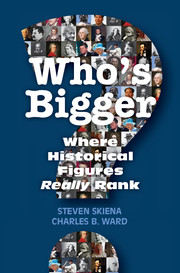
Is Hitler bigger than Napoleon? Washington bigger than Lincoln? Picasso bigger than Einstein? Quantitative analysts are rapidly finding homes in social and cultural domains, from finance to politics. What about history? In this fascinating book, Steve Skiena and Charles Ward bring quantitative analysis to bear on ranking and comparing historical reputations. They evaluate each person by aggregating the traces of millions of opinions, just as Google ranks webpages. The book includes a technical discussion for readers interested in the details of the methods, but no mathematical or computational background is necessary to understand the rankings or conclusions. Along the way, the authors present the rankings of more than one thousand of history's most significant people in science, politics, entertainment, and all areas of human endeavor. Anyone interested in history or biography can see where their favorite figures place in the grand scheme of things.