To save content items to your account,
please confirm that you agree to abide by our usage policies.
If this is the first time you use this feature, you will be asked to authorise Cambridge Core to connect with your account.
Find out more about saving content to .
To save content items to your Kindle, first ensure no-reply@cambridge.org
is added to your Approved Personal Document E-mail List under your Personal Document Settings
on the Manage Your Content and Devices page of your Amazon account. Then enter the ‘name’ part
of your Kindle email address below.
Find out more about saving to your Kindle.
Note you can select to save to either the @free.kindle.com or @kindle.com variations.
‘@free.kindle.com’ emails are free but can only be saved to your device when it is connected to wi-fi.
‘@kindle.com’ emails can be delivered even when you are not connected to wi-fi, but note that service fees apply.
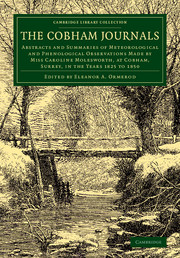
It is not known why Caroline Molesworth (1794–1872) began to make these detailed observations in the garden of her home in Cobham, Surrey. She was interested in botany, and when she moved with her widowed mother from London to Surrey in 1823, she undertook an almost daily survey of nineteen categories of information, which she maintained (with help in later years, as her health failed) until 1867. This 1880 publication, edited with a biographical introduction by the entomologist Eleanor Ormerod (1828–1901), summarises Molesworth's records for the period 1825–50. Ormerod explains the methods and instruments Molesworth used, and provides a complete record of the phenological detail over a 25-year period: she therefore omits what she considers less relevant meteorological data. The records enable year-on-year comparisons of dates on which flowers bloomed or migratory birds arrived, and this information remains of use to anyone studying long-term changes in climate.
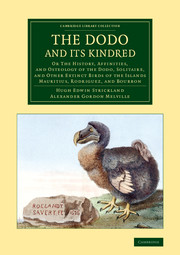
Well versed in natural history, particularly geology and ornithology, Hugh Edwin Strickland (1811–53) became fascinated by the dodo and mankind's influence on its extinction. Seeking to investigate this flightless bird and other extinct species from islands in the Indian Ocean, he invited the comparative anatomist Alexander Gordon Melville (1819–1901) to help him separate myth from reality. Divided into two sections, this 1848 monograph begins with Strickland's evaluation of the evidence, including historical reports as well as paintings and sketches, many of which are reproduced. Melville then analyses the osteology of the dodo and Rodrigues solitaire, describing his findings from dissections of the few available specimens and making comparisons with similar species. A seminal work, it correctly concluded that the dodo was more closely related to pigeons than vultures, and the book also inspired others to take up the search for new fossil evidence.
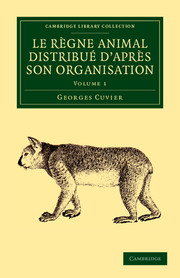
French zoologist and naturalist Georges Cuvier (1769–1832), one of the most eminent scientific figures of the early nineteenth century, is best known for laying the foundations of comparative anatomy and palaeontology. He spent his lifetime studying the anatomy of animals, and broke new ground by comparing living and fossil specimens - many he uncovered himself. However, Cuvier always opposed evolutionary theories and was during his day the foremost proponent of catastrophism, a doctrine contending that geological changes were caused by sudden cataclysms. He received universal acclaim when he published his monumental Le règne animal, which made significant advances over the Linnaean taxonomic system of classification and arranged animals into four large groups. The sixteen-volume English translation and expansion, The Animal Kingdom (1827–35), is also reissued in the Cambridge Library Collection. First published in 1817, Volume 1 of the original version covers mammals and birds.
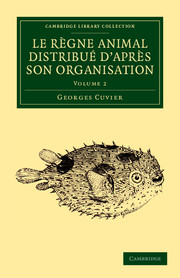
French zoologist and naturalist Georges Cuvier (1769–1832), one of the most eminent scientific figures of the early nineteenth century, is best known for laying the foundations of comparative anatomy and palaeontology. He spent his lifetime studying the anatomy of animals, and broke new ground by comparing living and fossil specimens - many he uncovered himself. However, Cuvier always opposed evolutionary theories and was during his day the foremost proponent of catastrophism, a doctrine contending that geological changes were caused by sudden cataclysms. He received universal acclaim when he published his monumental Le règne animal, which made significant advances over the Linnaean taxonomic system of classification and arranged animals into four large groups. The sixteen-volume English translation and expansion, The Animal Kingdom (1827–35), is also reissued in the Cambridge Library Collection. First published in 1817, Volume 2 of the original version covers reptiles and fish.
After a brief career at sea, during which he tested Harrison's chronometer for the Board of Longitude, John Robison (1739–1805) became lecturer in chemistry at the University of Glasgow. In 1774, having spent a period teaching mathematics in Russia, he returned to Scotland as professor of natural philosophy at Edinburgh. Despite his busy schedule, he contributed major articles on the sciences to the Encyclopaedia Britannica, giving an overview of contemporary scientific knowledge for the educated layperson. After his death, these and other pieces of his scientific writing were edited by his former pupil David Brewster (1781–1868) and were finally published in four volumes in 1822, with a separate volume of illustrative plates. This reissue incorporates those plates in the relevant volumes of text. Volume 4 contains a variety of Robison's encyclopaedia articles: on electricity and on magnetism, various pieces on the physics of sound and music, and assorted others.
In Britain, the name of Cadbury has been synonymous with chocolate ever since John Cadbury opened his factory in 1831. This book, written by Richard Cadbury (1835–99) under the pen name 'Historicus', was published in 1892. It describes the natural history of the tropical American cocoa plant, its spread in cultivation across the world, and the history of its use. He also deals with the manufacturing process, as exemplified by the Cadbury factory at Bournville, surrounded by the model housing and leisure facilities which the family built for its workers. The processing of cocoa beans into solid and drinking chocolate is described in detail, with emphasis on the developments in machinery which simplified production. A chapter deals with the importance of the vanilla plant for flavouring, and an appendix gives guidance on the cultivation of cocoa trees. This remains a fascinating account of one of the world's most popular indulgences.
Georges Cuvier (1769–1832), one of the founding figures of vertebrate palaeontology, pursued a successful scientific career despite the political upheavals in France during his lifetime. In the 1790s, Cuvier's work on fossils of large mammals including mammoths enabled him to show that extinction was a scientific fact. In 1812 Cuvier published this collection of his geological and osteological papers, focusing on living and extinct pachyderms, ruminants, horses and pigs. Volume 1 begins with a substantial essay on human origins and the formation of the earth, which was translated into English by Robert Kerr in 1813 (also available). It also includes an essay on the Egyptian ibis mummy brought back from Napoleon's campaign in Egypt, and an updated version of Cuvier's influential 1810 geological description of the Paris basin, co-authored with Alexandre Brogniart (1770–1847), which helped establish the principle of faunal succession in rock strata of different ages.
First published in 1826, at a time when the earth sciences were in a state of confusion and controversy, this pioneering study of volcanic action by Charles Daubeny (1795–1867) was significant in promoting the scientific method and the science of geology, at the same time establishing the author's international reputation. Having studied medicine, Daubeny increasingly turned his attention to chemistry, volcanos and earthquakes. Elected a fellow of the Royal Society, he also sought to elevate the status of science in Britain. He presents evidence here, gathered from his travels across Europe, in a methodical fashion, developing contemporary ideas regarding the processes at work beneath the surface of the earth. This reissued first edition provides an opportunity to examine Daubeny's reasoning prior to the revisions of the 1848 edition (also reissued in the Cambridge Library Collection), which was updated to take account of the work of Charles Darwin.
In the 1840s, the civil engineer Peter Bruff (1812–1900) designed what was then the largest brick structure in Britain, the 1,000-foot-long Chappel Viaduct in Essex. He went on to become a railway entrepreneur and developer, and was responsible for the creation of the resort town Clacton-on-Sea, where he also designed many of the buildings. In this illustrated guide, first published in 1838 and here reissued in the revised and expanded two-volume second edition of 1840–2, he discusses the theory and practice of surveying (calculating the accurate position of points in the landscape) and levelling (calculating the accurate height of points). Volume 1 covers surveying; Bruff discusses different methods for calculating bearings and distances, and the equipment required. He explains the various errors to which each method is prone, how to avoid or minimise them, and gives example surveys of land boundaries, parishes and railway lines.
After a brief career at sea, during which he tested Harrison's chronometer for the Board of Longitude, John Robison (1739–1805) became lecturer in chemistry at the University of Glasgow. In 1774, having spent a period teaching mathematics in Russia, he returned to Scotland as professor of natural philosophy at Edinburgh. Despite his busy schedule, he contributed major articles on the sciences to the Encyclopaedia Britannica, giving an overview of contemporary scientific knowledge for the educated layperson. After his death, these and other pieces of his scientific writing were edited by his former pupil David Brewster (1781–1868) and were finally published in four volumes in 1822, with a separate volume of illustrative plates. This reissue incorporates those plates in the relevant volumes of text. Volume 2 contains Robison's articles on the steam engine (revised and expanded by his friend James Watt), on other machinery, and on fluid flows.
Two years after Thomas Edison patented his electric light bulb, the 1881 International Exposition of Electricity in Paris, featuring many spectacular lighting displays, showcased the potential of this technology for commercial and domestic use. The accompanying International Congress of Electricians also agreed on international standards for units of electrical resistance, potential and current. In its wake, James Dredge (1840–1906), editor of the British periodical Engineering, compiled this illustrated overview of electrical technology and its application to lighting. First published in two volumes between 1882 and 1885, and using material that had previously appeared in Engineering, as well as new articles by various contributors, this substantial work reflects the complexities and possibilities of a propitious technological development. Among other topics, Volume 2 covers electrical measurement, standard textbooks, photometry, and recent developments in lamps and dynamos. The appendices give abstracts of British electrical patents from 1873 to 1882.
Jane Loudon (1807–58), the Mrs Beeton of the Victorian gardening world, wrote several popular books on horticulture and botany specifically for women. Her enthusiasm for plants and gardening was encouraged by her husband, the landscape designer John Claudius Loudon, whom she married in 1830. Her Instructions in Gardening for Ladies (also reissued in this series) was enormously successful, and she followed it up in 1842 with this volume on botany, in which she uses the natural system of classification. The 'grand object' of the work is 'to enable my readers to find out the name of a plant when they see it … or, if they hear or read the name … to make that name intelligible to them'. She takes her readers through the botanical orders, using a familiar plant as an exemplar for each, and then presents de Candolle's systematic description of plant species.
The innovative gardener and writer William Robinson (1838–1935), many of whose other works are reissued in this series, was sent by The Times as its horticultural correspondent to the Paris International Exposition of 1867. As a result of his visit, he produced two books, one on gardening trends in France, and this work of 1869 on the parks and gardens of Paris and its environs (including Versailles), and on the fruit and vegetable farming which fed the famous Parisian food markets such as Les Halles. Robinson admired especially the small planted open spaces, squares and courtyards in Paris, which had no equivalent in London, and which he claimed were 'saving [its inhabitants] from pestilential overcrowding, and making their city something besides a place for all to live out of who can afford it'. This highly illustrated work will interest not only historians of horticulture but also lovers of Paris.
The American inventor Samuel Morse (1791–1872) spent decades fighting to be recognised for his key role in devising the electromagnetic telegraph. While he will always be remembered in the history of telecommunications, and for co-developing the code which bears his name, Morse started out as a painter and also involved himself in matters of politics over the course of his career. Published in 1914, this two-volume collection of personal papers was edited by his son, who provides helpful commentary throughout, illuminating the struggles and successes of a remarkable life. Volume 2 begins with Morse's return voyage to the United States; following a conversation with a fellow passenger regarding electromagnetism, Morse began to develop the concept of the single-wire telegraph. The rest of the volume gives much personal background to the development of the invention and particularly to Morse's efforts to gain the recognition he believed he deserved.
Richard Inwards (1840–1937) trained as a mining engineer, working on projects in Europe and South America (his book on Tiwanaku in Bolivia, The Temple of the Andes, is also reissued in the Cambridge Library Collection). A fellow of the Royal Meteorological Society and the Royal Astronomical Society, Inwards became well known in scientific circles. Weather Lore was first published in 1869, with this 1893 second edition including new entries from the United States. Compiled from sources as diverse as Hesiod, the Bible and Francis Bacon, the collection includes the notable observations that 'if spaniels sleep more than usual, it foretells wet weather', but 'if rats are more restless than usual, rain is at hand'. Often entertaining, always fascinating, the book does not pretend to be scientifically accurate; as the author was to remark later, 'no human being can correctly predict the weather, even for a week to come'.
The American inventor Samuel Morse (1791–1872) spent decades fighting to be recognised for his key role in devising the electromagnetic telegraph. While he will always be remembered in the history of telecommunications, and for co-developing the code which bears his name, Morse started out as a painter and also involved himself in matters of politics over the course of his career. Published in 1914, this two-volume collection of personal papers was edited by his son, who provides helpful commentary throughout, illuminating the struggles and successes of a remarkable life. Volume 1 includes observations made in Europe while Morse studied painting. During the Napoleonic wars, he writes letters home describing the rising level of crime and social unrest in London, mentioning that he sleeps with a pistol. He is in London when Spencer Perceval is assassinated and later writes of meeting Turner, 'the best landscape painter living'.