Refine search
Actions for selected content:
12676 results in History of science
The Scientific Papers of the Honourable Henry Cavendish, F. R. S
-
- Published online:
- 05 November 2015
- Print publication:
- 02 February 2011
- First published in:
- 1921
Letters to Gilbert White of Selborne
- From his Intimate Friend and Contemporary the Rev. John Mulso
-
- Published online:
- 05 November 2015
- Print publication:
- 20 October 2011
- First published in:
- 1907
Selected Papers, 1821–38
-
- Published online:
- 05 November 2015
- Print publication:
- 17 April 2014
- First published in:
- 1821
The Scientific Papers of the Honourable Henry Cavendish, F. R. S
-
- Published online:
- 05 November 2015
- Print publication:
- 02 February 2011
- First published in:
- 1921
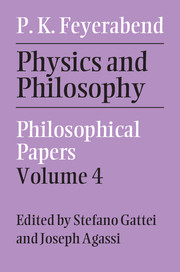
Physics and Philosophy
- Philosophical Papers
-
- Published online:
- 05 October 2015
- Print publication:
- 17 September 2015
24 - Natural Philosophy(1958)
- from Part Three - Encyclopedia Entries(1958–1967)
-
- Book:
- Physics and Philosophy
- Published online:
- 05 October 2015
- Print publication:
- 17 September 2015, pp 323-345
-
- Chapter
- Export citation
8 - About Conservative Traits in the Sciences, and Especially in Quantum Theory, and Their Elimination(1963)
- from Part One - Papers and Book Chapters(1948–1970)
-
- Book:
- Physics and Philosophy
- Published online:
- 05 October 2015
- Print publication:
- 17 September 2015, pp 188-200
-
- Chapter
- Export citation
1 - The Concept of Intelligibility in Modern Physics(1948)
- from Part One - Papers and Book Chapters(1948–1970)
-
- Book:
- Physics and Philosophy
- Published online:
- 05 October 2015
- Print publication:
- 17 September 2015, pp 3-8
-
- Chapter
- Export citation
9 - Problems of Microphysics(1964)
- from Part One - Papers and Book Chapters(1948–1970)
-
- Book:
- Physics and Philosophy
- Published online:
- 05 October 2015
- Print publication:
- 17 September 2015, pp 201-210
-
- Chapter
- Export citation
14 - In Defence of Classical Physics(1970)
- from Part One - Papers and Book Chapters(1948–1970)
-
- Book:
- Physics and Philosophy
- Published online:
- 05 October 2015
- Print publication:
- 17 September 2015, pp 239-268
-
- Chapter
- Export citation
7 - Problems of Microphysics(1962)
- from Part One - Papers and Book Chapters(1948–1970)
-
- Book:
- Physics and Philosophy
- Published online:
- 05 October 2015
- Print publication:
- 17 September 2015, pp 99-187
-
- Chapter
- Export citation
12 - Remarks about the Application of Non-Classical Logics in Quantum Theory(1966)
- from Part One - Papers and Book Chapters(1948–1970)
-
- Book:
- Physics and Philosophy
- Published online:
- 05 October 2015
- Print publication:
- 17 September 2015, pp 225-233
-
- Chapter
- Export citation
3 - Determinism and Quantum Mechanics(1954)
- from Part One - Papers and Book Chapters(1948–1970)
-
- Book:
- Physics and Philosophy
- Published online:
- 05 October 2015
- Print publication:
- 17 September 2015, pp 25-45
-
- Chapter
- Export citation
4 - A Remark on von Neumann's Proof(1956)
- from Part One - Papers and Book Chapters(1948–1970)
-
- Book:
- Physics and Philosophy
- Published online:
- 05 October 2015
- Print publication:
- 17 September 2015, pp 46-48
-
- Chapter
- Export citation
21 - Comments on Hill’s “Quantum Physics and Relativity Theory”(1961)
- from Part Two - Reviews and Comments(1957–1967)
-
- Book:
- Physics and Philosophy
- Published online:
- 05 October 2015
- Print publication:
- 17 September 2015, pp 311-314
-
- Chapter
- Export citation
26 - Ludwig Boltzmann, 1844–1906(1967)
- from Part Three - Encyclopedia Entries(1958–1967)
-
- Book:
- Physics and Philosophy
- Published online:
- 05 October 2015
- Print publication:
- 17 September 2015, pp 366-373
-
- Chapter
- Export citation
28 - Max Planck, 1858–1947(1967)
- from Part Three - Encyclopedia Entries(1958–1967)
-
- Book:
- Physics and Philosophy
- Published online:
- 05 October 2015
- Print publication:
- 17 September 2015, pp 378-382
-
- Chapter
- Export citation
19 - Professor Landé on the Reduction of the Wave Packet(1960)
- from Part Two - Reviews and Comments(1957–1967)
-
- Book:
- Physics and Philosophy
- Published online:
- 05 October 2015
- Print publication:
- 17 September 2015, pp 302-303
-
- Chapter
- Export citation
18 - Review of Hans Reichenbach,The Direction of Time, Berkeley–Los Angeles: University of California Press, 1956(1959)
- from Part Two - Reviews and Comments(1957–1967)
-
- Book:
- Physics and Philosophy
- Published online:
- 05 October 2015
- Print publication:
- 17 September 2015, pp 299-301
-
- Chapter
- Export citation
29 - Erwin Schrödinger, 1887–1961(1967)
- from Part Three - Encyclopedia Entries(1958–1967)
-
- Book:
- Physics and Philosophy
- Published online:
- 05 October 2015
- Print publication:
- 17 September 2015, pp 383-386
-
- Chapter
- Export citation
