To save content items to your account,
please confirm that you agree to abide by our usage policies.
If this is the first time you use this feature, you will be asked to authorise Cambridge Core to connect with your account.
Find out more about saving content to .
To save content items to your Kindle, first ensure no-reply@cambridge.org
is added to your Approved Personal Document E-mail List under your Personal Document Settings
on the Manage Your Content and Devices page of your Amazon account. Then enter the ‘name’ part
of your Kindle email address below.
Find out more about saving to your Kindle.
Note you can select to save to either the @free.kindle.com or @kindle.com variations.
‘@free.kindle.com’ emails are free but can only be saved to your device when it is connected to wi-fi.
‘@kindle.com’ emails can be delivered even when you are not connected to wi-fi, but note that service fees apply.
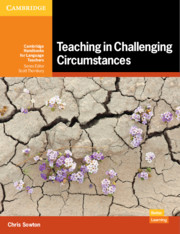
This is an essential resource for teachers who work in challenging circumstances, which might include formal education systems in the developing or developed world and informal or non-formal teaching in areas with growing numbers of refugees or displaced people. It draws on academic and professional research to provide practical advice that will help teachers address concerns including teaching large classes, working with limited resources and supporting learners who have experienced interrupted education and who may be suffering from trauma. It offers suggestions for creating a positive learning environment and implementing effective teaching practice and discusses the importance of resilience and wellbeing.
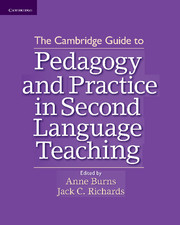
Written by internationally prominent researchers, educators, and emerging scholars, the chapters are grouped into five sections: rethinking our understanding of teaching, learner diversity and classroom learning, pedagogical approaches and practices, components of the curriculum, and media and materials. Each chapter covers key topics in teaching methodology such as reflective pedagogy, teaching large classes, outcomes-based language learning, speaking instruction, and technology in the classroom. Chapters assume no particular background knowledge and are written in an accessible style.
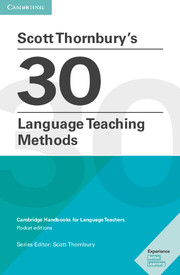
This easy-to-read book groups methods according to what they have in common, even if separated in time. At the same time, it rehabilitates some lost or forgotten methods, with a view to challenging current orthodoxies, especially with regard to such topics as translation, rote learning, authenticity, and communication. In doing this it aims to unpack, not just the history of methods, but the beliefs that underpin them and the benefits that still might possibly accrue from experimenting with them. Through its inclusion of interesting characters, intriguing anecdotes, and often bizarre techniques, the material is absorbing and engaging.
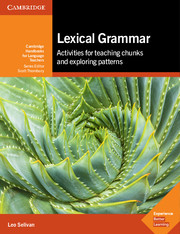
The book begins by looking at recent developments in corpus linguistics and second language acquisition research and outlines the important role which chunks play in textual cohesion and fluency, as well as in grammar acquisition. It goes on to provide practitioners with over 95 practical classroom suggestions and activities for making grammar teaching more lexical, and for making vocabulary practice more grammatical. Activities range from identifying, highlighting and recording chunks of language to enabling learners to use chunks in their active repertoire.
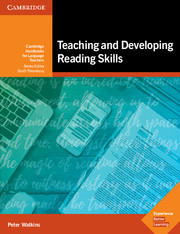
Supported by insights from research, this accessible book promotes the teaching of reading in a theoretically sound way, moving beyond a comprehension-testing approach. The practical part of the book provides a collection of accessible, generic activities to support and develop learners' reading skills and strategies. Its scope is wide-ranging, from promoting reading and developing fluency, to exploiting literary texts and digital sources, using learner-generated texts, developing critical reading skills and assessing reading.
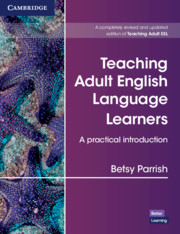
Teaching Adult English Language Learners is the completely revised and updated second edition of Betsy Parrish's Teaching Adult ESL: A Practical Introduction. This valuable guide for both novice and experienced teachers outlines good teaching practice and draws on classroom examples to offer practical guidance grounded in the latest research on language teaching. Addressing the diverse needs of adult English learners, it provides ideas on how to prepare learners for the demands and opportunities of the 21st century.
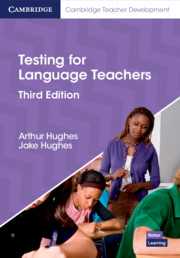
It combines theory and practical recommendations to help teachers understand the principles of testing and how they can be applied, supporting them to write better tests. The third edition has been extensively revised and updated to reflect developments in the field, while retaining the straightforward approach that made the earlier editions essential reading for trainee and experienced teachers alike. It features new content on technology, including computer adaptive testing and the use of automated scoring for all skills. It also includes an extended discussion of language testers' responsibilities and new chapters on non-testing methods of assessment.
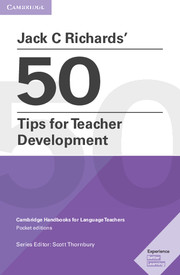
This book offers 50 practical ideas for teachers to use for their professional development. The tips cover a wide range of activities that can be carried out individually or in collaboration with others, including self and peer observation, journal writing, on-line forums, classroom research, action research, team teaching, lesson review, materials review, lesson study, mentoring, peer coaching, reading groups, and workshops. The Tips can be used by both novice and more experienced teachers and are intended to provide a basis for teachers to review the current state of their professional learning and to develop and implement goals for their development.
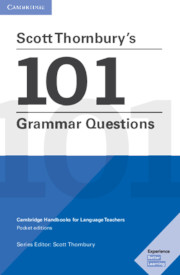
In this user-friendly reference book, Scott Thornbury draws on his extensive knowledge and experience to address many of the questions about grammar that regularly confront English language teachers when planning or delivering lessons. The answers are linked to classroom practice and supported by authentic examples of everyday grammar use. Scott Thornbury's 101 Grammar Questions is an essential book for teachers of all levels of experience and a useful reference for anyone interested in (and occasionally puzzled by) English grammar.
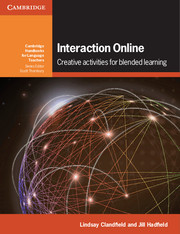
The book is relevant for use with online, blended or face-to-face courses and appropriate for a wide range of teachers, learning situations and institutional settings. This handbook contains over 75 tried and tested activities, suitable for a range of levels, which provide opportunities for strong online interaction. The introduction outlines the rationale and principles of interaction, as well as discussing tools for online interaction and the implications for teaching and learning. There are guidelines for setting up and managing online interaction and on using the learner-produced texts for feedback, error correction and assessment.
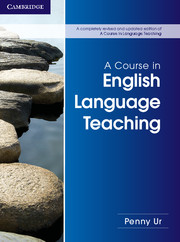
This is a comprehensive introduction to English language teaching for teachers in a variety of educational settings, including compulsory education.This book provides a comprehensive introduction to English language teaching, and is suitable for teachers in a variety of educational settings, including compulsory education. It has been completely revised and updated to include essential new topics for the modern English language teacher, including English as an international language, Content and Language Integrated Learning (CLIL) and using digital materials. It is ideal for initial teacher training and as a reference guide for practising teachers. The book combines theory and practice, with each unit containing tasks that encourage reflection and discussion, plus action tasks such as classroom observation and practice.
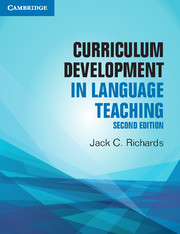
Curriculum Development in Language Teaching Second edition describes and examines key stages in the process of curriculum development and implementation, including situation analysis, needs analysis, goal setting, syllabus design, materials development and adaptation, teaching and teacher support, and evaluation. As well as describing and examining a traditional product-focused curriculum perspective, is also considers curriculum from the perspective of classroom processes. The book is written in an accessible manner to give the reader a clear introduction to fundamental issues and practices and highlights issues which can impact significantly on curriculum, so readers gain an insight into the effectiveness of innovation in curriculum.