To save content items to your account,
please confirm that you agree to abide by our usage policies.
If this is the first time you use this feature, you will be asked to authorise Cambridge Core to connect with your account.
Find out more about saving content to .
To save content items to your Kindle, first ensure no-reply@cambridge.org
is added to your Approved Personal Document E-mail List under your Personal Document Settings
on the Manage Your Content and Devices page of your Amazon account. Then enter the ‘name’ part
of your Kindle email address below.
Find out more about saving to your Kindle.
Note you can select to save to either the @free.kindle.com or @kindle.com variations.
‘@free.kindle.com’ emails are free but can only be saved to your device when it is connected to wi-fi.
‘@kindle.com’ emails can be delivered even when you are not connected to wi-fi, but note that service fees apply.
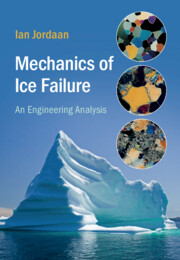
Featuring real-world examples and practical methodology, this rigorous text explores time dependence in the mechanics of ice. Emphasizing use of full scale data, and implementing risk-based design methods, mechanical theory is combined with design and modelling. Readers will gain understanding of fundamental concepts and modern advances of ice mechanics and ice failure processes, analysis of field data, and use of probabilistic design methods, with applications to the interaction of ships and offshore structures with thick ice features or icebergs. The book highlights the use of viscoelastic theory, including nonlinearity with stress and the effects of microstructural change, in the mechanics of ice failure and fracture. The methods of design focus on risk analysis, with emphasis on rational limit-state principles and safety. Full discussion of historical discoveries and modern advances – including Hans Island, Molikpak, and others – support up-to-date methods and models to make this an ideal resource for designers and researchers.
Groundwater flow varies spatiotemporally under many real-world situations, different from the natural gradient experiments in Chapter 10. This chapter presents field experiments that explore the role of velocity variation at the local- and large-scale solute migration in the aquifer and reveal difficulties in characterizing the aquifer, monitoring, and predicting solute transport even in a small-scale aquifer.
Widely used, parsimonious, practical well-mixed models are presented in this chapter for lakes water quality analyses. In addition, the volume-average, ensemble average, and stochastic concepts implicitly rooted in these models are explained and emphasized.
Chapter 4 introduces the molecular diffusion concept and Fick’s Law to explain the mixing phenomena at a small-scale CV in the distributed models rather than the large CV of the well-mixed model. For this purpose, it begins with describing diffusion phenomena, then formulating Fick’s law and developing the diffusion equation. Subsequently, examining the random velocity of Brownian particles and their pure random walk, we articulate the probabilistic nature of the molecular diffusion process and the reason why Fick’s Law is an ensemble mean law. Next, analytical solutions to the diffusion equation for various types of inputs are introduced. The advection-dispersion equation (ADE) formulation then follows, which couples the effect of fluid motion at fluid continuum scale and random motion of fluid molecules at the molecular scale to quantify solute migration. Likewise, we present analytical solutions to the ADE for several input forms and discuss snapshots and breakthroughs for different input forms.
This chapter discusses two different approaches to describing fluid flow: a Lagrangian approach (following a fluid element as it moves) and a Eulerian approach (watching fluid pass through a fixed volume in space). Understanding each of these descriptions of flow is needed to fully understand the dynamics of fluids. This chapter is devoted to diving into the differences between the two descriptions of fluid motion. Understanding this chapter will help tremendously in the understanding of the upcoming chapters when the Navier–Stokes equations and energy equation are discussed. This chapter will introduce the material derivative. It is extremely important to understand this derivative before the Navier–Stokes equations themselves are tackled.
Field tracer experiments in Borden aquifer in Canada and the Macrodispersion Experiment (MADE) Site, Mississippi, are reviewed. Both experiments injected tracers in aquifers and monitored their movements over fields at ten to hundred meters under natural gradient conditions. The behaviors of the tracer plumes at these two sites are distinctly different because the Borden aquifer is statistically homogeneous, and the aquifer of MADE is statistically heterogeneous. As a result, the validity of the classical ADE and non-Fickian dual-domain models becomes a contentious debate and deserves articulation of the differences between the ensemble mean nature of the models and the observations in one realization. The two experiments provided opportunities for understanding the limitations of applying solute transport theories and mathematical models based on soil-column experiments to real-world scenarios where heterogeneity is multi-scales, and groundwater flow varies spatiotemporally. Ignorance of the differences in scale of dominant heterogeneity and the observation, model, and interest scales is to blame. We explore and discuss the strengths and weaknesses of the theories and models.
In the previous chapter, the forces acting on a moving fluid element were exhaustively studied. Using Newtons second law of motion, the Navier–Stokes equations for both compressible and incompressible flows were obtained. This chapter uses an alternative approach to developing the Navier–Stokes equations. Namely, by starting from a Eulerian description (as opposed to a Lagrangian description), the integral form and conservation form of the Navier–Stokes equations are developed. The continuity and Navier–Stokes equations in its various forms are tabulated and reviewed in this chapter. This chapter ends by solving some very simple, yet common, problems involving the incompressible Navier–Stokes equations.
This chapter introduces numerical methods, including 1) Finite Difference Approach, 2) Methods of characteristics (Eulerian-Lagrangian), and 3) Finite Element Approach for solving the ADE applicable to multidimensional, variable velocity, irregular boundary, and initial conditions. However, only one- and two-dimension examples are illustrated for convenience. Once the algorithms are understood, they can be expanded to other situations with ease.
Quantifying the multiscale hydraulic heterogeneity in aquifers and their effects on solute transport is the task of this chapter. Using spatial statistics, we explain how to quantify spatial variability of hydraulic properties or parameters in the aquifer using the stochastic or random field concept. In particular, we discuss spatial covariance, variogram, statistical homogeneity, heterogeneity, isotropy, and anisotropy concepts. Field examples complement the discussion. We then present a highly parameterized heterogeneous media (HPHM) approach for simulating flow and solute transport in aquifers with spatially varying hydraulic properties to meet our interest and observation scale. However, our limited ability to collect the needed information for this approach promotes alternatives such as Monte Carlo simulation, zonation, and equivalent homogeneous media (EHM) approaches with macrodispersion approaches. This chapter details the EHM with the macordispersion concept.
This chapter develops the Navier–Stokes equations using a Lagrangian description. In doing so, the concept of a stress tensor and its role in the overall force balance on a fluid element is discussed. In addition, the various terms in the stress tensor as well as the individual force terms in the Navier–Stokes equations are investigated. The chapter ends with a discussion on the incompressible Navier–Stokes equations.
This chapter serves as an introduction to the concept of conservation and how conservation principles are used in fluid mechanics. The conservation principle is then applied to mass and an equation known as the continuity equation is developed. Various mathematical operations such as the dot product, the divergence, and the divergence theorem are introduced along the way. The continuity equation is discussed and the idea of an incompressible flow is introduced. Some examples using mass conservation are also given.
In this chapter, a concept known as scaling is introduced. Scaling (also known as nondimensionalization) is essentially a form of dimensional analysis. Dimensional analysis is a general term used to describe a means of analyzing a system based off the units of the problem (e.g. kilogram for mass, kelvin for temperature, meter for length, coulomb for electric change, etc.). The concepts of this chapter, while not entirely about the fluid equations per se, is arguably the most useful in understanding the various concepts of fluid mechanics. In addition, the concepts discussed within this chapter can be extended to other areas of physics, particularly areas that are heavily reliant on differential equations (which is most of physics and engineering).
This chapter introduces simple graphical methods to estimate advection velocity and dispersivity of solute migration through soil columns, using one-dimensional ADE presented in previous chapters. Methods of spatial and temporal moments are also introduced for solute concentration breakthroughs in one-dimensional transport and snapshots of the multi-dimensional solute migrations, respectively. Unlike automatic nonlinear regression analysis, these methods use physical insights and analytical solutions to illustrate logical approaches to estimate these parameters. The automatic regression analysis (such as Microsoft Excel introduced in Chapter 1) may find the parameters that fit the solution to the data well. However, the parameter values may not be physically possible if the estimation problem is poorly constrained (see examples in Chapter 11).
In addition to the continuity equation, there is another very important equation that is often employed alongside the Navier–Stokes equations: the energy equation. The energy equation is required to fully describe compressible flows. This chapter guides the student through the development of the energy equation, which can be an intimidating equation. A discussion on diffusion and its interplay with advection is also included, leading to the idea of a boundary layer. The chapter ends with the addition of the energy equation in shear-driven and pressure-driven flows.