To save content items to your account,
please confirm that you agree to abide by our usage policies.
If this is the first time you use this feature, you will be asked to authorise Cambridge Core to connect with your account.
Find out more about saving content to .
To save content items to your Kindle, first ensure no-reply@cambridge.org
is added to your Approved Personal Document E-mail List under your Personal Document Settings
on the Manage Your Content and Devices page of your Amazon account. Then enter the ‘name’ part
of your Kindle email address below.
Find out more about saving to your Kindle.
Note you can select to save to either the @free.kindle.com or @kindle.com variations.
‘@free.kindle.com’ emails are free but can only be saved to your device when it is connected to wi-fi.
‘@kindle.com’ emails can be delivered even when you are not connected to wi-fi, but note that service fees apply.
Two-dimensional problems of plane stress and plane strain are considered. The plane stress problems are the problems of thin plates loaded over their lateral boundary by tractions which are uniform across the thickness of the plate, while its flat faces are traction free. The plane strain problems involve long cylindrical bodies, loaded by tractions which are orthogonal to the longitudinal axis of the body and which do not vary along this axis. The tractions over the bounding curve of each cross section are self-equilibrating. Two rigid smooth constraints at the ends of the body prevent its axial deformation. The stress components are expressed in terms of the Airy stress function such that the equilibrium equations are automatically satisfied. The Beltrami–Michell compatibility equations require that the Airy stress function is a biharmonic function. The Airy theory is applied to analyze pure bending of a thin beam, bending of a cantilever beam by a concentrated force, and bending of a simply supported beam by a distributed load. The approximate character of the plane stress solution is discussed, as well as the transition from the plane stress to the plane strain solution.
The analysis of normal and shear stresses over differently oriented surface elements through a considered material point is presented. The Cauchy relation for traction vectors is introduced, which leads to the concept of a stress tensor. The analysis is presented of one-, two-, and three-dimensional states of stress, the principal stresses (maximum and minimum normal stresses), the maximum shear stress, and the deviatoric and spherical parts of the stress tensor.The equations of equilibrium are derived and the corresponding boundary conditions are formulated.
In addition to rotation, non-circular cross sections of twisted rods undergo longitudinal displacement, which causes warping of the cross section. This warping is independent of the longitudinal z coordinate and is a harmonic function of the (x,y) coordinates within the cross section. The Prandtl stress function is introduced, in terms of which the shear stresses are given as its gradients. This automatically satisfies equilibrium equations, while the compatibility conditions require that the stress function is the solution to Poisson’s equation. From the boundary condition of a traction-free lateral surface, it follows that the stress function is constant along the boundary of the cross section. The applied torque is related to the angle of twist by the integral condition of moment equilibrium. This theory is applied to determine the stress and displacement components in twisted rods of elliptical, triangular, rectangular, semi-circular, grooved-circular, thin-walled open, thin-walled closed, and multicell cross sections. The expressions for the torsional stiffness are derived in each case. The maximum shear stress and the warping displacement are also evaluated and discussed.
Partial differential equations whose solution specifies the elastic response of a loaded body are summarized. If all boundary conditions are given in terms of tractions, the boundary-value problem can be specified entirely in terms of stresses. The governing differential equations are then the Cauchy equations of equilibrium and the Beltrami–Michell compatibility equations. If some of the boundary conditions are given in terms of the displacements, the boundary-value problem is formulated in terms of the displacement components through the Navier equations of equilibrium. The boundary conditions can be expressed in terms of displacements, or in terms of displacement gradients. Due to the linearity of all equations and boundary conditions, the principle of superposition applies in linear elasticity. The semi-inverse method of solution and the Saint-Venant principle are introduced and discussed. The solution procedure is illustrated in the analysis of the stretching of a prismatic bar by its own weight, thermal expansion of a compressed prismatic bar, pure bending of a prismatic bar, and torsion of a prismatic rod with a circular cross section.
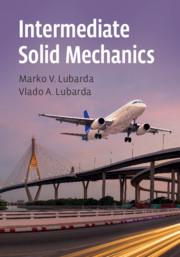
Based on class-tested material, this concise yet comprehensive treatment of the fundamentals of solid mechanics is ideal for those taking single-semester courses on the subject. It provides interdisciplinary coverage of the key topics, combining solid mechanics with structural design applications, mechanical behavior of materials, and the finite element method. Part I covers basic theory, including the analysis of stress and strain, Hooke's law, and the formulation of boundary-value problems in Cartesian and cylindrical coordinates. Part II covers applications, from solving boundary-value problems, to energy methods and failure criteria, two-dimensional plane stress and strain problems, antiplane shear, contact problems, and much more. With a wealth of solved examples, assigned exercises, and 130 homework problems, and a solutions manual available online, this is ideal for senior undergraduates studying solid mechanics, and graduates taking introductory courses in solid mechanics and theory of elasticity, across aerospace, civil and mechanical engineering, and materials science.
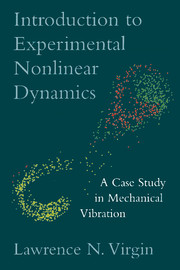
Nonlinear behavior can be found in such highly disparate areas as population biology and aircraft wing flutter. Largely because of this extensive reach, nonlinear dynamics and chaos have become very active fields of study and research. This book uses an extended case study - an experiment in mechanical vibration - to introduce and explore the subject of nonlinear behavior and chaos. Beginning with a review of basic principles, the text then describes a cart-on-a-track oscillator and shows what happens when it is gradually subjected to greater excitation, thereby encountering the full spectrum of nonlinear behavior, from simple free decay to chaos. Experimental mechanical vibration is the unifying theme as the narrative evolves from a local, linear, largely analytical foundation toward the rich and often unpredictable world of nonlinearity. Advanced undergraduate and graduate students, as well as practising engineers, will find this book a lively, accessible introduction to the complex world of nonlinear dynamics.
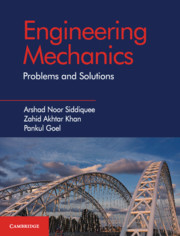
This comprehensive and self-contained textbook will help students in acquiring an understanding of fundamental concepts and applications of engineering mechanics. With basic prior knowledge, the readers are guided through important concepts of engineering mechanics such as free body diagrams, principles of the transmissibility of forces, Coulomb's law of friction, analysis of forces in members of truss and rectilinear motion in horizontal direction. Important theorems including Lami's theorem, Varignon's theorem, parallel axis theorem and perpendicular axis theorem are discussed in a step-by-step manner for better clarity. Applications of ladder friction, wedge friction, screw friction and belt friction are discussed in detail. The textbook is primarily written for undergraduate engineering students in India. Numerous theoretical questions, unsolved numerical problems and solved problems are included throughout the text to develop a clear understanding of the key principles of engineering mechanics. This text is the ideal resource for first year engineering undergraduates taking an introductory, single-semester course in engineering mechanics.
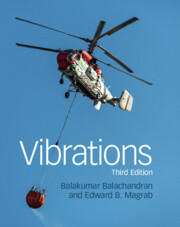
This new edition explains how vibrations can be used in a broad spectrum of applications and how to meet the challenges faced by engineers and system designers. The text integrates linear and nonlinear systems, and covers the time domain and the frequency domain, responses to harmonic and transient excitations, and discrete and continuous system models. It focuses on modeling, analysis, prediction, and measurement to provide a complete understanding of the underlying physical vibratory phenomena and their relevance for engineering design. Knowledge is put into practice through numerous examples with real-world applications in a range of disciplines, detailed design guidelines applicable to various vibratory systems, and over forty online interactive graphics which provide a visual summary of system behaviors and enable students to carry out their own parametric studies. Some thirteen new tables act as a quick reference for self-study, detailing key characteristics of physical systems and summarizing important results. This is an essential text for undergraduate and graduate courses in vibration analysis, and a valuable reference for practicing engineers.