Refine search
Actions for selected content:
212276 results in Engineering
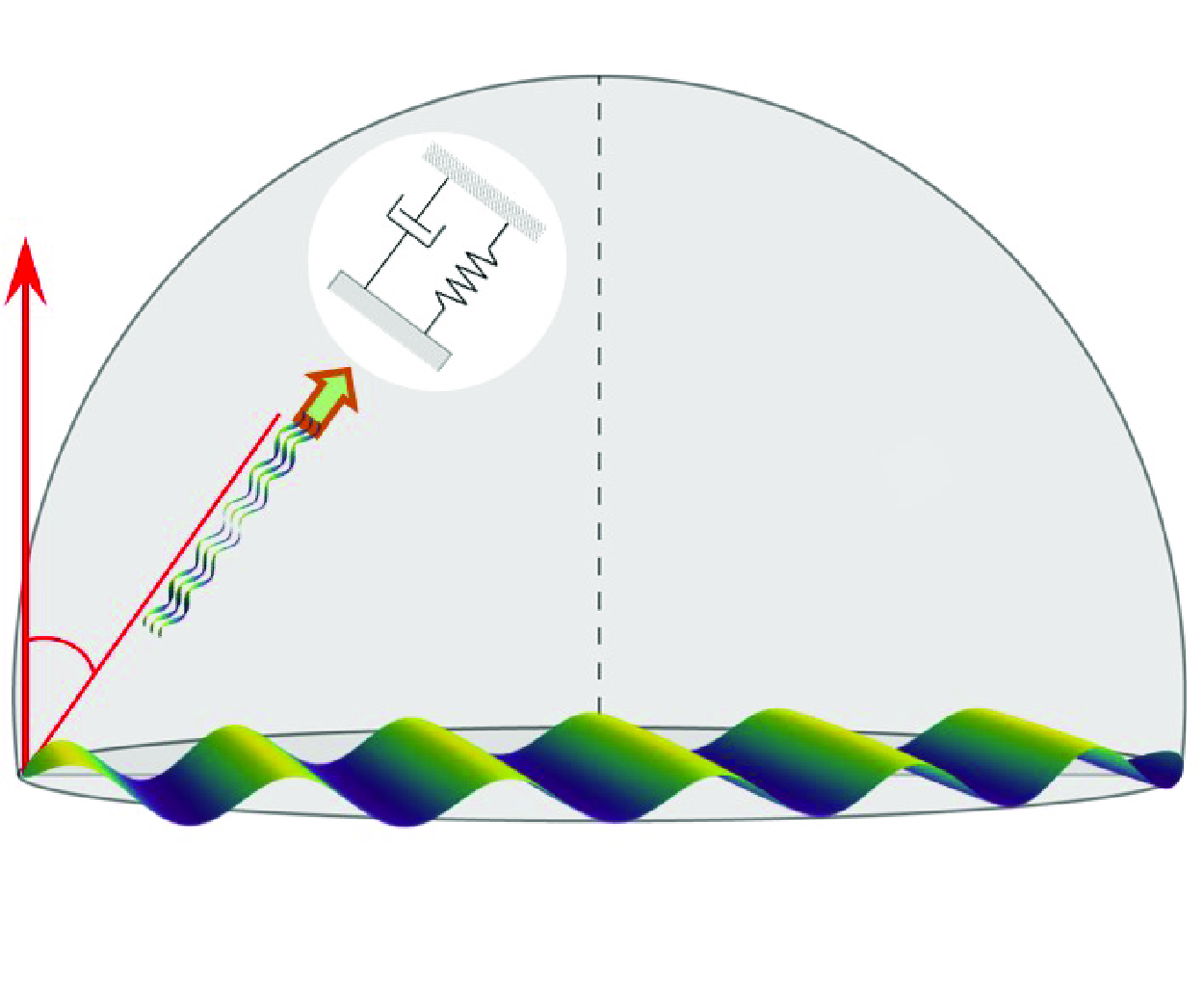
Acoustothermal effect: mechanism and quantification of the heat source
-
- Journal:
- Journal of Fluid Mechanics / Volume 1012 / 10 June 2025
- Published online by Cambridge University Press:
- 04 June 2025, A11
-
- Article
-
- You have access
- Open access
- HTML
- Export citation
Revisiting two-dimensional viscoelastic Kolmogorov flow: a centre-mode-driven transition – CORRIGENDUM
-
- Journal:
- Journal of Fluid Mechanics / Volume 1012 / 10 June 2025
- Published online by Cambridge University Press:
- 04 June 2025, E1
-
- Article
-
- You have access
- Open access
- HTML
- Export citation
Phase-changing droplet dynamics in idealised trailing vortex flows
-
- Journal:
- The Aeronautical Journal / Volume 129 / Issue 1339 / September 2025
- Published online by Cambridge University Press:
- 04 June 2025, pp. 2544-2555
-
- Article
-
- You have access
- Open access
- HTML
- Export citation
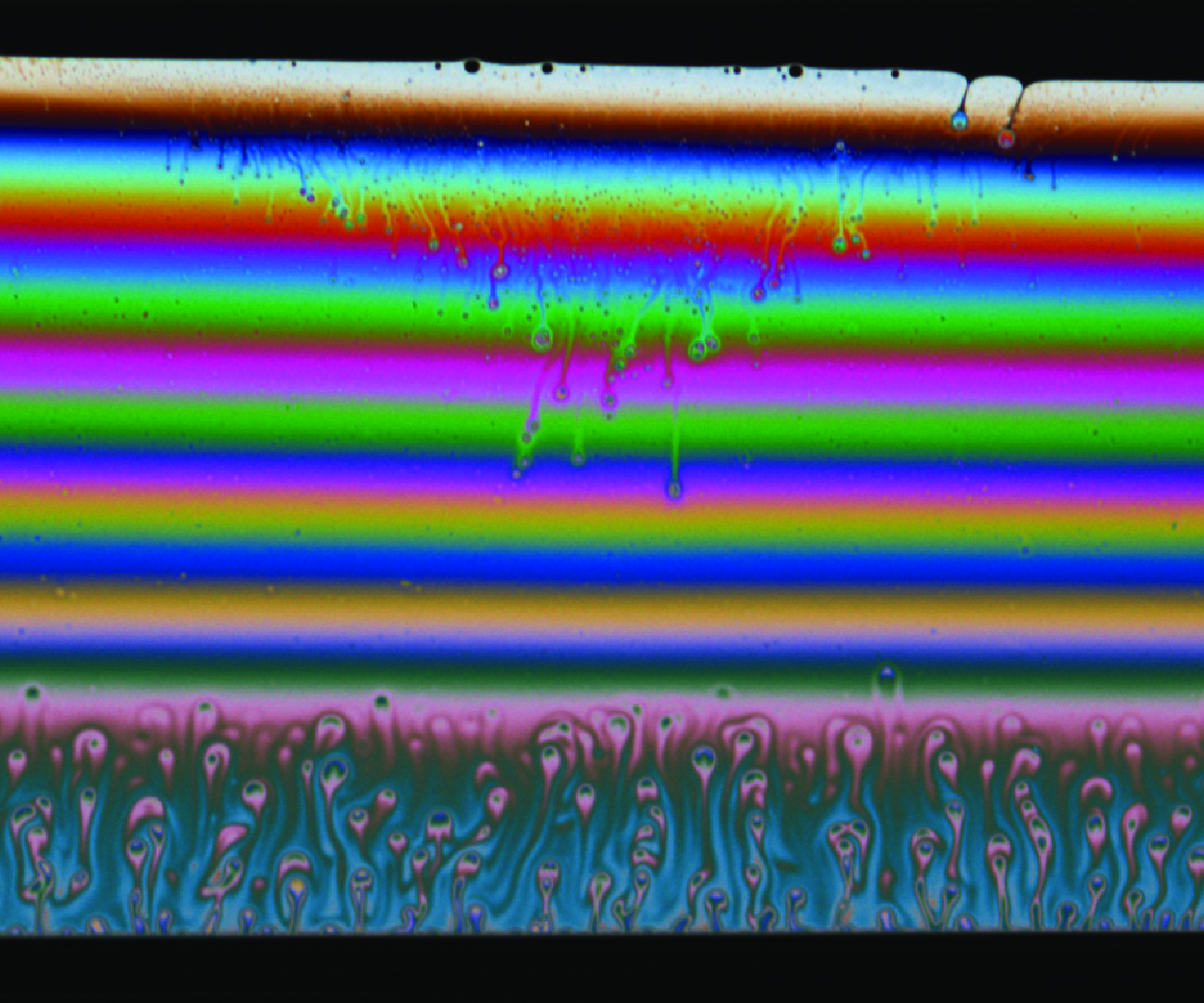
Drainage and lifetime of thin liquid films: the role of salinity and convective evaporation
-
- Journal:
- Journal of Fluid Mechanics / Volume 1012 / 10 June 2025
- Published online by Cambridge University Press:
- 04 June 2025, A18
-
- Article
-
- You have access
- Open access
- HTML
- Export citation

Method of aerodynamic noise source identification for cylinder flows
-
- Journal:
- Journal of Fluid Mechanics / Volume 1012 / 10 June 2025
- Published online by Cambridge University Press:
- 04 June 2025, A13
-
- Article
- Export citation

Basic Electronics
- Principles and Applications
-
- Published online:
- 03 June 2025
- Print publication:
- 01 March 2018
-
- Textbook
- Export citation

Strength of Materials
- Fundamentals and Applications
-
- Published online:
- 03 June 2025
- Print publication:
- 13 August 2018
-
- Textbook
- Export citation

Molecular streaming in a charged angstrom channel: a toy model
-
- Journal:
- Journal of Fluid Mechanics / Volume 1012 / 10 June 2025
- Published online by Cambridge University Press:
- 03 June 2025, A9
-
- Article
- Export citation
Recurring spoken term discovery in the zero-resource constraint using diagonal patterns
-
- Journal:
- Data-Centric Engineering / Volume 6 / 2025
- Published online by Cambridge University Press:
- 02 June 2025, e28
-
- Article
-
- You have access
- Open access
- HTML
- Export citation
High-power high-energy Yb-doped CaGdAlO4 regenerative amplifier with approximately 130 fs pulses – ERRATUM
-
- Journal:
- High Power Laser Science and Engineering / Volume 13 / 2025
- Published online by Cambridge University Press:
- 02 June 2025, e30
-
- Article
-
- You have access
- Open access
- HTML
- Export citation
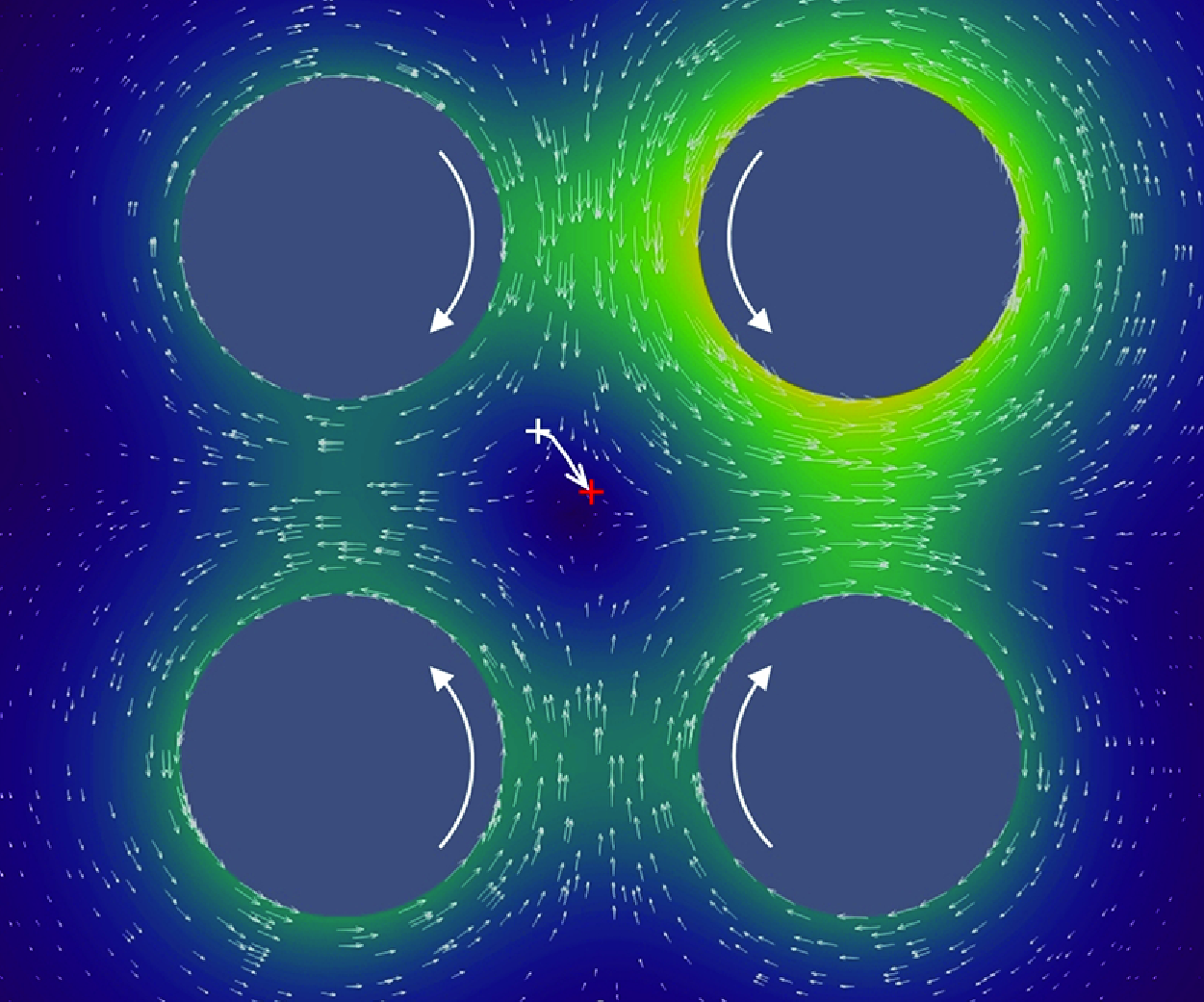
Reinforcement-learning-assisted control of four-roll mills: geometric symmetry and inertial effect
-
- Journal:
- Journal of Fluid Mechanics / Volume 1012 / 10 June 2025
- Published online by Cambridge University Press:
- 02 June 2025, A8
-
- Article
-
- You have access
- Open access
- HTML
- Export citation
-
Embedding the intrinsic symmetry of a flow system in training its machine learning algorithms has become a significant trend in the recent surge of their application in fluid mechanics. This paper leverages the geometric symmetry of a four-roll mill (FRM) to enhance its training efficiency. Stabilising and precisely controlling droplet trajectories in an FRM is challenging due to the unstable nature of the extensional flow with a saddle point. Extending the work of Vona & Lauga (Phys. Rev. E, vol. 104(5), 2021, p. 055108), this study applies deep reinforcement learning (DRL) to effectively guide a displaced droplet to the centre of the FRM. Through direct numerical simulations, we explore the applicability of DRL in controlling FRM flow with moderate inertial effects, i.e. Reynolds number $\sim \mathcal{O}(1)$, a nonlinear regime previously unexplored. The FRM’s geometric symmetry allows control policies trained in one of the eight sub-quadrants to be extended to the entire domain, reducing training costs. Our results indicate that the DRL-based control method can successfully guide a displaced droplet to the target centre with robust performance across various starting positions, even from substantially far distances. The work also highlights potential directions for future research, particularly focusing on efficiently addressing the delay effects in flow response caused by inertia. This study presents new advances in controlling droplet trajectories in more nonlinear and complex situations, with potential applications to other nonlinear flows. The geometric symmetry used in this cutting-edge reinforcement learning approach can also be applied to other control methods.


Inverse Problems and Applications
- Inside Out II
-
- Published online:
- 30 May 2025
- Print publication:
- 17 December 2012
JNM 2024 Special Issue
-
- Journal:
- International Journal of Microwave and Wireless Technologies / Volume 17 / Issue 6 / July 2025
- Published online by Cambridge University Press:
- 30 May 2025, p. 919
-
- Article
-
- You have access
- HTML
- Export citation
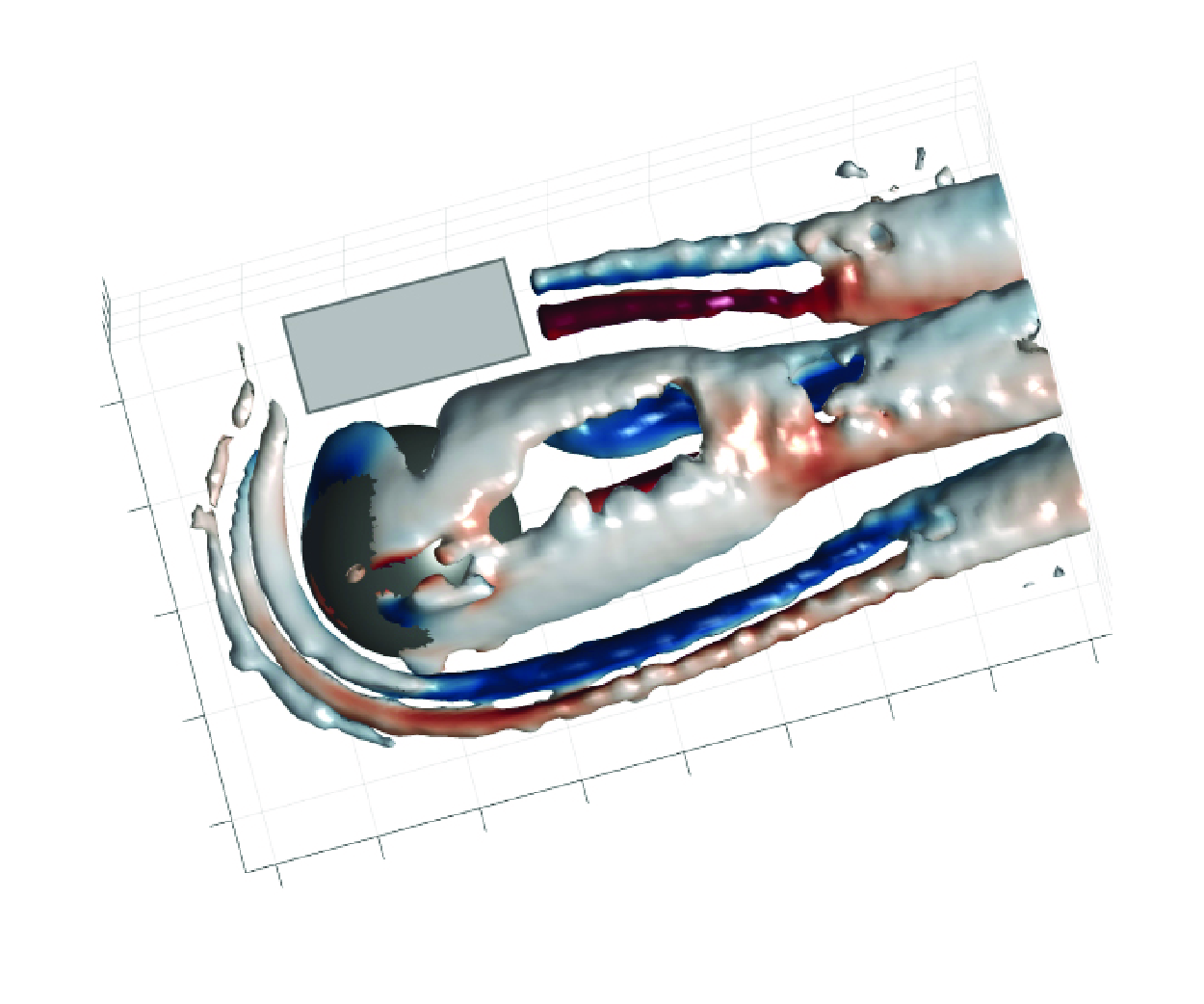
The near-wake vortex dynamics of a wall-mounted hemisphere measured with tomographic particle image velocimetry
-
- Journal:
- Journal of Fluid Mechanics / Volume 1012 / 10 June 2025
- Published online by Cambridge University Press:
- 30 May 2025, A7
-
- Article
- Export citation

Revisiting the theory of van Driest: a general scaling law for the skin-friction coefficient of high-speed turbulent boundary layers
-
- Journal:
- Journal of Fluid Mechanics / Volume 1012 / 10 June 2025
- Published online by Cambridge University Press:
- 29 May 2025, R3
-
- Article
-
- You have access
- Open access
- HTML
- Export citation
-
The skin-friction coefficient is a dimensionless quantity defined by the wall shear stress exerted on an object moving in a fluid, and it decreases as the Reynolds number increases for wall-bounded turbulent flows over a flat plate. In this work, a novel transformation, based on physical and asymptotic analyses, is proposed to map the skin-friction relation of high-speed turbulent boundary layers (TBLs) for air described by the ideal gas law to the incompressible skin-friction relation. Through this proposed approach, it has been confirmed theoretically that the transformed skin-friction coefficient $C_{f,i}$, and the transformed momentum-thickness Reynolds number $Re_{\theta ,i}$ for compressible TBLs with and without heat transfer, follow a general scaling law that aligns precisely with the incompressible skin-friction scaling law, expressed as $ (2/C_{f,i} )^{1/2}\propto \ln Re_{\theta ,i}$. Furthermore, the reliability of the skin-friction scaling law is validated by compressible TBLs with free-stream Mach number ranging from $0.5$ to $14$, friction Reynolds number ranging from $100$ to $2400$, and the wall-to-recovery temperature ratio ranging from $0.15$ to $1.9$. In all of these data, $ (2/C_{f,i} )^{1/2}$ and $\ln Re_{\theta ,i}$ based on the present theory collapse to the incompressible relation, with a squared Pearson correlation coefficient reaching an impressive value $0.99$, significantly exceeding $0.85$ and $0.86$ based on the established van Driest II and the Spalding–Chi transformations, respectively.


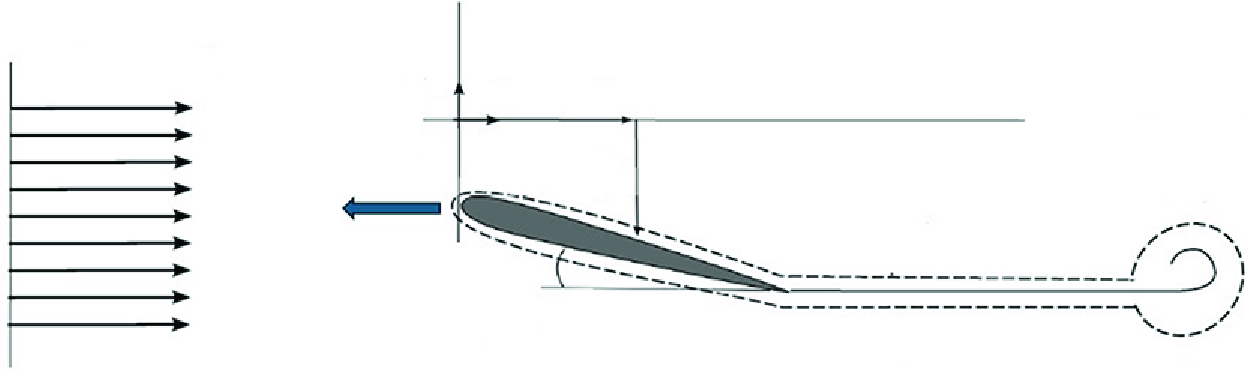
A note on the thrust of airfoils
-
- Journal:
- Journal of Fluid Mechanics / Volume 1012 / 10 June 2025
- Published online by Cambridge University Press:
- 29 May 2025, A6
-
- Article
-
- You have access
- Open access
- HTML
- Export citation
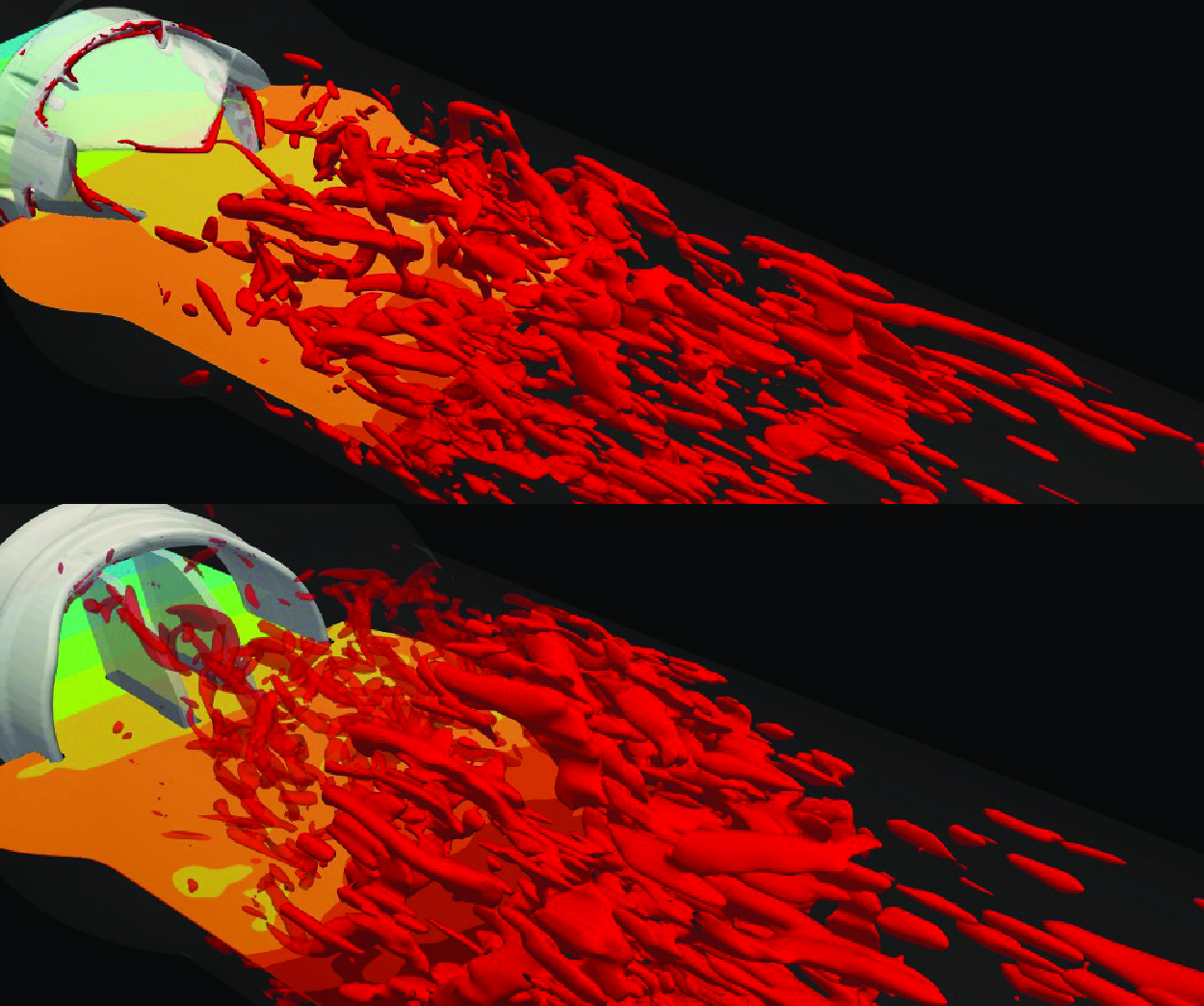
Closure dynamics of aortic mechanical heart valves versus bioprosthetic heart valves
-
- Journal:
- Journal of Fluid Mechanics / Volume 1012 / 10 June 2025
- Published online by Cambridge University Press:
- 29 May 2025, A3
-
- Article
-
- You have access
- Open access
- HTML
- Export citation
FLM volume 1011 Cover and Front matter
-
- Journal:
- Journal of Fluid Mechanics / Volume 1011 / 25 May 2025
- Published online by Cambridge University Press:
- 29 May 2025, p. f1
-
- Article
-
- You have access
- Export citation
Measurements of turbulent decay in a von Kármán flow at high Reynolds numbers
-
- Journal:
- Journal of Fluid Mechanics / Volume 1012 / 10 June 2025
- Published online by Cambridge University Press:
- 29 May 2025, R4
-
- Article
-
- You have access
- Open access
- HTML
- Export citation
-
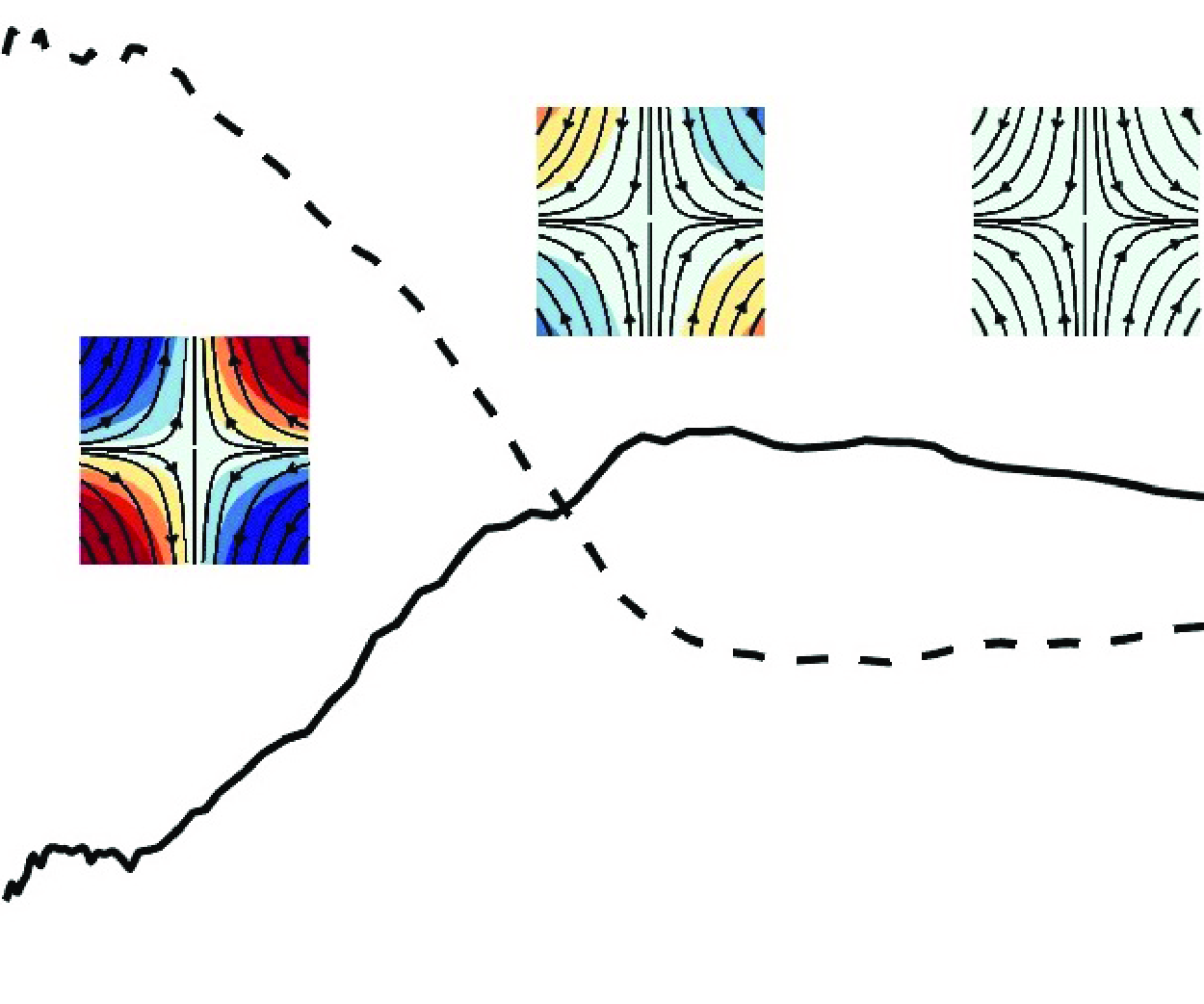
We present the measurements of the decay of stationary turbulence at Reynolds numbers based on the Taylor microscale $Re_{\lambda }=493, 599, 689$ produced in a large-scale von Kármán flow using stereoscopic particle image velocimetry. First, steady-state conditions were established, after which the impellers were simultaneously and abruptly stopped, and the turbulent decay was measured over 10–20 impeller rotation periods. A total of 258 decay experiments were performed. The temporal evolution of the ensemble-averaged turbulent kinetic energy (TKE) showed excellent agreement over all $Re_{\lambda }$ and exhibited two distinct phases: a short, initial transition phase where the TKE remained almost constant due to the inertia of the flow and lasted approximately $0.4$ impeller rotations, followed by a classical power-law decay. To extract the decay exponent $n$, a curve-fitting function based on a one-dimensional energy spectrum was used, and successfully captured the entire measured decay process. A value $n=1.62$ was obtained based on ensemble-averaged TKE. However, different decay exponents were found for individual velocity components: $n=1.38$ for the axial component consistent with various reports in the literature and Loitsiansky’s prediction ( $n=1.43$), and $n=1.99$ for the radial and circumferential components indicating saturation/confinement effects. Similarly, the longitudinal integral length scale in the axial direction grew as $L\propto t^{2/7}$, whereas it remained nearly constant in the radial direction. Finally, the evolution of the ensemble-averaged velocity gradients showed that after the impellers were stopped, the mean flow pattern persisted for a short time before undergoing a large-scale reversal before the onset of the turbulent decay.


Dual-band miniaturized quarter-mode substrate integrated waveguide antennas for 5G terminal applications
-
- Journal:
- International Journal of Microwave and Wireless Technologies / Volume 17 / Issue 4 / May 2025
- Published online by Cambridge University Press:
- 29 May 2025, pp. 701-709
-
- Article
- Export citation
