To save content items to your account,
please confirm that you agree to abide by our usage policies.
If this is the first time you use this feature, you will be asked to authorise Cambridge Core to connect with your account.
Find out more about saving content to .
To save content items to your Kindle, first ensure no-reply@cambridge.org
is added to your Approved Personal Document E-mail List under your Personal Document Settings
on the Manage Your Content and Devices page of your Amazon account. Then enter the ‘name’ part
of your Kindle email address below.
Find out more about saving to your Kindle.
Note you can select to save to either the @free.kindle.com or @kindle.com variations.
‘@free.kindle.com’ emails are free but can only be saved to your device when it is connected to wi-fi.
‘@kindle.com’ emails can be delivered even when you are not connected to wi-fi, but note that service fees apply.
This is the full text of James Jeans's Rouse Ball Lecture given in 1925 at Cambridge University, and surveys the field of atomic and subatomic physics in the early days of quantum mechanics, with a brief historical perspective on measurement.
This book can be described as a student's edition of the author's Dynamical Theory of Gases. It is written, however, with the needs of the student of physics and physical chemistry in mind, and those parts of which the interest was mainly mathematical have been discarded. This does not mean that the book contains no serious mathematical discussion; the discussion in particular of the distribution law is quite detailed; but in the main the mathematics is concerned with the discussion of particular phenomena rather than with the discussion of fundamentals.
Sir George Darwin (1845–1912) was the second son and fifth child of Charles Darwin. After studying mathematics at Cambridge he read for the Bar, but soon returned to science and to Cambridge, where in 1883 he was appointed Plumian Professor of Astronomy and Experimental Philosophy. His family home is now the location of Darwin College. His work was concerned primarily with the effect of the sun and moon on tidal forces on Earth, and with the theoretical cosmogony which evolved from practical observation: he formulated the fission theory of the formation of the moon (that the moon was formed from still-molten matter pulled away from the Earth by solar tides). He also developed a theory of evolution for the Sun–Earth–Moon system based on mathematical analysis in geophysical theory. This volume of his collected papers covers tidal friction and cosmogony.
Sir George Darwin (1845–1912) was the second son and fifth child of Charles Darwin. After studying mathematics at Cambridge he read for the Bar, but soon returned to science and to Cambridge, where in 1883 he was appointed Plumian Professor of Astronomy and Experimental Philosophy. His family home is now the location of Darwin College. His work was concerned primarily with the effect of the sun and moon on tidal forces on Earth, and with the theoretical cosmogony which evolved from practical observation: he formulated the fission theory of the formation of the moon (that the moon was formed from still-molten matter pulled away from the Earth by solar tides). He also developed a theory of evolution for the Sun–Earth–Moon system based on mathematical analysis in geophysical theory. This volume of his collected papers covers figures of equilibrium of rotating liquid and geophysical investigations.
Sir George Darwin (1845–1912) was the second son and fifth child of Charles Darwin. After studying mathematics at Cambridge he read for the Bar, but soon returned to science and to Cambridge, where in 1883 he was appointed Plumian Professor of Astronomy and Experimental Philosophy. His family home is now the location of Darwin College. His work was concerned primarily with the effect of the sun and moon on tidal forces on Earth, and with the theoretical cosmogony which evolved from practical observation: he formulated the fission theory of the formation of the moon (that the moon was formed from still-molten matter pulled away from the Earth by solar tides). This volume of his collected papers covers periodic orbits and some miscellaneous papers, including two investigating the health statistics of the marriage of first cousins – of interest to a member of a dynasty in which such marriages were common.
Sir George Darwin (1845–1912) was the second son and fifth child of Charles Darwin. After studying mathematics at Cambridge he read for the Bar, but soon returned to science and to Cambridge, where in 1883 he was appointed Plumian Professor of Astronomy and Experimental Philosophy. His family home is now the location of Darwin College. His work was concerned primarily with the effect of the sun and moon on tidal forces on Earth, and with the theoretical cosmogony which evolved from practical observation: he formulated the fission theory of the formation of the moon (that the moon was formed from still-molten matter pulled away from the Earth by solar tides). He also developed a theory of evolution for the Sun–Earth–Moon system based on mathematical analysis in geophysical theory. This volume of his collected papers covers oceanic tides and lunar disturbances of gravity.
Astronomer and philosopher J. F. W. Herschel's A Preliminary Discourse on the Study of Natural Philosophy, originally published in 1830, can be regarded as the first modern work on the philosophy of science. In this book, Herschel carefully sets out what he regards as the principles and methods of scientific investigation, both at a theoretical level and at the level of experiment or observation. He describes nature as being governed by laws which are difficult to discern by mere observation and so deduces that theoretical science requires analogical reasoning. In the Discourses, written as the first in a series called Cabinet Cyclopaedia, he covers a wide range of methodological, scientific and philosophical subjects that include discussions of contemporary astronomy, atomism and chemistry. His writing on light is heavily influenced by Newton. Herschel also ponders the differences between human beings and animals and the relationship between religious faith and scientific enquiry.
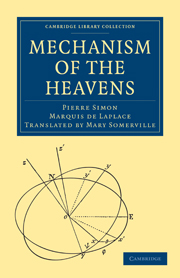
Published in 1831, this work forms part of a collection of introductory volumes suggested by Henry, Lord Brougham and Vaux, the Lord Chancellor, for the Society of the Diffusion of Useful Knowledge. Due to the exceptional mathematical ability of its author, however, it outgrew its original plan and has since been seen as a rather more ambitious project. Praised by Somerville's contemporary Sir John Herschel for its presentation of general astronomical theories and the mechanical principles employed in their derivation, the work was a tour de force of scientific and technical exposition. It is especially remarkable both for its author's firm grasp of the subject, especially given her lack of formal mathematical training, and for its clear outline of Newtonian philosophy for a popular audience.
The fame of Augustus De Morgan (1806–1871), a brilliant mathematician and logician, has been eclipsed by that of his son, the celebrated ceramicist William De Morgan. However, as readers of his Memoir will discover, De Morgan senior enjoyed an equally distinguished, if turbulent, career. Collated by his wife, and published in 1882, nine years after his death, the Memoir of Augustus de Morgan chronicles the varied life of an under-appreciated genius. Biographical narrative is interleaved with his own correspondence, revealing a humorous and warm personality as well as an exceptional intellect. As the Pall Mall Gazette told its readers, 'quaint and original to the last, every word of De Morgan's correspondence is well worth reading'. Although rich in detail about his work and publications, Sophia Elizabeth's affectionate account of her husband is also sympathetic and witty, making it an ideal introduction to one of Britain's greatest minds.
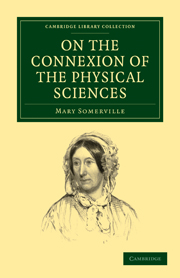
Mary Somerville (1780–1872) would have been a remarkable woman in any age, but as an acknowledged leading mathematician and astronomer at a time when the education of most women was extremely restricted, her achievement was extraordinary. Laplace famously told her that 'There have been only three women who have understood me. These are yourself, Mrs Somerville, Caroline Herschel and a Mrs Greig of whom I know nothing.' Mary Somerville was in fact Mrs Greig. After (as she herself said) translating Laplace's work 'from algebra into common language', she wrote On the Connexion of the Physical Sciences (1834). Her intention was to demonstrate the remarkable tendency of modern scientific discoveries 'to simplify the laws of nature, and to unite detached branches by general principles.' This and her next book, the two-volume Physical Geography, also reissued in this series, were enormously influential both within the scientific community and beyond.
Throughout his life, the mechanical engineer Richard Trevithick was dogged by misfortune and never achieved worldly success, He was born at Pool in the parish of Illogan, Cornwall on 13 April 1771; he had four sisters, but no brothers. His father held the responsible position of manager at the important Dulcoath mine. While he was still a baby, the family moved to Penponds, just outside Camborne, where he went to school and learned the three R's. He grew up into an immensely strong young man, capable of lifting heavier weights than anyone else around. While still quite young he was appointed engineer, responsible for erecting and servicing the steam engines that pumped out water from the pits. In those days, the alternative to the Newcomen engine was the one supplied by the firm of Boulton and Watt.
In 1797, Trevithick's father died and his 26-year-old son became sufficiently well-off to marry. His bride was Jane Harvey, daughter of a local businessman. A woman of strong character who spared him domestic worries, she stood by him through thick and thin, despite the fact that with him work took precedence over family life. Trevithick was convinced of the need to increase the efficiency of steam engines to cope with the increasing depth of the pits but, like many others, was held back by Watt's master patent, covering every conceivable innovation, and Watt was opposed to the use of steam at much more than atmospheric pressure.
Germany enjoyed a period of exceptional prosperity in the last quarter of the nineteenth century. The country overtook France in many ways, and engineering was one of these. Electrical engineering was a German speciality. Ferdinand Braun was born on 6 June 1850 at Fulda, a Catholic enclave in a Protestant region not far from Frankfurt. His father was a minor civil servant, who married the daughter of his superior. Ferdinand, their youngest son, had, altogether, four brothers and two sisters. After leaving the local gymnasium, Braun began studying physics at the minor University of Marburg but he soon moved to Berlin, where he received his doctorate in 1872. Like Heinrich Hertz later on, he became a protégé of Helmholtz. Two years later, as a young gymnasium instructor in Leipzig, he wrote his first book Der Junger Mathematiker und Naturforscher. He then progressed up the academic ladder, being außerordentliche professor first in Marburg and then in Strasbourg, then ordentliche professor first in Tübingen and then back to Strasbourg, where he remained for almost the whole of the rest of his career, during which time the city was in German hands.
Braun was the first to investigate the rectifier effect in semiconductor crystals, the phenomenon behind most solid-state electronics. In 1897, he invented, but refused to patent, the cathode ray oscilloscope, which became the basis for the television tube, computer terminals and many other electronic devices.
Russia has produced some great engineers, who had to contend with political as well as technical difficulties. The first to be profiled here, Peter Akimovich Pal'chinskii, became one of the victims of Stalin's paranoia. His father, Akim Fedorovich Pal'chinskii, a land surveyor and estate appraiser, married twice and had five children by his first wife, Aleksandra, seven by his second, Olga. Born on 3 October 1875, Peter was the oldest son by Aleksandra. As a child, he lived with his mother in Kazan, along with his brother Fedor and his three sisters Anna, Sophia and Elena, while the children of the second marriage lived with their parents in Saratov, further down the Volga.
Peter was an energetic youth and a bright student. After the age of eight, when his parents were divorced, he saw his father rarely. He confided primarily in his mother, a member of a socially prominent but impecunious family. She greatly influenced his early education. Under her tutelage, he became a good pianist, despite his lack of natural talent for the instrument. She also encouraged him to use the extensive family library, where, as well as works of literature, Peter read books on popular science and history. He also learned French and German; later he added English and Italian.
The future scientist, engineer, inventor, humanist and Nobel laureate Dennis Gabor, in Hungarian Gábor Dénes, was born in Budapest on 5 June 1900. The eldest in a family of three boys, he was followed by George, who died in 1935, and then André, born in 1903. Dennis knew his paternal grandfather, who had been born in 1832 of parents who had settled in Hungary at the end of the eighteenth century, having come from Russia and Spain. The family were tall, fair blue-eyed people, thought by the family to have been descendants of one of the Russian tribes, the Cerims or Kuzri, who adopted the Jewish faith centuries earlier. The boys' father Bertalan (or Bartholemew) came from the Hungarian town of Eger in 1867. He had been a gifted and ambitious child who hoped to go to university and qualify as an engineer, the profession followed by several other members of the family: unfortunately, his father's business failed and as a result he had to leave school early and take a clerical job at the age of 17. Nevertheless, he worked his way up and succeeded in becoming director of the largest industrial enterprise in Hungary. Their mother, Adrienne (née Kalman), was an actress who gave up the stage when she married. Her father was a highly skilled watchmaker and the son of an excellent tailor, but Dennis knew very little of his mother's forebears; he thought they were probably Sephardic Jews who settled in Hungary in the eighteenth century.
This work is intended for those who would like to read something, but not too much, about the life stories of some of the most remarkable engineers born since the Renaissance. There are five or six profiles in each of nine chapters, making 51 engineers altogether. The emphasis is mainly on their varied life stories, not so much on the details of their achievements. Although I knew none of them personally – most of them died long before I was born – I know something of their works. In France I have sailed along Riquet's Grand Canal de Languedoc, been impressed by the fortifications of Vauban and ascended the Eiffel tower. In England, I have seen mighty beam engines at work, and in museums. I have ridden on the footplates of steam engines, and I have frequently used Brunel's Great Western Railway. In the United States, I have walked across Roebling's Brooklyn Bridge and have inspected the Wrights' biplane in the Smithsonian National Air and Space Museum. In the Second World War, I had first-hand experience of the V-1 flying bomb and the V-2 ballistic missile. In Russia, I have flown in one of Tupolev's aircraft. My house is full of electrical appliances, as is the car I drive. I write this book on a laptop computer, the descendant of Babbage's analytical engine, which was to be powered by steam.
Among Smeaton's apprentices was a young man who became first his assistant, then his partner. William Jessop has been unfairly neglected; because not very much is known about his life, apart from his work. His parents, Josias and Elizabeth Jessop, had three other children: two younger sons and one daughter. William, the future engineer, was born on 23 January 1745 at Devonport, where his father was employed. When Smeaton arrived in Plymouth in 1756 to build the new Eddystone lighthouse, he placed Josias in charge of the workyard and they worked together until it was finished three years later. It was hardly surprising when Josias' son William, who was keen to be trained in engineering, was accepted by Smeaton as an apprentice and thus William learned the basics of theoretical and practical engineering at Austhorpe Lodge.
At the age of 27, Jessop was beginning to act as Smeaton's junior partner. His first major work was in Ireland, where he extricated the government from difficulties over the construction of the Grand Canal that links the Liffey at Dublin with the Shannon near Banagher. Under his capable aegis, the line westwards was resurveyed, the fine Leinster aqueduct was built over the Liffey at Sallins, and the canal was driven successfully across the Bog of Allen. In 1773, still under 30, he was elected a member of the Smeatonian society.