To save content items to your account,
please confirm that you agree to abide by our usage policies.
If this is the first time you use this feature, you will be asked to authorise Cambridge Core to connect with your account.
Find out more about saving content to .
To save content items to your Kindle, first ensure no-reply@cambridge.org
is added to your Approved Personal Document E-mail List under your Personal Document Settings
on the Manage Your Content and Devices page of your Amazon account. Then enter the ‘name’ part
of your Kindle email address below.
Find out more about saving to your Kindle.
Note you can select to save to either the @free.kindle.com or @kindle.com variations.
‘@free.kindle.com’ emails are free but can only be saved to your device when it is connected to wi-fi.
‘@kindle.com’ emails can be delivered even when you are not connected to wi-fi, but note that service fees apply.
In previous chapters, we have noted that soils of low permeability – typically, clayey soils – will not be able to respond rapidly to changes in stresses which require deformation, which in turn implies, for our one-dimensional systems, change in volume. We suggested in Section 6.2 that there would be a transient process between time t = 0 and time t → ∞ during which the temporary disequilibrium of pore pressures would disappear as deformation of the soil spring permitted stresses to be transferred from pore pressure to effective stresses supported by the soil itself. The detail of this process was not considered: we merely looked at the two extremes of the immediate aftermath of the change in external stress (at t = 0) and the eventual equilibrium at infinite time (t → ∞). In this chapter, we will explore various aspects of the analysis of the transient process between these two extremes. The transient process is known as consolidation.
We will first produce an approximate solution which forces us to concentrate on the important physical aspects of the problem. However, the governing differential equation – the diffusion equation – is one that is common to many problems which involve gradient driven flow: heat flows down a temperature gradient, pollution flows down a concentration gradient, pore water flows down a gradient of total head (Sections 5.2, 5.4).
In the context of our chosen one-dimensional approach to the mechanics of soils, we are somewhat limited in what we can say about the strength of soils but there are some ideas which can usefully be presented. Stiffness is concerned with the deformations of geotechnical systems – the serviceability limit states under operational or working loads. Strength is concerned with the collapse of geotechnical systems – the ultimate limit states for which failure of the geotechnical system will occur. Classically, it has always been easier to make statements about ultimate collapse conditions than about deformations, and geotechnical design often proceeds by starting with a collapse calculation and then factoring down the loading sufficiently that, from experience, the resulting reduced load would not be expected to produce excessive displacements. This is always a rather uncertain route by which to control those displacements, especially if the nature of the problem under consideration is more than somewhat different from those previously experienced – a proper understanding of stiffness is really more satisfactory. However, it does emphasise the traditional importance of understanding the strength of soils and the modes of failure of geotechnical systems.
Failure mechanisms
Figure 8.1 shows a schematic picture of a pile foundation. A pile is a long slender stiff structural member which is used to transfer loads from some surface structure through more or less soft soils to a certain depth in the ground (Fig. 1.9).
Each chapter has ended with a summary of the key points. Here it is appropriate to reiterate the primary intentions of this book and to point the way towards the next stages of soil mechanics education.
There are two themes which have been developed in this book:
The model of soil stiffness and strength links effective stresses and density. Changes in mechanical behaviour of soils can only be properly understood when the stresses and volumetric packing are considered in parallel. The role that history plays in changes in density – which tend to be locked into soils as loads are applied and then removed – is key for the subsequent understanding of the strength of soils. There is then a link with permeability and the ease with which water (or other pore fluid) can move through the voids of the soil, and thus the ability of the soil to respond rapidly to changes in stress. The concepts of drained and undrained response again bring together the thoughts about effective stresses and volumetric packing. This is the essence of critical state soil mechanics, which at its simplest level (Fig. 10.1) tells us that we cannot hope to understand the behaviour of soils unless we think all the time in parallel of the changes in effective stress and of density.
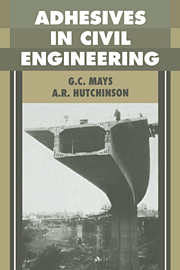
This book provides a complete and clear introduction to the use of adhesives to form load-bearing joints in bridges, civil engineering and building structures. Recent advances in adhesive technology have led to a rapid growth in the use of adhesives and in many cases, the use of adhesives can prove more convenient, less expensive, stronger, and more durable than traditional methods of joining. The first part of this book addresses the crucial factors involved in the formation of a successful adhesive joint, including adhesive selection, surface preparation, joint design, fabrication and protection from the environment. The second part of the book describes the growing uses of adhesives to repair and strengthen existing structures, in addition to describing their use in new constructions and applications which are now being developed for the future. The connections between the two parts of the book are brought out wherever possible so that the links between theory and practice are emphasized. The book gives the reader all the information required to fully exploit the economic and technical advantages of adhesives over conventional methods. Professional civil and structural engineers in higher education and industry will find this book invaluable as will graduate students of construction.
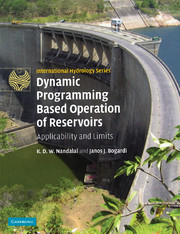
Dynamic programming is a method of solving multi-stage problems in which decisions at one stage become the conditions governing the succeeding stages. It can be applied to the management of water reservoirs, allowing them to be operated more efficiently. This is one of the few books dedicated solely to dynamic programming techniques used in reservoir management. It presents the applicability of these techniques and their limits on the operational analysis of reservoir systems. The dynamic programming models presented in this book have been applied to reservoir systems all over the world, helping the reader to appreciate the applicability and limits of these models. The book also includes a model for the operation of a reservoir during an emergency situation. This volume will be a valuable reference to researchers in hydrology, water resources and engineering, as well as professionals in reservoir management.