To save content items to your account,
please confirm that you agree to abide by our usage policies.
If this is the first time you use this feature, you will be asked to authorise Cambridge Core to connect with your account.
Find out more about saving content to .
To save content items to your Kindle, first ensure no-reply@cambridge.org
is added to your Approved Personal Document E-mail List under your Personal Document Settings
on the Manage Your Content and Devices page of your Amazon account. Then enter the ‘name’ part
of your Kindle email address below.
Find out more about saving to your Kindle.
Note you can select to save to either the @free.kindle.com or @kindle.com variations.
‘@free.kindle.com’ emails are free but can only be saved to your device when it is connected to wi-fi.
‘@kindle.com’ emails can be delivered even when you are not connected to wi-fi, but note that service fees apply.
Clinical remedial programs to treat severe dyslexia require spelling mastery of the word. Most remedial approaches require writing with words learned. This is the strength of Language Experience Approach (LEA), which becomes important in teaching these students. Remedial reading may be described as the spelling route to reading. Exercises that engage the student in these activities ensure that students know the meaning and spelling of the word, and it is documented in assessments.
Well-researched techniques for the remediation of reading deficits are recommended. It is important to match techniques to a student's strengths. One remediation plan is not optimal for every dyslexic student because of the four global patterns of processing difficulties and individual variances. These variations include different characteristics not mentioned in the four global patterns due to documented research over the last 30 years.
As remedial plans are formulated for each student, a framework is developed to document how well the remedial plan illustrates positive results in the different literary tasks. This framework affords the student the opportunity to practice all literary tasks necessary for growth. The framework is authentic based on an LEA format. This becomes evident upon examination of exemplary remediation procedures for dyslexia. These procedures are termed clinical remediation because they are often individualized or very small group instruction. LEA or an adaptation of LEA becomes the standard for this documentation.
When something stated in a respected journal but not well-researched yields desired results, and the instructor notices something that might help a student, they should try it. Techniques originate this way, not in a vacuum. Being knowledgeable about perceptual processing abilities for reading and the techniques in place is a solid foundation for capitalizing on new techniques.
Remedial Programs for Specific Perceptual Processing Deficits
Two main areas comprise decoding deficits: lack of success in decoding and lack of lexical knowledge. These deficits reflect a lack of both phonological processing and morphological knowledge about word structure. Deficits in decoding may be from several different perceptual processing deficits. They occur with problems in auditory or visual processing or both, and possibly sensory integration. Lack of morphological knowledge results in students needing overt, explicit, and direct teaching.
Several approaches in early childhood programs have embraced the concept of wholistic learning. A program is considered wholistic when it attempts to enhance the whole child in every developmental aspect as the child matures. Individual aspects of this development are not separated but overtly encouraged by student exploration and through teacher guidance. The connection between sensory-motor development, cognition, and literary abilities is strong. Several developmental programs for early childhood attempt to build background experiences that not only coordinate sensory-motor development but also enhance the child's ability to draw on this development as literary abilities evolve. Cognition is reinforced as the child internalizes these abilities and makes decisions for future actions. These programs recognize the importance of developing the whole child, taking into consideration the environment and the uniqueness of individual growth patterns, rather than compartmentalizing these as discrete subjects. This chapter develops the foundation of this type of teaching and describes early programs for wholistic comprehensive instruction for reading.
Types of cognition
Many researchers have developed theories for cognition that provide a look at different abilities and sub-abilities in the individual. Some are discrete, some are developmental for the child, and some are maturational through adulthood. It is worth considering these foundational theories that explain the areas of the brain involved and delineate the stages of growth. Wechsler's research in the area of verbal and nonverbal cognition allows us to understand anatomically where certain functions of cognition take place. In the left hemisphere of the brain, verbal information is learned, processed, and expressed. The left hemisphere processes in a linear, analytical manner and is sequentially oriented for processing. It is the seat of most language processing. The right hemisphere is functionalized for dreaming, intuition, visuospatial processing, quantitative thinking, and gestalt thinking.
There are four distinct hierarchical stages of cognition. Schema is considered the fundamental representation of a witnessed event or object. Symbol is a contrived mental representation standing for an event or an object. A concept is a representation of multiple events or objects. Rule pertains to a predictable relationship between multiple concepts.
The term literacy includes technology, which embraces the proficient use of available digital hardware and software (Williams et al. 2012). There are numerous technology software applications used today in schools. For instance, many classrooms have interactive whiteboards, computers, and online communication available (Gunaydin & Karamete 2016). Additionally, teachers and students may have handheld devices and smartphones at school or at home. According to Leu et al. (2004), the new technologies of this century need to be discovered and examined because everything that is read today is not textbook based.
Technology and LEA
Technology can be used to motivate and enhance the reading and writing process. One example of technology engagement is the introduction of the Language Experience Approach (LEA) writing of stories with a three-step approach: whole class application, small group application, and an individual application in the same manner as previously discussed in Chapter 1.
Whole Class Application
For example, for a whole class application, wordless picture books are projected on classroom screens for all the students to see. These books are employed as a stimulus for writing LEA student-generated stories that describe the events in the story. The teacher uses an interactive whiteboard to write the sentences the students create to describe the scenes in the wordless picture book. Important vocabulary words are colorhighlighted or underlined by the students. Punctuation can be bolded so that when the text is read aloud, students who have difficulty with punctuation can be visually aided to recognize where to stop, where to pause, etc. The teacher reads the LEA story to the whole class from the interactive whiteboard while the students watch and listen to the teacher's intonation and prosody. The students check if the recorded ideas are stated appropriately.
When student-generated stories are written on the interactive white board, a large size font should be employed while composing so that all students in the room can see. The teacher may place the student's initials beside the sentence that each student generated for the group story.
The advantage of using a computer to copy the stories is that the story can be printed when the exercise is finished, and each student can have a copy to take home and practice reading. Students use the copy in the classroom the next day to reread the story.
This book considers Russell Stauffer's Language Experience Approach (LEA) in detail. An approach must be judged by its impact on student learning and not on the age of conception. Here, we explore the nature of wholistic teaching in early childhood and beyond. The developmental maturation is explained for each different language task.
Theme One: Child Development and Wholistic Teaching
The first theme of shared information is child development and wholistic instruction. Both language arts instruction with researched language arts materials and with LEA, as either ancillary or solo instruction, have a place in the language arts curriculum. LEA is presented as a wholistic program of teaching beginning reading which includes all of the prime tenets of being geared to the development of the whole child in the literary tasks. When it is used as the main method of beginning reading instruction, it is more than adequate to offer everything necessary for success. If used as an ancillary program for beginning reading, it covers all the necessary items that enable the child to develop in a wholistic manner in the literary tasks. When used in the upper grades, it has the potential to aid student development in a myriad of ways needed for mature readers. Teaching literacy skills is a well-researched topic. There have been years of research on how to teach them, what to teach, and when to introduce them. In addition, many different techniques and strategies are available to teachers. Many research journal articles describe what works for different students. Assessment is also a wellstudied topic. Tests for different skills and students have been developed, offering grade levels, age levels, and standardized scoring. All of this attests to the scientific legwork that has been accomplished over the years that provides the field of education a strong background for enhancing developmental skills needed for beginning literacy tasks, choosing the correct methodology, and appropriately assessing progress.
Theme Two: Using LEA as a Stand-alone Approach or an Integrated Approach
Stauffer's conceptualization of LEA emphasizes early reading instruction, though he also has a protocol for struggling readers. One of the most essential points of LEA is that it enhances the ability for instruction to take place in a relaxed and natural setting whereby the students use what they know as a foundation for instruction.
1. Reading, writing, speaking, and listening occur in context with purposeful communication.
2. The interests, curiosities, culture, capacity, precepts, and concepts of each individual are used.
3. Use of word recognition and word identification is developed in a meaningful context ensuring the use of meaning clues.
4. Reading skills taught are assimilated and used.
5. Individual interests and understandings are extended and refined.
6. Appreciation of the value and uses of reading is afforded.
LEA is a total language arts approach relying heavily upon dictated stories, word banks, and creative writing. LEA is a comprehensive methodology that can be used to teach literacy.
A2 Wells (1979) list of essentials
1. They do not direct what the children say.
2. They are collaborative constructors of meaning.
3. They are attentive listeners.
4. Make attempts to use verbal and nonverbal cues to understand the child.
5. Help children extend their responses so that knowledge of the world and linguistic ability are fostered.
A3 Remedial approaches require a student to write the word from memory to consider it mastered
1. The Fernald method
2. Oton–Gillingham and its offshoots
a. Recipe for Reading
b. Slingerland Approach
c. Herman-Lexia
3. Reading Recovery
4. Words Their Way
5. Blau and Blau
6. Spalding
Appendix B (Chapter 2)
B1 Otis media
This condition is caused by fluid buildup in the middle ear, which obliterates some of the sound of speech for the young child. It interferes with the progression in which speech sounds are learned. These children learn to speak normally but do not really hear all of the speech sounds (American Academy of Pediatrics 2004). It may be caused by an allergic condition or a progression of ear infections. Treatment may contain both medicine and tubes placed in the ears of some children.
B2 Irregular speech
Since the window is quite large for speech to develop, it is difficult for parents to process if their child exhibits irregular speech. Another complicating factor is that not every child fits the normal developmental pattern, but they speak quite well and do not appear to have any problems with speech as they mature. But there are some blatant signs that all might not be progressing smoothly.
Two reading issues that exist in middle to secondary schools that impact a student's academic achievement are vocabulary development and comprehension ability. The Language Experience Approach (LEA) can be utilized to enhance both factors for lower-achieving students. Cunningham and Stanovich (1997) indicate the powerful and lasting effects of vocabulary knowledge on student's reading comprehension. Rasinski and Padak (2004) indicate fluency will get a student nowhere without knowing the meaning of words. Comprehension depends on the accurate understanding of the meaning of words and the ability to infer the meaning of unknown words encountered in reading (Roberts et al. 2008). These statements need little explanation. A word caller or a reader with limited vocabulary knowledge will not be the most successful student. Additionally, the student must have the ability to retain and retrieve the meaning of vocabulary words to fully comprehend the text during reading and for successful completion of assessments.
The use of visual literacy aids such as graphic organizers for developing comprehension and ready recall aids in building comprehension (Kim et al. 2004). Visual displays of information help students organize thoughts and aid in the recall of information. Sadoski and Paivio (2013) corroborate these findings and propose that information is stored in two different codes, verbal and visual. With these points in mind, strategies developed utilizing both vocabulary development and visual displays of information are embedded in LEA to aid students experiencing these problems.
Teaching the literacy process in secondary education involves using methods that can support student development and reading to learn in different curricular areas. Expository or informational text style and structure are sometimes more difficult for students to follow than story structure. Because the vocabulary in informational texts is particular to a specific field, it tends to be more abstract and the sentence structure is more elaborate. Imagery is often lacking and needs to be supplied by the reader.
Teaching Academic Vocabulary
Research has shown that gaps in reading achievement are often associated with gaps in vocabulary knowledge (Scott et al. 2003; Watts 1995). Developing language skills is not a focus in most secondary schools. Scott et al. (2003) observed 23 ethnically diverse classrooms and found that only 6% of school time was concentrated on vocabulary development, and in core academic subject areas, only 1.4% of instructional time was spent expanding vocabulary.
The primary objective of this paper is to contribute to the advancement of second language (L2) fluency research by outlining a specific proposal for future replication studies. The overarching goal is to assess the generalisability of the original findings of the two influential studies in the area of perceived fluency: Kormos and Dénes (2004) and Rossiter (2009). This objective will be achieved by first introducing the concept of L2 fluency that often conflates two categories: (1) overall language proficiency; (2) temporal features of speech production. The paper then highlights limitations in the current fluency research paradigm emphasising the variability in the methods employed for speech analysis and rating data collection. This diversity makes it somewhat challenging to compare results across various studies. In response to these challenges, the second part of the paper proposes several close and approximate replications of the two studies.
Language MOOC research has experienced a notable evolution from practice to conceptuality since its emergence as a subdiscipline of computer-assisted language learning. The versatility of the MOOC format for language learning has led to experimental designs that combine linguistic acquisition with other educational activities. This has been considered to be conducive to new ways of understanding how language learning occurs in LMOOCs, although there is no solid classification of LMOOCs subtypes to date based on course design. This study aimed to contribute to the conceptualisation of the field by creating a taxonomy for existing LMOOCs. Grounded theory strategies were adopted, so evidence was systematically collected to develop conceptual categories based on a thorough analysis process of the syllabus and short description of 432 courses. As a result, six LMOOC modalities emerged from the analysis: general language learning LMOOCs, LMOOCs for academic purposes, LMOOCs for professional purposes, LMOOCs focused on a specific language skill development, cultural-oriented LMOOCs, and meta-language learning LMOOCs. This study means a significant contribution to the LMOOC research field inasmuch as it is one of the first empirical-based attempts to broaden the definition of LMOOC.
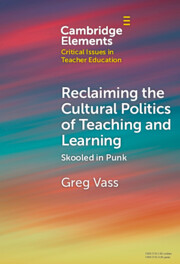
Despite often being associated with anti-establishment, irreverent, and a do-it yourself (DIY) rejection of dominant culture, less considered may the collaborative, communal and curative threads of punk thinking, being and doing. From the outset, punk offered critiques and alternative ways of conceptualizing a world and ways of worlding, that aren't as harmful and constraining as those encountered by many in the dominant milieu of life. This monograph is focused on how and why punk can productively contribute to efforts that are responding to the influences of dominant culture in education, such as the effects of standardization, heightened accountabilities, and 'gap talk'. For this Element, punk can be thought of as social practices that generate cultural resources that can be utilized to critique dominant culture. Hence, this Element aims to make the case that punk sensibilities offer educators opportunities to reclaim the cultural politics of teaching and learning.
Concerns over the quality of teaching in massive open online courses devoted to language learning (LMOOCs) have prompted extensive research on learning behavior in such courses. The purpose of this study is to gain a better understanding of autonomous learning check-ins – that is, individuals sharing their own learning records and/or other information about their learning-related experience – a novel behavior that has not been studied in previous LMOOC research. Using learning analytics, we found that just 6.2% (n = 699) of a sample of 11,293 learners autonomously engaged in check-in behavior, and that the content of these learners’ check-ins varied considerably according to their contexts and the language skills they were seeking to acquire. We further found (1) a positive association between check-in behavior and LMOOC completion; (2) that students who chose to check in earned relatively low grades on unit quizzes, especially in their early stage of learning, but outperformed the non-check-in group significantly in final exam scores; and (3) that those who checked in engaged with a significantly wider array of in-LMOOC learning components than those who did not, and thus accessed a wider system of language-learning experiences. Taken together, these results confirm that check-in behavior can aid the process of learning in an LMOOC and further highlight this behavior’s wider potential to aid self-directed autonomous online learning.
This article explores my relational learning reflections with the Laitu Khyeng Indigenous community in the Chittagong Hill Tracts (CHT), Bangladesh, focusing on Indigenous perspectives on climate change education. Implementing a relational theoretical framework, I share my reflections on relational learning in this research as part of being accountable to the Indigenous community. Through exploring Indigenous land-based climate change research, five central themes emerge Indigenous land rights, relationship with the environment, community-led relationality as collaboration, intergenerational relational knowledge and relationality as ethical reciprocity. The findings explore the intrinsic connection between Indigenous communities and their ancestral territories, emphasising the significance of upholding Indigenous sovereignty over land for sustainable adaptation to climate change. In this article, I highlight the importance of relational learning as a form of education, fostering resilience rooted in preserving traditional practices and spaces. Relationality with the environment is central to Indigenous climate education, promoting understanding and reciprocity with the land. In my learning, I learned that community dynamics and collaborative learning are essential for effective climate education, emphasising collective action and diverse perspectives. In relational learning, inter-generational knowledge transmission ensures the preservation and sharing of traditional land-based knowledge across generations, forming the foundation for sustainable adaptation strategies. Ethical engagement and reciprocity guide research interactions, emphasising mutual respect and cultural sensitivity. By centring Indigenous perspectives and knowledge systems, this study advocates for community-led approaches to climate change education, fostering resilience and environmental stewardship within Indigenous communities.
Second language acquisition (SLA) or second/foreign language teaching has been influenced to various degrees by key linguistic theories, including structural linguistics (Bloomfield, 1933; Saussure, 1959), generative linguistics (Chomsky, 1957, 1965), systemic functional linguistics (Halliday, 1973), and, more recently, contemporary Cognitive Linguistics (CL; Goldberg, 1995; Lakoff, 1987, 1993; Langacker, 1987, 1991; Talmy, 1988, 2000), a theory composed of several related linguistic approaches often viewed as a response or complement to generative linguistics. While structural linguistics, generative linguistics, and systemic functional linguistics have each provided a theoretical impetus for one or more of the prominent language teaching methods or approaches over the past century (such as the Audiolingual method, the Natural method, and the Communicative Language Teaching method), CL, as a newcomer, has begun to exert a growing influence since the early 1990s. Given that the purpose of this research timeline article is to present a historical overview of the key thoughts and studies on CL-inspired approaches to instructed second language acquisition (ISLA),1 a brief discussion of CL's main differences from the other linguistic theories and its key theoretical tenets is in order.
Research on digital multimodal composing (DMC) in second language (L2) classrooms has proliferated considerably in recent years, to a large extent in response to the changing digital and multimodal communication landscape. This article offers a research agenda on DMC in L2 classrooms. We begin with a theoretically oriented overview of DMC scholarship. We then examine seven research themes for future research inquiry, from which we draw seven research tasks. The seven themes are: (1) the effectiveness of DMC for L2 writing development; (2) DMC task design; (3) L2 teacher education/training for implementing DMC; (4) feedback practice for DMC; (5) DMC assessment; (6) collaborative DMC as a translanguaging space; and (7) the deployment of DMC for critical digital literacies. Throughout the article, we refer to interdisciplinary scholarship and methods from multimodality, L2 writing, composition studies, new literacy studies, language teacher education, and computer-assisted language learning. The seven research tasks represent what we see as the essential next steps for understanding DMC, which is a young domain that has great potential to advance L2 language and literacy education in the digital age.
The purpose of this study was to explore how science and environmentally related museums in Alberta, Canada are digitally engaging with climate change and energy education. This inquiry utilised qualitative discourse analysis to examine the discourses, dynamics and tensions present in digital museum contexts related to climate and energy education in Alberta. Drawing on Eisner’s three curricula — the explicit, implicit and null — the study focused on museums’ websites and social media activity. The museums studied share common foci on science, environment, or energy but range in size and location. As a long-standing energy-based economy, Alberta provides an interesting, and often contested, setting to observe climate and energy education in practice at museums, many of which exist in communities and within governance and stakeholder networks which are connected to the energy industry. Discourse-connected findings, discussion and implications are presented in relation to museums’ institutional mandates, curricular initiatives, pedagogical practices, special events and infrastructure initiatives.
This article traces the transnational circulation of socialist reforms in the field of sex education through the work of Monika Krause, a citizen of the German Democratic Republic (GDR) who migrated to Cuba and became the “Cuban Queen of Condoms.” For Krause, the overarching goal of sex education was to “teach tenderness” to the people. The socialist state’s mission to prepare the population for love, marriage, partnership, and family in Cuba and the GDR involved using complex measures. This paper describes these, contextualizes them in transnational debates, and explains some of the internal reasoning behind their institutionalization. It also explains why looking at state-level efforts to “teach tenderness to the people” matters for a transnational history of sex education.
Book banning is a topic covered in many US history classrooms. Students learn that in the first decades of the twentieth century, fights over the teaching of evolution led to restrictions on science texts. Meanwhile, fears about the spread of communism sparked campaigns to limit access to “subversive” ideas. Well into the 1960s, textbooks usually explain, Americans remained at odds about what schools should be free to teach.
What’s old is new, it seems. And tomorrow’s textbooks will have to be updated with stories from the present. As this issue goes to press, conservative groups across the United States have sought to remove hundreds of titles from schools and libraries. Such attempts range from challenges filed by individual parents—often inspired by the list curated on BookLooks.org—to statewide legislative efforts to recall books from schools. Thousands of books have been removed from libraries and classrooms, and the chilling effect has led cautious educators to self-censor even further.
For this policy dialogue, the HEQ editors asked Adam Laats and Kasey Meehan to discuss book banning in the US, focusing particularly on the motivations of groups seeking to limit what young people can read. Adam Laats is a professor of education and history at SUNY Binghamton. A leading scholar of conservative activism in education, he is the author of several books including The Other School Reformers (Harvard University Press, 2015) and Fundamentalist U (Oxford University Press, 2018). Kasey Meehan is the director of the Freedom to Read program at PEN America, where she leads initiatives to protect the right of students to freely access literature in schools. Founded in 1922, PEN America is the largest of the more than one hundred centers worldwide that make up the PEN International network. PEN America works to ensure that people everywhere have the freedom to create literature, to convey information and ideas, to express their views, and to access the views, ideas, and literatures of others.
HEQ policy dialogues are, by design, intended to promote an informal, free exchange of ideas between scholars. At the end of the exchange, we offer a list of references for readers who wish to follow up on sources relevant to the discussion.