To save content items to your account,
please confirm that you agree to abide by our usage policies.
If this is the first time you use this feature, you will be asked to authorise Cambridge Core to connect with your account.
Find out more about saving content to .
To save content items to your Kindle, first ensure no-reply@cambridge.org
is added to your Approved Personal Document E-mail List under your Personal Document Settings
on the Manage Your Content and Devices page of your Amazon account. Then enter the ‘name’ part
of your Kindle email address below.
Find out more about saving to your Kindle.
Note you can select to save to either the @free.kindle.com or @kindle.com variations.
‘@free.kindle.com’ emails are free but can only be saved to your device when it is connected to wi-fi.
‘@kindle.com’ emails can be delivered even when you are not connected to wi-fi, but note that service fees apply.
This chapter will explore the fundamentals of drama, both as a skill and as a methodology for teaching other curricular requirements. It also offers practical activities and assessment practices, as well as theoretical underpinnings and methods to further develop teaching methodologies beyond this text. You will have the confidence and knowledge to engage learners of all ages and abilities to explore their own ideas through dramatic performance and to evaluate the performance of others. The key to drama is not only the development of skills, but also the ability to apply processes and value these processes as equal to the end product of a drama activity. The application of drama in literacy, numeracy and other areas of learning will be embedded throughout. In Australia, much of the focus on drama in the classroom is from a Western perspective.
More than ever before, we are surrounded by many forms of media technologies, including film, television, the internet, games, print and audio. The Australian Curriculum focuses on media arts, which incorporates the creative use of these technologies as an art form. The aims, according to ACARA, are that students develop: enjoyment and confidence to participate in, experiment with and interpret the media-rich culture and communications practices that surround them; creative and critical thinking skills through engagement as producers and consumers of media; aesthetic knowledge and a sense of curiosity and discovery as they explore images, text and sound to express ideas, concepts and stories for different audiences; and knowledge and understanding of their active participation in existing and evolving local and global media cultures. In Media Arts, students use images, sound, text, interactive elements and technologies to creatively explore, produce and interpret stories about people, ideas and the world around them. They explore the diverse cultural, social and organisational influences on media practices, and draw on this understanding when producing and responding to media arts works.
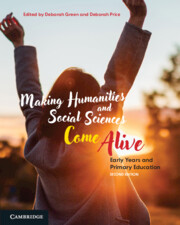
A strong foundation in Humanities and Social Sciences helps young learners to think critically, communicate effectively, make decisions and adapt to change. Making Humanities and Social Sciences Come Alive prepares pre-service educators to effectively teach and integrate the crucial learning area of HASS, incorporating the sub-strands of History, Geography, Civics and Citizenship, and Economics and Business. The second edition provides a comprehensive introduction to HASS education for both the early years and primary education. Closely aligned with the latest versions of the Australian Curriculum and the Early Years Learning Framework, the text delivers an in-depth understanding of the curriculum structure, pedagogical approaches to teaching HASS, inclusivity, global connections and the transition to practice. Wide-ranging updates include strengthened links to demonstrate the relevance of theory and research to classroom practice, and applications for integrating the Australian Curriculum's general capabilities and cross-curriculum priorities.
The arrival of COVID-19 in the US during the spring of 2020 cast a spotlight on the issue of vaccinations and their efficacy. School closures and school vaccination policies were among the most contentious arenas of debate as parents, teachers, and policymakers wrestled with how best to respond to the pandemic. Disease in school is not a new topic—our nation has previously faced outbreaks of influenza, polio, measles, and more. A look at the past can teach us much about how to understand the passionate, and sometimes partisan, views about school vaccination. Outside of schools, the anti-vax movement has enjoyed greater visibility and support even as public health officials emphasize the importance of herd immunity and broad vaccinations. The confirmation of Robert F. Kennedy Jr. as Health and Human Services secretary in February of this year makes it likely that the issues of school vaccination and immunization policy will continue to be vigorously debated.
This introductory chapter provides a brief survey of working definitions of oracy, including a history of the concept in British educational thought, and offers ways of contextualising the idea within broader debates over speaking and listening in popular culture.
In this chapter the sociolinguist Ian Cushing critiques what he sees as the prevailing narrative on oracy and social justice. He challenges two key points: Firstly, he disputes the 1960s theory of oracy, which viewed certain communities as linguistically deficient, attributing educational struggles to individual shortcomings rather than systemic injustices. Secondly, he opposes the contemporary oracy agenda’s focus on individual language modification to address broader societal inequities, arguing for transformative methodologies tackling root causes. Cushing criticizes organizations like Voice 21 for perpetuating deficit perspectives and language policing in the name of social justice. Instead, he advocates for a holistic approach acknowledging language struggles’ intersection with socioeconomic and racial inequalities. Only systemic transformation, he concludes, will offer genuine social justice.
In this chapter Classics teachers Katrina Kelly and Arlene Holmes-Henderson are joined by Amanada Moorghen and Rebekah Simon-Caffyn of Voice 21 to share new data on how teaching oracy can influence confidence in pupils. In ‘Confidence and Outcomes for Students and Teachers: what does the evidence say?’ they analyse qualitative feedback from over 5000 students and 293 teachers in primary and secondary schools. Confidence has been regularly identified as a primary benefit of a high-quality oracy education, they observe, but very little is known about what aspects of confidence are affected, and the impact of this on students. Their chapter breaks ‘confidence’ down into its component parts and explores what the data from their study shows. They find clear links between the practice of oracy and increased student confidence and outcomes in both speaking and listening across a variety of other contexts and skills, and offer a series of practical proposals for schools.
In Chapter 11, Alan Howe, one of the leading figures in the history of British oracy education, offers a personal history of the implementation of oracy over the last four decades. His essay "From Elocution to Empowerment " starts with Andrew Wilkinson’s 1965 work, before discussing what he calls the five ages of oracy: the Prescriptive Age, Corrective Age, Expressive Age, Participative Age, and Reductive Era. Howe argues that these ages represent shifts in perception and emphasis, from correcting speech to celebrating natural language development and encouraging political engagement. By building carefully on this history, he makes the case that oracy can become a major force for empowerment and social change.
In this chpater, the Classics Professor Arlene Holmes-Henderson and headteacher Sarah Lambert offer a survey of oracy education policies and practices outside the UK, focusing on initiatives such as the ESU International, Voice 21’s International Oracy Leaders, Oracy Italy, and Oracy Dubai. It then delves into the role of organizations like the English Speaking Union (ESU) in promoting effective communication skills globally, particularly through programs like the International Public Speaking Competition (IPSC). The chapter highlights the case study of Oracy Dubai at Dubai College, illustrating how oracy has been embedded as a whole-school priority. It discusses the challenges faced by teachers, students, and parents in embracing oracy education, including time constraints, curriculum demands, and language barriers. Recommendations are provided for cultivating connections with local schools, providing training and resources for staff, and involving young people in shaping oracy strategies.
In "What can be learnt from global traditions of oracy?" the prominent anthropologist Karin Barber explores the intertwined nature of orality and literacy across cultures. Despite the high value placed on literacy, she observes, orality remains a vibrant skill and creative domain in many societies. Recent studies emphasize the coexistence and mutual influence of oral and written traditions, demonstrated through examples like Italian commedia dell’arte and Afghan refugee poets. The chapter focuses first on the Yorùbá culture of Nigeria, where oral traditions shape individual identities and social interactions alongside a vibrant written literature. Further examples from Kenya and the Basque country highlight how informal oral genres integrate into education, fostering creativity, language skills, and cultural preservation. Overall, the chapter underscores oracy’s educational value and cultural significance across contexts, offering insights applicable to promoting oracy skills in the UK.
In this chapter, Debbie Newman, CEO of the education charity the Noisy Classroom, highlights the often overlooked role of listening in oracy. Despite oracy frameworks’ focus on speaking, listening remains undervalued. Drawing from experiences throughout her career, Newman underscores varied talk cultures among schools, from concerns about articulation to speaking reluctance. Arguing for a balanced approach, she stresses listening’s importance alongside speaking in academic, social, and professional contexts. To her this does not mean superficial "listening behaviours" but instead the broader understanding of listening as a cognitive skill. Newman explores how schools cultivate listening, citing examples from Modern Foreign Languages and drama departments, as well as through debate and discussion techniques. By championing listening skills, Newman contends, schools can enhance students’ abilities, fostering empathy and critical thinking for success in academic and real-world settings.
In this chapter, Qamar Shafiq, an experienced teacher of English from Staffordshire, assesses the practical implications of critiques of oracy education for ethnic minority pupils. He urges nuanced perspectives and practical strategies for academic success across backgrounds. He challenges low expectations, advocating fluency in standard English for societal integration and equal opportunities. Drawing from personal experiences as someone whose first language was not English, he stresses educators’ role in enhancing linguistic skills while respecting cultural diversity. Shafiq promotes a balanced approach supporting both oracy and standard English proficiency, rejecting hindering radical ideologies. Ultimately, he asserts the pragmatic case that marginalized groups require a solid foundation in oracy and standard English for success in education and beyond.