To save content items to your account,
please confirm that you agree to abide by our usage policies.
If this is the first time you use this feature, you will be asked to authorise Cambridge Core to connect with your account.
Find out more about saving content to .
To save content items to your Kindle, first ensure no-reply@cambridge.org
is added to your Approved Personal Document E-mail List under your Personal Document Settings
on the Manage Your Content and Devices page of your Amazon account. Then enter the ‘name’ part
of your Kindle email address below.
Find out more about saving to your Kindle.
Note you can select to save to either the @free.kindle.com or @kindle.com variations.
‘@free.kindle.com’ emails are free but can only be saved to your device when it is connected to wi-fi.
‘@kindle.com’ emails can be delivered even when you are not connected to wi-fi, but note that service fees apply.
Economists across the political spectrum agree that public policy can be improved by using incentives to achieve policy goals. In realms as disparate as lowering pollution and lessening traffic jams, economists have urged the use of market-like incentives such as taxes and fees to achieve public goals.
Many of today’s regulatory programs rely on detailed regulations to achieve their objectives. The Environmental Protection Agency, for instance, was tasked by Congress with regulating more than 200,000 plants that emit air pollutants. Economists have shown that using economic incentives, such as pollution and carbon taxes, would achieve cleaner air for a lower cost than reliance on regulations. Some studies have found that incentive-based schemes could achieve equivalent air quality for as little as 10 percent of the costs of existing methods. Similarly, in the large cities where they have been tried, variable tolls that rise with congestion have proved effective in lessening traffic jams and raising money to add lanes to crowded highways where necessary.
Despite the manifest economic benefits, pursuing public goals with incentives often meets public and political resistance.
The equity issue economists spend most of their time on is the current distribution of income and whether that distribution is becoming more unequal through time. Mainstream economists strongly disagree about these matters. Some want substantial increases in income tax for the highest earners; others think substantial increases would hurt economic growth in the medium to long term as lower after-tax income makes potential innovators more risk-averse while other high-paid workers decide to retire earlier. It is striking that almost no economists bring up a right to the fruits of one’s labor and fair compensation for one’s innovative ideas. Jefferson, on the left, Hamilton, on the right, and all the principal founders in between were strong believers in property rights. All the arguments about fairness, economic growth, and deserts are considered at length.
Economists agree about some equity matters. For example, they think the general public does not understand the actual incidence of taxes. Taxing unemployment insurance sounds regressive, but with our progressive income tax it actually hurts most those with above-average income. Raising business taxes sounds progressive, but labor and consumers pay a substantial part of this tax.
What comes to mind when you think about economics? Nothing good, if you are the reader I most want to reach. You know little or nothing of it and have always found it forbidding. Even if you took an introduction to economics in college (perhaps at your father’s insistence), you remember little of it. The class was boring. Depending on your age, you were presented with screechy blackboards with chalk dust flying or whiteboards or slides with diagram after diagram. Your professor, whether droning or excited, would have been telling you that diagrams were the best way to really understand economics.
Economists are, at best, skeptical of politicians who trumpet industrial policies; they point to their failures in this country and abroad. They wish the politicians’ electoral mantra was “Growth, growth, growth,” not “Jobs, jobs, jobs.” They believe the focus on jobs leads to subsidies for declining industries where there are lots of workers and voters rather than for industries of the future, where there are few. Economic growth and higher standards of living inevitably mean that employment patterns will change over decades.
Even left-of-center economists love markets. For example, in their introductory economics textbook, New York Times columnist Paul Krugman and his wife Robin Wells say: “Markets are an amazingly effective way to organize economic activity.” By shrinking profits, and, in their wake, workforces, markets help societies create workforces with better-paying jobs.
Most economists, however, support government interventions to combat the monopolistic power of firms and to support some standards of safety for workers. An increasing number would support raises in the minimum wage. Nevertheless, economists strongly oppose the rapid increase in the licensing of occupations as well as many other regulations imposed on firms.
In most situations economists are convinced that markets are better suited than governments to bring about a pattern of expenditures that will please consumers. One big problem, however, is that, while pleasing consumers, producers can be producing costs for others (externalities such as pollution) that the factories’ prices do not account for. Economists think placing a tax on pollution can increase the price of the product so that consumers will have to pay the full cost to society of purchasing it. On the other hand, when consumers educate their children, those in the broader society gain in addition to what parents would be willing to pay. A subsidy for external benefits of education may thus be justified. Both kinds of externalities can be seen as providing an agenda for government.
Externalities can also be used to indicate the level of government that should be intervening with a tax or a subsidy. Noise pollution from a rowdy bar can be a local responsibility because adjoining towns will rarely be affected. But noise pollution from airlines would have to be addressed by the federal government.
Cost–Benefit analysis: Since the 1980s benefit–cost analysis has been used in a host of federal agencies. One of its principal functions has been to slow down or kill proposals for new regulations from tunnel-visioned departmental advocates. A high-level advocate for benefit–cost analysis under President Obama said as much when he noted that, under Democratic presidents, departmental leaders too often saw regulations as a simple transfer “from the bad guys (the corporations) to the good guys (the people).” Costs could get out of hand.Traditionally, benefit–cost analysts tried to figure out what the benefits and costs of new programs or regulations would be for consumers. For example, they could begin their analysis of the benefits of programs to reduce air pollution by noting that housing values increased where pollution was low.
Unfortunately, in the Obama administration, analysts began to substitute their beliefs about what consumers should choose for actual evidence about what consumers do choose. Consumer sovereignty thus disappeared. And, in the Trump administration, evidence about the costs of new regulations was welcome, but not evidence about benefits. Thus, benefit–cost analysis in the federal government is currently in crisis.
Economists dispute the popular wisdom that “anything worth doing is worth doing well.” That’s because of their understanding of the concept of marginalism. Most choices in life are made “at the margin.” We obviously need food and water to live, but, usually, once we have enough of these things, their marginal value – the price we are willing to pay for a little bit more of them – rapidly diminishes.
The insights of marginalism are important to understanding many public debates. Arguments over health spending are a good example. Although we might spend all that is needed to fix a broken leg or save a particular life, much health care spending “on the margin” is not about meeting vital needs. We will weigh the “need” for an extra treatment on our tennis elbow very differently if our cost is a $10 insurance co-pay versus a much higher fee out of pocket.
If we think about marginal cost as economists do, we will use well the time and money we devote to a task, but we will rarely do as much as interested professionals think necessary. How well we do a thing must be weighed against all the other things worth doing.
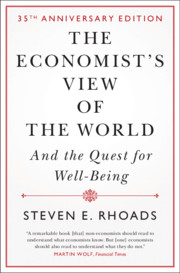
Released in 1984, Steven E. Rhoads' classic was considered by many to be among the best introductions to the economic way of thinking and its applications. This anniversary edition has been updated to account for political and economic developments - from the greater interest in redistributing income and the ascendancy of behaviorism to the Trump presidency. Rhoads explores opportunity cost, marginalism, and economic incentives and explains why mainstream economists - even those well to the left - still value free markets. He critiques economics for its unbalanced emphasis on narrow self-interest as controlling motive and route to happiness, highlighting philosophers and positive psychologists' findings that happiness is far more dependent on friends and family than on income or wealth. This thought-provoking tour of the economist's mind is a must read for our times, providing a clear, lively, non-technical insight into how economists think and why they shouldn't be ignored.
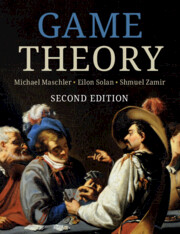
Now in its second edition, this popular textbook on game theory is unrivalled in the breadth of its coverage, the thoroughness of technical explanations and the number of worked examples included. Covering non-cooperative and cooperative games, this introduction to game theory includes advanced chapters on auctions, games with incomplete information, games with vector payoffs, stable matchings and the bargaining set. This edition contains new material on stochastic games, rationalizability, and the continuity of the set of equilibrium points with respect to the data of the game. The material is presented clearly and every concept is illustrated with concrete examples from a range of disciplines. With numerous exercises, and the addition of a solution manual for instructors with this edition, the book is an extensive guide to game theory for undergraduate through graduate courses in economics, mathematics, computer science, engineering and life sciences, and will also serve as useful reference for researchers.
Although economics models goods as unified, in fact artworks are goods that are made up of many different rights. Here, we consider intellectual property, specifically copyright, as part of the bundle of rights. We review fair use and expand to discuss other forms of property artists have in their work, including resale royalties and fractional equity. We consider case studies of Richard Prince, Takis, and the Art Workers’ Coalition, the Siegelaub–Projansky Artist’s Contract, Adrian Piper, Betty Parsons Gallery, Green Gallery, and Shepard Fairey. Although this chapter focuses on a US legal context, it also includes international treaties and systems of moral rights.
Market structure is the type of overall market we see in different situations. A theoretical starting point in economics is the idea of the perfectly competitive market in which the market itself sets the price, there are uniform goods, and there is mobility of resources. In many markets, there are concentrations of power and there is complexity. We study in depth the price-fixing scandal that unfolded between Christie’s and Sotheby’s auction houses in the 1990s, owing to the duopolistic market structure between the two firms. Substantial litigation ensued with fines and penalties around $512 million. We consider US tests for market concentration and monopolistic power.