To save content items to your account,
please confirm that you agree to abide by our usage policies.
If this is the first time you use this feature, you will be asked to authorise Cambridge Core to connect with your account.
Find out more about saving content to .
To save content items to your Kindle, first ensure no-reply@cambridge.org
is added to your Approved Personal Document E-mail List under your Personal Document Settings
on the Manage Your Content and Devices page of your Amazon account. Then enter the ‘name’ part
of your Kindle email address below.
Find out more about saving to your Kindle.
Note you can select to save to either the @free.kindle.com or @kindle.com variations.
‘@free.kindle.com’ emails are free but can only be saved to your device when it is connected to wi-fi.
‘@kindle.com’ emails can be delivered even when you are not connected to wi-fi, but note that service fees apply.
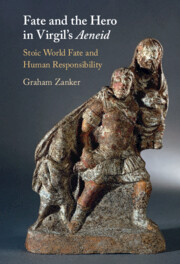
The figures of Dido and Aeneas in Aeneid 4 illustrate how Virgil adopts Stoic belief in human responsibility. Dido’s naturally determined disposition to fall in love with Aeneas is indeed Homerically co-motivated with Venus and Juno (who can be viewed as Stoic ‘impressions’), but she allows it to resist ‘incognitively’ what she knows from Aeneas and the prophets is fate, Aeneas’ duty to ‘follow Italy’. She is ‘dragged’ by fate through her own noble disposition when she realises her wrongdoing and wishes for her death. Otherwise, her career and her curses on Rome illustrate perfectly the Stoic chain of fate’s causality. Aeneas, despite his growing knowledge of his fate and his natural disposition to fulfil it, at first rejects it because of his Stoically ‘incognitive’ loneliness. In his speech to Dido, he reveals that his assent to fate is still shaky when he states that he is not following Italy ‘of my own will’. The oak simile captures his situation: ‘his mind remains unmoved, tears roll to no purpose.’ But after Mercury urges him to perform his duty to fate, he obeys, ‘rejoicing’ , finally giving his assent to fate, but remaining very much a Stoic ‘moral progressor’.
This book explores how Virgil in his Aeneid incorporates the ancient Stoics' thinking about how humans can exercise moral responsibility and how this can affect providential world fate. The third-century BC philosopher Chrysippus of Soli located this freedom in the way we can assent to courses of action, and Graham Zanker innovatively demonstrates how Virgil appropriates this concept in the way that Jupiter and Aeneas can assent to the world fate in which they have discovered they must play a part, or Juno and Dido can withhold their assent to it. Indeed, Virgil even offers the model to no-one less than Augustus: the emperor is invited to give his assent to ruling what was believed to be his 'world-wide' empire justly. The book is accessible to both students and professional scholars of the Aeneid, with all Greek and Latin translated into idiomatic English.
This chapter presents a detailed examination of the theory of language put forward in the Babylonian cosmogony, Enuma elish. This poem locates the origin of language at the very beginnings of the cosmos’ formation, even before the gods came to be. Accordingly, language is one of the first principles on which the world is founded. Thus, just as there is a temporal and spatial dimension of existence, there is also a linguistic one that is beyond the human and the divine. The poem futher explores this idea in using wordplay and etymology of sacred places, divine objects, and gods. In this context, the patron god of Babylon, Marduk, is conceptualized as a polyonymous cosmic divinity who incorporates into his persona the names of other gods.
This chapter surveys cuneiform texts that reflect various degrees of linguistic awareness, providing the reader with a general perspective on Babylonian semiotics and linguistics. The chapter begins with a discussion of the scholarly settings in which cuneiform developed and goes on to explore how this writing system, together with practices of divination and magic, influenced the linguistic consciousness of scribes. It examines a variety of texts, including the basic elementary school exercise SA A, which Assyro-Babylonian scholars often interpreted as an esoteric text describing the very first human words. It also investigates the conceptions of language in epic narratives such Adapa and the South Wind and Gilgamesh.
This book traced the broad as well as the narrow paths that led from Mesopotamian theories of language to their Greek adaptations. It argued that some stories, like the succession myths, displayed not only a shared interest in the nature of language but were also a vehicle for transcultural transmission. Within this context, the idea of a universal god whose multiple names describe cosmic history was utilized by elite specialists for purposes of understanding the world. Rather than viewing transculturation in terms of influence or, contrarily, in asserting independence, this study showed how the Greeks made selective use of Mesopotamian cultural goods to achieve prestige through innovation.
This chapter explores coincidences and divergences between Hesiod’s conception of language and those found in Akkadian literature. First, it provides a synopsis of Hesiod’s ideas about language and the interrelation of these ideas with the poet’s broader poetics. Then it discusses how Hesiodic conceptions of language are deeply intertwined with the interpretation of divine names. The chapter also investigates how Hesiod’s particular ways of interpreting theonyms is used to endorse hermeneutic practices anchored in an oral tradition. It explores the differences between the Theogony and its cuneiform counterparts, especially by comparing how wordplay and etymology are deployed in the analysis of divine names.
This chapter examines the Derveni papyrus and compares its hermeneutics to exegetic techniques found in cuneiform texts. The analysis shows that the anonymous author of the papyrus operates with semantic and theological models that align with ideas expressed in Akkadian texts, particularly those ideas relating to theonyms and the evolution of the cosmos. As in some Assyrian and Babylonian texts, the author makes use of hermeneutic techniques that heavily rely on morphological analysis aiming to prove that divine names have a unified referent. This referent is a polyonymous cosmic god, Nous (Mind), which has the same characteristics of the Babylonian gods Ninurta and Marduk when represented as universalizing divinities of multiple names.
Extraordinary individuals in ancient Greece claimed to know the real meaning of names. They understood "real meaning" to be the theological and cosmological truths hidden in language. Although the truths were plural and there was no consensus about what true names ultimately reveal, the theoretical assumptions of those individuals were essentially similar: they believed that language in general, but more specifically the names of the gods, contained crucial information about the cosmos. Classicists tend to think that those views were already present in archaic hexametric poetry and further developed centuries later by philosophers, sophists, and religious innovators of the sixth and fifth centuries BCE. But did Greek philosophies of language and the semantics of divine names effectively develop in isolation? The present book explores points of contact between Greek and Mesopotamian systems of thinking about language and reality and argues for the importance of bringing into a dialogue cuneiform and Greek texts concerned with the cosmic function of language.
This chapter explores the reception of Thucydides in later Greek and Roman historiography. It identifies three key themes in this reception. First, the tendency to avoid naming Thucydides, making him an ‘absent presence’ in later historical writing. Second, the adaptation and redeployment of Thucydidean themes in subsequent work. Third, the importance allotted to Thucydides’ Athenian context. These themes are discussed with reference to a number of ancient historical writers, including Xenophon, Appian and Sallust.