To save content items to your account,
please confirm that you agree to abide by our usage policies.
If this is the first time you use this feature, you will be asked to authorise Cambridge Core to connect with your account.
Find out more about saving content to .
To save content items to your Kindle, first ensure no-reply@cambridge.org
is added to your Approved Personal Document E-mail List under your Personal Document Settings
on the Manage Your Content and Devices page of your Amazon account. Then enter the ‘name’ part
of your Kindle email address below.
Find out more about saving to your Kindle.
Note you can select to save to either the @free.kindle.com or @kindle.com variations.
‘@free.kindle.com’ emails are free but can only be saved to your device when it is connected to wi-fi.
‘@kindle.com’ emails can be delivered even when you are not connected to wi-fi, but note that service fees apply.
To evaluate Hera according to the criteria generally used among humans would mean making her a shrewish wife and an unworthy mother. Is there not, one might ask, a fundamental irony in taking a goddess who was so scrupulous in observing and enforcing the boundaries between the human and the divine sphere, and then subjecting her to interpretations that project onto the gods specific features of human life? The widely practised reading of Hera through the prism of an anthropomorphic morality has considerably confused and impoverished our understanding of the goddess. To maintain this interpretation, scholars have found it necessary to develop two parallel ways of reading the available evidence: limit the goddess to the role of legitimate wife in the cults of the cities and separate off the image of the ‘untamed shrew’, restricting it to traditional narratives. The consequence of this approach was to neglect a whole series of elements which do not fit into this diptych-model of the goddess. Thus Hera’s status as a sovereign was relegated to being a local echo of a past which had disappeared, whereas the status of ‘the Hera of Zeus’ as queen of Olympus was greatly underestimated in cultic contexts. In addition, the jealous and angry Hera of the mythological dictionaries, excellent as many of them are in their fashion, acted as a kind of magnet to draw in the diverse aspects of the cholos of Hera, which drastically reduced its complexity.
In 1864 a piece of masonry half hidden in the soil attracted the attention of a scholar and member of the Institut de France who was visiting the island of Thasos. In one of his letters he mentions a ‘funerary bas-relief’ depicting a figure seated on a throne, next to another who is standing up. There were several further mentions of this piece in the intervening years, but finally in 1911 Charles Picard began the excavation of the remains on the island under the auspices of the French Archaeological Institute, and he completely uncovered the piece of stone. When this was done, it turned out not to be a free-standing funereal stele but a monument which was built into one of the gates of the city. It shows a seated deity holding a sceptre, and next to it a winged figure who is about to leave. Picard thought that the seated figure was Zeus and the winged one Iris or Eileithyia, and the reason he gave for this attribution was that the full image shows a small building, perhaps a shrine, in which the bas-reliefs of the two figures are located; however, above the apex of the pediment of this building an eagle is clearly depicted. In addition, the seated figure seemed to him too masculine to be a goddess, as some of his predecessors had thought. Several decades later, the column forming the other jamb of the gate was uncovered.
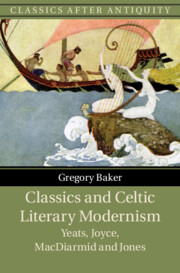
Celtic modernism had a complex history with classical reception. In this book, Gregory Baker examines the work of W. B. Yeats, James Joyce, David Jones and Hugh MacDiarmid to show how new forms of modernist literary expression emerged as the evolution of classical education, the insurgent power of cultural nationalisms and the desire for transformative modes of artistic invention converged across Ireland, Scotland and Wales. Writers on the 'Celtic fringe' sometimes confronted, and sometimes consciously advanced, crudely ideological manipulations of the inherited past. But even as they did so, their eccentric ways of using the classics and its residual cultural authority animated new decentered idioms of English - literary vernaculars so fragmented and inflected by polyglot intrusion that they expanded the range of Anglophone literature and left in their wake compelling stories for a new age. This title is also available as Open Access on Cambridge Core.
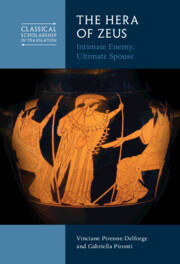
The goddess Hera is represented in mythology as an irascible wife and imperfect mother in the face of a frivolous Zeus. Beginning with the Iliad, many narrative traditions depict her wrath, the infidelities of her royal husband and the persecutions to which she subjects his illegitimate offspring. But how to relate this image to the cults of the sovereign goddess in her sanctuaries across Greece? This book uses the Hera of Zeus to open up new perspectives for understanding the society of the gods, the fate of heroes and the lives of men. As the intimate enemy of Zeus but also the fierce guardian of the legitimacy and integrity of the Olympian family, she takes shape in more subtle and complex ways that make it possible to rethink the configuration of power in ancient Greece, with the tensions that inhabited it, and thus how polytheism works.
Time is integral to human culture. Over the last two centuries people's relationship with time has been transformed through industrialisation, trade and technology. But the first such life-changing transformation – under Christianity's influence – happened in late antiquity. It was then that time began to be conceptualised in new ways, with discussion of eternity, life after death and the end of days. Individuals also began to experience time differently: from the seven-day week to the order of daily prayer and the festal calendar of Christmas and Easter. With trademark flair and versatility, world-renowned classicist Simon Goldhill uncovers this change in thinking. He explores how it took shape in the literary writing of late antiquity and how it resonates even today. His bold new cultural history will appeal to scholars and students of classics, cultural history, literary studies, and early Christianity alike.
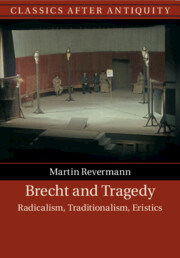
This wide-ranging, detailed and engaging study of Brecht's complex relationship with Greek tragedy and tragic tradition argues that this is fundamental for understanding his radicalism. Featuring an extensive discussion of The Antigone of Sophocles (1948) and further related works (the Antigone model book and the Small Organon for the Theatre), this monograph includes the first-ever publication of the complete set of colour photographs taken by Ruth Berlau. This is complemented by comparatist explorations of many of Brecht's own plays as his experiments with tragedy conceptualized as the 'big form'. The significance for Brecht of the Greek tragic tradition is positioned in relation to other formative influences on his work (Asian theatre, Naturalism, comedy, Schiller and Shakespeare). Brecht emerges as a theatre artist of enormous range and creativity, who has succeeded in re-shaping and re-energizing tragedy and has carved paths for its continued artistic and political relevance.
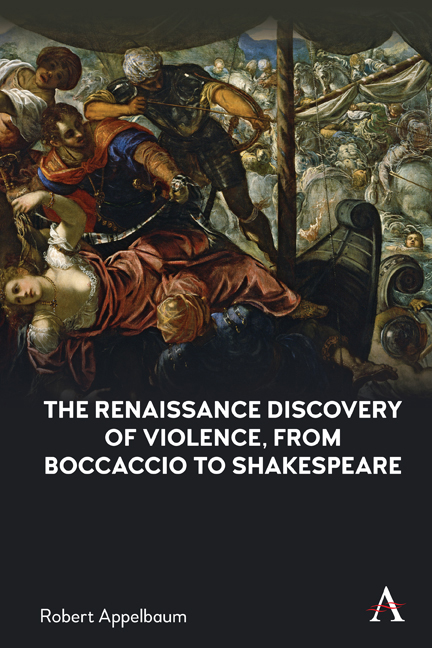
Many have wondered why the works of Shakespeare and other early modern writers are so filled with violence, with murder and mayhem. This work explains how and why, putting the literature of the European Renaissance in the context of the history of violence. Personal violence was on the decline in Europe beginning in the fifteenth century, but warfare became much deadlier and the stakes of war became much higher as the new nation-states vied for hegemony and the New World became a target of a shattering invasion. There are times when Renaissance writers seem to celebrate violence, but more commonly they anatomized it and were inclined to focus on victims as well as warriors on the horrors of violence as well as the need for force to protect national security and justice. In Renaissance writing, violence has lost its innocence.
This chapter explores in particular the 'greek presence' in the small organon, as manifested in the form of greek tragedy and/or its theorist aristotle. This is embedded within a broader analysis of this key work as a fundamenal contribution to theatre theory. New archival material in the form of brecht's type-written inserts into his personal copy of aristotle's 'poetics' is published for the first time and discussed in detail.