To save content items to your account,
please confirm that you agree to abide by our usage policies.
If this is the first time you use this feature, you will be asked to authorise Cambridge Core to connect with your account.
Find out more about saving content to .
To save content items to your Kindle, first ensure no-reply@cambridge.org
is added to your Approved Personal Document E-mail List under your Personal Document Settings
on the Manage Your Content and Devices page of your Amazon account. Then enter the ‘name’ part
of your Kindle email address below.
Find out more about saving to your Kindle.
Note you can select to save to either the @free.kindle.com or @kindle.com variations.
‘@free.kindle.com’ emails are free but can only be saved to your device when it is connected to wi-fi.
‘@kindle.com’ emails can be delivered even when you are not connected to wi-fi, but note that service fees apply.
The full range of internal dialect divisions within Indo-European that Albanian potentially enters into are surveyed here and shown to be complex and multifaceted. Nonetheless, it is argued that the overall evidence, based on the criterion of significant shared innovations, points to a particularly close connection between Albanian and Greek. It is further argued that this connection constitutes a subdivision within a discernible Palaeo-Balkanic subgroup that includes Messapic, Phrygian, and Armenian and possibly other fragmentarily known languages. This qualitative assessment of how Albanian fits in dialectally within the larger family matches results reported from computational phylogenetic investigation.
The range of traditional cladistic analysis can be extended greatly with computational methods, but it is necessary to understand how those methods work and what they can and cannot tell us about the diversification of language families. This chapter explores those possibilities and their limits.
This chapter shows how scholars have both justified, and argued against, the subgrouping of Indo-European in the history of the discipline and sets out the justifications given for methodological choices made by researchers. Since the late nineteenth century, it has been generally agreed that the best supporting evidence for reconstructing a subgroup comprising two or more languages is the presence of non-trivial linguistic innovations which have taken place in common during their prehistory, innovations which were not shared by other languages in the same family. This chapter addresses questions which arise out of this methodology, including whether all shared linguistics innovations should be given equal weight in the assessment of possible subgroups, and whether it is possible to reconstruct dialectal variation in a proto-language.
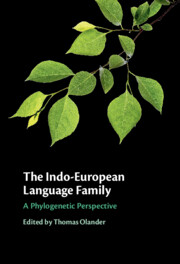
Modern languages like English, Spanish, Russian and Hindi as well as ancient languages like Greek, Latin and Sanskrit all belong to the Indo-European language family, which means that they all descend from a common ancestor. But how, more precisely, are the Indo-European languages related to each other? This book brings together pioneering research from a team of international scholars to address this fundamental question. It provides an introduction to linguistic subgrouping as well as offering comprehensive, systematic and up-to-date analyses of the ten main branches of the Indo-European language family: Anatolian, Tocharian, Italic, Celtic, Germanic, Greek, Armenian, Albanian, Indo-Iranian and Balto-Slavic. By highlighting that these branches are saliently different from each other, yet at the same time display striking similarities, the book demonstrates the early diversification of the Indo-European language family, spoken today by half the world's population. This title is also available as open access on Cambridge Core.
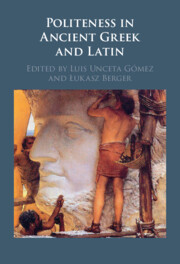
Politeness serves to manage social relations or is wielded as an instrument of power. Through good manners, people demonstrate their educational background and social rank. This is the first book to bring together the most recent scholarship on politeness and impoliteness in Ancient Greek and Latin, signalling both its universal and its culture-specific traits. Leading scholars analyse texts by canonical classical authors (including Plato, Cicero, Euripides, and Plautus), as well as non-literary sources, to provide glimpses into the courtesy and rudeness of Greek and Latin speakers. A wide range of interdisciplinary approaches is adopted, namely pragmatics, conversation analysis, and computational linguistics. With its extensive introduction, the volume introduces readers to one of the most dynamic fields of Linguistics, while demonstrating that it can serve as an innovative tool in philological readings of classical texts.
Im/Politeness Research is already a well stablished research field which offers interesting insights for the analysis of Ancient Greek and Latin texts, and the interpersonal dynamics of the societies that spoke those languages throughout time. This chapter gives a broad and accesible overview of the history of Im/Politeness Research, including its origins, the main stages of its development, its key concepts and methods and the current research trends. It also discusses the tools of Conversation Analysis and their possible contribution to our understanding of im/politeness, includuing the ways this methodology can help to extend the scope of study. Special emphasis is also given to the particular problems faced by classicists when examining im/politeness phenomena in ancient languages, and the ways to overcome those issues with the help of suitable methodologies. Finally, the chapter presents the structure and contents of the rest of the volume.
Ancient Greek does not have a term equivalent to ‘please’ and the bare imperative is used for requests. The understanding of Ancient Greek can benefit from a comparison with some modern languages where the equivalent to ‘please’ is either more restricted in use (Modern Greek) or absent (Danish): these two languages have different strategies (diminutives for Modern Greek, particles for Danish) in the case of routine interactions where the aim is to signal to the interlocutor that the request is expected in the context.
The aim of the chapter is to evaluate the role of the particle δή in such a function of de-dramatization and trivialization of the potentially threatening speech act, through a corpus study in dialogical texts of the classical period (comedies of Aristophanes, philosophical dialogues of Plato). The study shows that this post-positive particle can function as a positive politeness marker (in Brown and Levinson’s sense), to signal a weakly threatening or expected request in the context.
The chapter sets out to query ancient scholars’ awareness of politeness phenomena as reflected in language and the metalinguistic tools they used to describe them. Particular attention is devoted to the terms charientismos and astimos, as well as to some specific acceptations of reticentia and expressions like grave or durum dictu.
Even if as a general rule ancient grammarians and commentators did not analyse the ordinary spoken language, since they mostly focused on poetry and the more exalted prose genres, it can be argued that all commentators of literary texts pay some considerable attention to ordinary language in interaction, and some attempt is made by them at identifying and labelling what they correctly see as speakers’ rhetorical strategies to reach a pragmatic goal while avoiding conflicts with an interlocutor or giving offence. These writers also make interesting deductions about the social and educational implications of the correct use of politeness etiquette and ritualization.
The author examines how commands and requests are expressed in a corpus of Greek and Latin literature, in order to show how the politeness systems of ancient Greek and Latin may have differed.
The chapter uses the dialogues of Roman comedy (Plautus, Terence) to examine the correlation between the characters’ perception of im/politeness and the practice of interrupting. By adopting the methods of Conversation Analysis, the study sets out criteria to distinguish interruptions from other non-hostile or non-salient types of interventions in a dramatic text without explicit stage directions. According to the main argument, proper interruptions – just like impolite behaviour – are constructed interactionally and their identification depends on how the affected party reacts to someone invading their speaking turn. The analysis of face work in various types of turn-taking incidents, either collaborative or disruptive and antagonistic, helps to justify why given talk is not handled as an interruption. After comparing some qualitative and quantitative data, the chapter shows that there are many examples of face-threatening and hostile interventions in the comedy corpus that cannot be analysed as interruptions but rather should be associated with the type of interaction (e.g. conflictual talk) or the speaker’s dominant position within.